

Introduction
AI service agents are changing how businesses deliver services and manage customer engagements. They deliver greater accuracy, faster responses, and higher customer satisfaction compared to traditional automation. AI agents go beyond simple reactions by analyzing intent, processing requests, and operating across multiple systems. With rising customer expectations, businesses require faster and more intelligent service models. Relying only on manual teams to resolve customer queries is no longer an option. AI service agents may encounter difficulties with highly complex or multi-dimensional issues.
AI service agents allow human teams to focus on complex, high-value tasks. By leveraging intelligent technology and automation, businesses reduce costs, handle higher volumes of requests, and deliver faster, more consistent service to customers. This post explains how AI service agents work, outlines their benefits and use cases, and describes how Flowtrics supports their implementation.
What Are AI Service Agents?
AI service agents are artificially intelligent software solutions that perform customer service functions independently. They offer more than automated responses to frequently asked questions. These intelligent systems interpret user requests, understand context, and respond without ongoing human oversight. They assess conversations, access connected applications, and manage workflows across business systems. By handling tasks quickly and accurately, AI service agents enable faster response times, resolve issues more efficiently, and enhance customer satisfaction by providing prompt, effective support. AI-driven support platforms manage tasks end-to-end in real time. This includes raising tickets, updating records, and processing requests. Digital service agents can facilitate complicated processes for users.
The Advancement of Chatbots
Traditional chatbots use script-driven conversations and predefined workflow management. As a result, they often struggle with complex queries, dynamic requests, and changing customer needs. They typically respond only according to their programmed rules. AI-powered service agents are the next generation of conversational technology. Unlike scripted chatbots, AI service agents use artificial intelligence models for contextual reasoning and to execute actions. This allows AI service agents to manage more complex tasks and engage with customers more effectively.
Here are some key distinctions between them:
- Traditional chatbots answer customers’ queries.
- AI service agents perform tasks.
- Chatbots follow pre-set guidelines.
- AI service agents adapt and evolve through learning.
As a result, companies can deliver faster and more intelligent services to their customers.
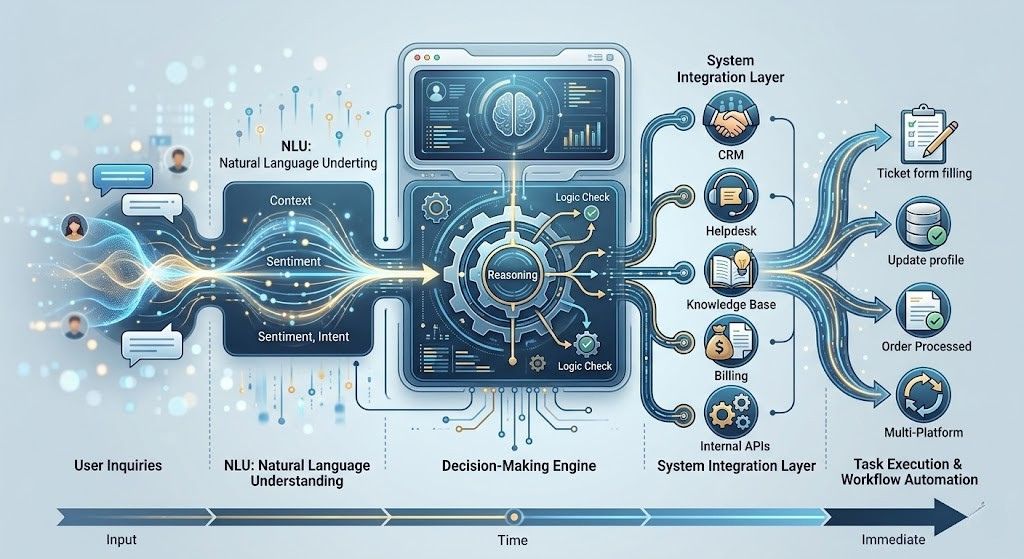
How AI Service Agents Work
Natural Language Understanding (NLU)
The first step is to systematically analyze and interpret user inquiries. Unlike keyword matching, agents identify intent, context, sentiment, and urgency to understand the user’s purpose. As a result, the platform recognize customer needs instead of simply matching specific terms. This capability enables organizations to provide more accurate, personalized, and efficient services. With NLU technology, the system can handle more complex interactions. As a result, response quality improves, enabling organizations to deliver consistently accurate and meaningful customer interactions.
Decision-Making Engine
Once the request is analyzed, the AI service agent will determine the best course of action. This is because it considers various approaches, studies existing information, and decides which option will be the most effective for the specific case. The decision-making engine is also important for enabling AI service agents to evolve in response to changes in customer requirements and service situations. For this reason, it allows organizations to achieve higher levels of efficiency and accuracy in providing service. This is how AI service agents become truly “agentic” rather than only reactive. This is because it uses reasoning to solve requests, make decisions, and take action in integrated systems.
System Integration Layer
AI service agents seamlessly integrate with all primary business systems and operational platforms.
Examples of these integrations include:
- CRM systems
- Helpdesk solutions
- Knowledge databases
- Billing systems
- Internal APIs
Through this integration layer, AI service agents access real-time data and perform tasks across multiple platforms. This enables them to perform advanced functions beyond basic conversation. This capability streamlines workflows, reduces manual tasks, and increases automation efficiency.
For example, AI service agents can update customer profiles, process orders, generate tickets, and retrieve account data independently. Ultimately, this empowers companies to operate faster, more flexibly, and with greater cohesion, resulting in improved business outcomes and more unified customer experiences across all channels.
Task Execution and Workflow Automation
As soon as an AI service agent makes a decision, it executes its instructions immediately. In contrast to waiting for human interaction, the system performs tasks immediately to keep processes running smoothly.
Tasks performed by the system may include:
- Creating tickets
- Entering customer information
- Requesting a particular service
- Initiating workflows
Furthermore, AI service agents can coordinate their actions across multiple platforms simultaneously. Thus, companies can eliminate potential lags and achieve greater operational consistency. Due to the above-mentioned features of AI service agents, companies manage to avoid numerous unnecessary delays. That way, employees can focus on important tasks while AI agents handle more routine tasks.
Core Capabilities of AI Service Agents
Problem Solving through Multiple Steps
The intelligent automation systems will be able to effectively handle complex workflow processes and customer queries in a step-by-step manner. This is because they go ahead and dissect the problem into steps and solve them accordingly. Furthermore, the AI service agents evaluate every step of the process before proceeding to the next. For this reason, they can undertake more complex service scenarios with greater accuracy. Through such an approach, companies can increase operational efficiency. Moreover, it enables a more streamlined, quicker customer experience.
Omnimodal Customer Support
AI-enabled support tools operate across multiple channels, allowing companies to engage customers wherever they interact.
For example, these agents can manage customer communication through:
- Live chat
- Website portals
- Messaging services
The omnimodal approach enables organizations to provide consistent, seamless client experiences by eliminating the need for customers to repeat information. Formal support also enables organizations to respond to customer inquiries more quickly and efficiently. AI-based solutions optimize client communication by increasing efficiency and personalization, which enhances satisfaction and streamlines operations.
Context Memory
AI-powered service agents maintain the context and recall it continuously throughout conversations. Contrary to handling each message separately as a new query, they take into account the conversation history, as well as the customer’s preferences and actions. Thanks to this feature, digital support agents provide more precise and relevant answers to customers’ questions in any situation. Besides, context memory helps save the customer’s time by avoiding unnecessary repetition of actions and problem descriptions. In other words, context memory makes customer support more effective.
Continuous Learning
AI service agents enhance their abilities through data feedback and real-time user interaction. These systems evolve by learning from client interactions, the services they provide, and operational workflows. This adaptability enables AI agents to refine responses, boost accuracy, and strengthen decision-making. Consequently, organizations deliver smarter customer experiences with this technology. These agents improve at recognizing intent, resolving issues, and meeting evolving client needs. This ensures companies boost efficiency while maintaining consistent support across channels.
Key Benefits of AI Service Agents
Quicker Resolution Times
By interpreting customer queries in real-time, AI service agents deliver instant answers. Rather than leaving customers to wait in a queue, they immediately analyze their request and take the right action. In this way, they help reduce the lengthy queue and ticket backlog. With precise routing and prioritization, urgent requests avoid unnecessary delays. Overall, they enable companies to resolve customer issues promptly while improving service performance and quality.
Continuous Availability
Unlike human teams, AI-enabled service representatives provide uninterrupted, 24/7 customer support. They respond instantly to customer queries at any time, ensuring clients receive immediate assistance whenever needed. Clients receive immediate answers without waiting for standard support hours. Continuous AI availability enables firms to deliver seamless client service.
Lowering Operational Costs
The use of AI-based agents by businesses will enable firms to expand their customer support operations without increasing staff. Businesses won’t be adding more employees but will be able to automate their processes effectively. This leads to increased efficiency and lower operational costs. Also, the ability to answer repetitive queries means fewer human efforts are needed. Through cost savings, resources can now be invested in areas that add greater value.

AI Service Agents in Real Business Use Cases
Automated Customer Support
The AI service representatives streamline customer support by resolving common inquiries, delivering technical solutions, and processing support tickets instantly. They operate independently of human input, identify recurring issues, and deliver precise answers. This capability allows them to address basic customer needs without involving human agents. Furthermore, they manage the categorization and routing of more complex inquiries. Through automation, companies reduce customer support workloads, accelerate response times, and maintain consistently high service quality.
Sales and Lead Generation
AI service agents actively support users during product discovery by promptly providing relevant information. Unlike situations where customers search for information on their own, these agents deliver timely and relevant details. In addition to supporting purchase decisions, these agents answer customer questions and offer guidance throughout the process. This approach enables customers to make informed decisions.
AI Service Agents vs Traditional Systems
Human Support Teams
Human support teams offer empathy, analytical thinking, and prudent judgment when engaging with customers. Therefore, they are crucial for addressing difficult problems that require a personalized approach. However, human support teams face limitations in scalability, availability, and expertise. Because human support teams require breaks, companies may encounter delays in assistance during peak workloads. As a result, customer support may be delayed when staff are overburdened.
Rule-Based Chatbots
Rule-based chatbots respond immediately by following predefined dialogues and decision paths. This allows them to efficiently handle straightforward, repetitive requests. However, such chatbots lack the flexibility to handle complex or unforeseen queries beyond their programmed conversation flows. Additionally, rule-based chatbots falter with scenarios outside their scripted frameworks. Ultimately, companies may encounter significant obstacles in resolving complex queries, potentially resulting in decreased customer satisfaction or increased support costs.
Robotic Process Automation (RPA)
Robotic process automation deploys software robots to execute back-end operations based on explicit rules and workflows. This technology streamlines organizational workflows by eliminating manual intervention from repetitive tasks such as data entry. However, RPA cannot understand human language or manage end-to-end service delivery independently of customers. Additionally, RPA functions independently of customers and cannot oversee the entire service delivery process. Therefore, combining RPA with advanced artificial intelligence technologies is essential to achieve more comprehensive business process automation.
How to Implement AI Service Agents in a Business
Step 1: Determine the Appropriate Use Cases
When implementing AI service agents, enterprises must first identify the most suitable use cases. This involves targeting labor-intensive and time-consuming processes. Customer support is often well-suited as it receives frequent, predictable inquiries. Consequently, organizations can rapidly achieve measurable outcomes. By prioritizing relevant use cases, enterprises establish a solid base for AI service agent deployment.
Step 2: Identify and Map Workflows
Before adopting process automation, companies should assess their existing workflows. This assessment clarifies task distribution and the systems currently in use. Identifying inefficiencies helps prevent barriers when implementing AI service agents. This facilitates seamless integration of service agents into business processes.
Step 3: Integrating Core Systems
Once workflow design is completed, businesses should then proceed to integrate their core systems to fully leverage the capabilities of AI service agents. Specifically, these should include integrating CRM applications, ticketing systems, and other critical data sources. Not only does integration provide real-time access to data and the execution of actions across multiple systems, but it also allows AI service agents to go beyond mere responses. Integration means that they can automate entire processes from start to finish.
Step 4: Training and Configuring the Agent
Once the systems have been integrated, companies can train and configure the AI service agent to align with their business objectives and customer needs. During this phase, companies set the tone of response and escalation strategies to provide consistency throughout. Moreover, such configurations help the AI service agent learn appropriate actions based on different situations and the level of human intervention required. Therefore, the use of AI service agents provides consistent, contextually relevant, and accurate responses to customers. The correct configuration ensures efficient functioning and effective service delivery by AI service agents.
Step 5: Monitoring and Improving
Once deployed, companies must continually track the performance of their AI service agents to ensure optimal effectiveness. They must evaluate key performance metrics to measure efficiency and accuracy. Additionally, businesses should utilize feedback from customer-AI interactions to pinpoint deficiencies. As a result, AI service agents’ capabilities advance, improving customer service. By consistently tracking and refining the system, companies sustain strong performance.
Challenges of AI Service Agents
Issues Regarding Data Security
As AI service agents become more prevalent, companies must prioritize data security. AI systems process sensitive personal, financial, and operational information. Companies should implement strong compliance measures to ensure responsible data management. This approach helps mitigate risks related to data breaches, unauthorized access, and regulatory non-compliance.
Complexity of System
With the introduction of AI service agents into businesses, there are often issues related to system complexity. The reason is that some systems may have been developed when technology was not advanced enough to integrate modern AI. Fortunately, through careful planning, businesses can minimize this problem. Moreover, early assessment of integration systems will help teams determine whether the process will be smooth. This leads to an overall easy integration process for businesses.
Human Oversight Needs
While autonomous in operation, AI-based service agents still need regular monitoring and guidance from humans to ensure accuracy and accountability. This is because firms will have to be proactive in checking their system performances, especially during crucial and risky situations. Moreover, some decisions may call for human intervention, particularly those involving potential risks or complications. In this regard, human oversight is important to ensure that AI systems’ activities are guided by company policies and values. A proper mix of automation and oversight will help increase effectiveness and efficiency in service delivery.
The Future of AI Service Agents
Fully Autonomous Service Agents
AI-driven service agents will operate with increasing autonomy, demanding minimal human oversight. Instead of executing linear commands, these agents will analyze requests, identify optimal actions, and respond decisively. These agents will oversee end-to-end workflows, from task allocation to completion. This transition will boost operational efficiency and elevate business service support. Begin automation adoption now to streamline complex processes while upholding service excellence.
Cooperation Among Multiple Agents
In the era of AI-driven systems, multiple agents will collaborate to manage intricate business operations. Instead of relying on a single platform, companies will deploy agents specialized in distinct functions, coordinating to fulfill their objectives efficiently. Each agent within an AI service will perform a distinct role, such as handling customer inquiries, retrieving data, or executing tasks. Consequently, companies can anticipate significant gains in operational efficiency.
Proactive Service Models
AI agents will predict customers’ needs. Autonomous AI systems will detect potential problems using pattern recognition and data analysis. A proactive approach enables companies to avoid disruptions, maintain service quality, and address issues before they impact customers. Adopting this strategy improves customer satisfaction through uninterrupted service.
How Flowtrics Enables AI Service Agents
Flowtrics provides a structured approach to deploying AI-driven automation across business workflows. It helps organizations transition from manual systems to intelligent service models.
Unified Automation Layer
Flowtrics integrates disconnected business systems to create a unified, intelligent automation layer. Its functionality ensures that different tools, data sources, and processes are connected to work together. Consequently, the next-generation service platforms can move freely across different systems without disruptions or manual platform changes. Also, such an approach ensures quicker access to the data and a smoother workflow execution. This way, companies benefit from increased efficiency, driven by the seamless functioning of automation, among other things.
Workflow Intelligence
The Flowtrics system automates business workflows across multiple systems, coordinating them smartly. It removes manual steps, speeding up complex tasks and keeping them in order. Workflow intelligence reduces human involvement by automating tedious tasks. This increases efficiency and delivers consistent results. Companies automate tasks while maintaining precision.
Scalability
Flowtrics delivers scalable automation. Businesses can expand and meet growing demands without interruption. The system integrates with the current infrastructure. Organizations can scale easily as needs evolve, without major changes. The scalable architecture lets organizations add automation features over time. It avoids costly upgrades and supports ongoing AI development. This approach maintains efficiency as automation needs change.
Conclusion
AI service agents are transforming customer service, workflows, and automation. They handle inquiries, execute tasks, and integrate with existing systems. Unlike traditional chatbots, predictive support technologies manage complete workflows. This ensures faster response times, lowers operational costs, and guarantees consistent customer interactions. As digital business processes advance, AI service agents are indispensable to digital infrastructure. Platforms such as Flowtrics deliver intelligent automation at scale and ensure seamless system connectivity. By embracing AI service agents now, companies position themselves at the forefront of digital transformation, empowering lasting efficiency, scalability, and growth.