

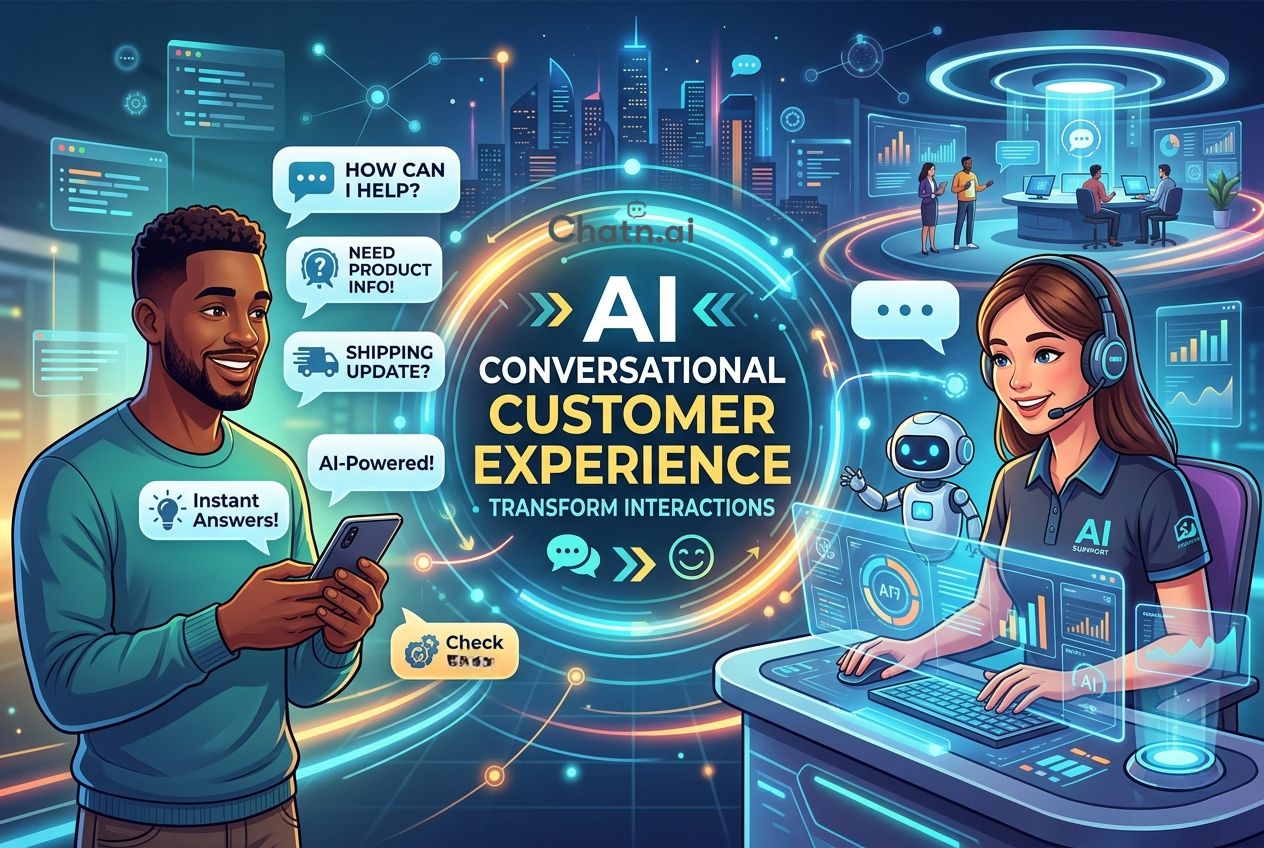
In today’s digital age, customers expect quick, personalized, and seamless experiences. As a result, businesses can no longer rely on slow email responses and FAQs. Instead, intelligent systems, enabled by AI, are changing the face of customer engagement with businesses. The rise of AI-driven conversational tools demonstrates their growing relevance in customer experiences. By using AI chatbots and conversational AI, businesses can offer smarter, faster, and more engaging experiences across every digital touchpoint. Furthermore, AI conversational experiences are not just futuristic concepts; they are essential business solutions for companies seeking to deliver satisfaction, reduce costs, and build loyalty. With solutions like Chatn.ai, businesses can efficiently automate conversations while still maintaining a human touch, ensuring that customers feel heard, understood, and valued.
What Is AI Conversational Customer Experience?
To fully grasp what an AI conversational customer experience is, it is first necessary to understand what conversational AI is. In a nutshell, conversational AI is about using AI-based chat to enable a business to simulate natural conversations with clients. Moreover, conversational AI is not limited to responding to customer queries; it also involves interpreting them and offering personalized solutions to their problems. Ultimately, by adopting an AI-driven conversational customer experience, a business can improve customer satisfaction and build stronger relationships with clients.
Defining Conversational AI in CX
Conversational AI is an advanced technology that leverages Natural Language Processing (NLP), Machine Learning, and other algorithms to comprehend customer intentions effectively. It is quite different from other chatbots or conventional AI because it can effectively respond to complex queries and identify patterns in conversations. It can also respond to queries in a natural manner. Another advantage of conversational AI is that it can support customers across various platforms, such as websites, mobile applications, and social media. It can provide customers with personalized, efficient, and solution-oriented support.
Key Components of AI-Driven Customer Experience
An effective AI conversational experience includes several core elements:
- Real-time Chat Capabilities: Instant responses reduce wait times and frustration.
- Automated FAQs and Support: AI handles repetitive questions, freeing human agents for complex tasks.
- Personalized Recommendations: AI analyzes user data to suggest products or solutions tailored to individual preferences.
- Omnichannel Integration: Consistent customer experience across web, mobile, and social platforms strengthens trust and loyalty.
By integrating these components, businesses can elevate interactions from basic responses to meaningful, engagement-driven experiences.
Why AI Conversational Experiences Matter for Businesses
Companies that adopt AI conversational systems gain a competitive advantage. These solutions not only enhance customer satisfaction but also improve operational efficiency.
Quick and Fast Servers Increase Customer Satisfaction
Whenever a customer engages with a brand online, they expect an immediate response. Thus, organizations should be responsive to ensure that they satisfy the increased expectations. AI chatbots powered by AI-controlled CX enable organizations to do so by making them available 24/7 and significantly shortening response times. For example, the intelligent agents of Chatn.ai can process thousands of questions simultaneously, so customers do not have to wait in long queues for service. AI conversational systems allow businesses to deliver consistent service even during high-traffic hours.
Additionally, this kind of speed and availability is also of great help in enhancing the overall customer experience. Customers who contact the organization feel important and heard when they receive prompt, responsive assistance. Therefore, they will be more inclined to be active and keep communicating with the brand. Moreover, the conversion rate is usually higher when responding faster, across both sales and support responses. Finally, by providing real-time customer support with AI, a company can make customers happier, build stronger loyalty, and deliver more valuable engagement through digital channels.
One-on-One Customer Interactions Lead to Loyalty
The current customers are not satisfied with generic answers. Rather, the way of business offers has to be relevant and personally oriented to the needs. Systems based on AI are actively analyzing customer data to offer solutions tailored to each customer, whether by suggesting appropriate sales or by offering highly customized support. Furthermore, the smart systems analyze behavioral history, interests, and conversation history to generate more engaging, context-based communications.
As a result, companies will be able to respond to the needs of specific customers in real time, thereby enhancing the overall experience. Whenever customers get answers that accurately address their expectations, they feel appreciated and listened to. Therefore, such individualization builds trust and boosts patronage. Moreover, customized interactions help brands foster closer relationships with their audience. Finally, companies that emphasize AI-driven personalization tend to have higher retention rates, customer satisfaction, and considerably lower churn.
Scalability and Cost Effectiveness
Conventional customer care services usually involve large departments handling large volumes of queries. With increased demand, companies have to allocate more resources to maintain service quality at the required level. Nevertheless, AI chat systems provide a more effective way out. These systems reduce operational costs and enable faster, more consistent responses by automating repetitive processes. Besides, AI-based technology can process thousands of conversations simultaneously, enabling companies to scale their support services without overloading human departments.
Moreover, companies can implement AI across various channels, such as websites, mobile applications, and social media, without requiring a large number of employees. Organizations can therefore deliver uniform levels of service even during high traffic. As a result, complex customer problems that involve human touch and empathy can be given more consideration by the teams. However, in the end, investing in AI conversational customer experience helps businesses enhance efficiency, support operations more easily, and save costs in the long term.

How Chatn.ai Elevates AI Conversational Customer Experience
Chatn.ai stands out by offering a platform designed to maximize the potential of AI conversations. Its systems combine advanced automation with actionable insights for teams to deliver exceptional experiences.
Collaborative Omnichannel Conversations
Chatn.ai is an efficient integration that ensures the customer has the same experience across channels, whether a website, mobile app, or social media platform. Consequently, users do not even have to repeat themselves, which decreases frustration to a considerable degree and enhances overall satisfaction. Moreover, integrating omnichannel helps companies gain a comprehensive view of all customer interactions and provide more personalized, even safer, experiences across touchpoints.
Moreover, teams will have the only platform for tracking, controlling, and streamlining real-time discussions. As a result, employees will be able to save time, streamline workflows, and focus on high-value activities that require human attention. By connecting all channels into a seamless system, Chatn.ai is not only more efficient in its operations but also provides a higher level of customer trust, loyalty, and involvement across all digital platforms.
Analytics-Driven Improvement
Chatn.ai is not just any conversational processing; it actively examines conversations to extract valuable information. By monitoring key indicators (response time, resolution rate, and engagement patterns), the business can gain actionable insights to optimize customer interactions and operations. Moreover, the insights enable teams to detect trends, spot recurring problems, and optimize strategies in real time.
Consequently, teams will be able to keep AI responses optimized, keep knowledge bases up to date, and create more personalized, context-aware interactions. Moreover, data-driven improvements will enable the AI system to adapt to evolving customer expectations and maintain support and engagement strategies that remain relevant and efficient. As a result, companies that use analytics in AI discussions can deliver greater satisfaction, increase efficiency, and remain competitive by providing a high-quality customer experience.
Implementing AI Conversational Solutions Effectively
Deploying an AI conversational platform requires careful planning to maximize impact. A structured approach ensures your team delivers exceptional experiences from day one.
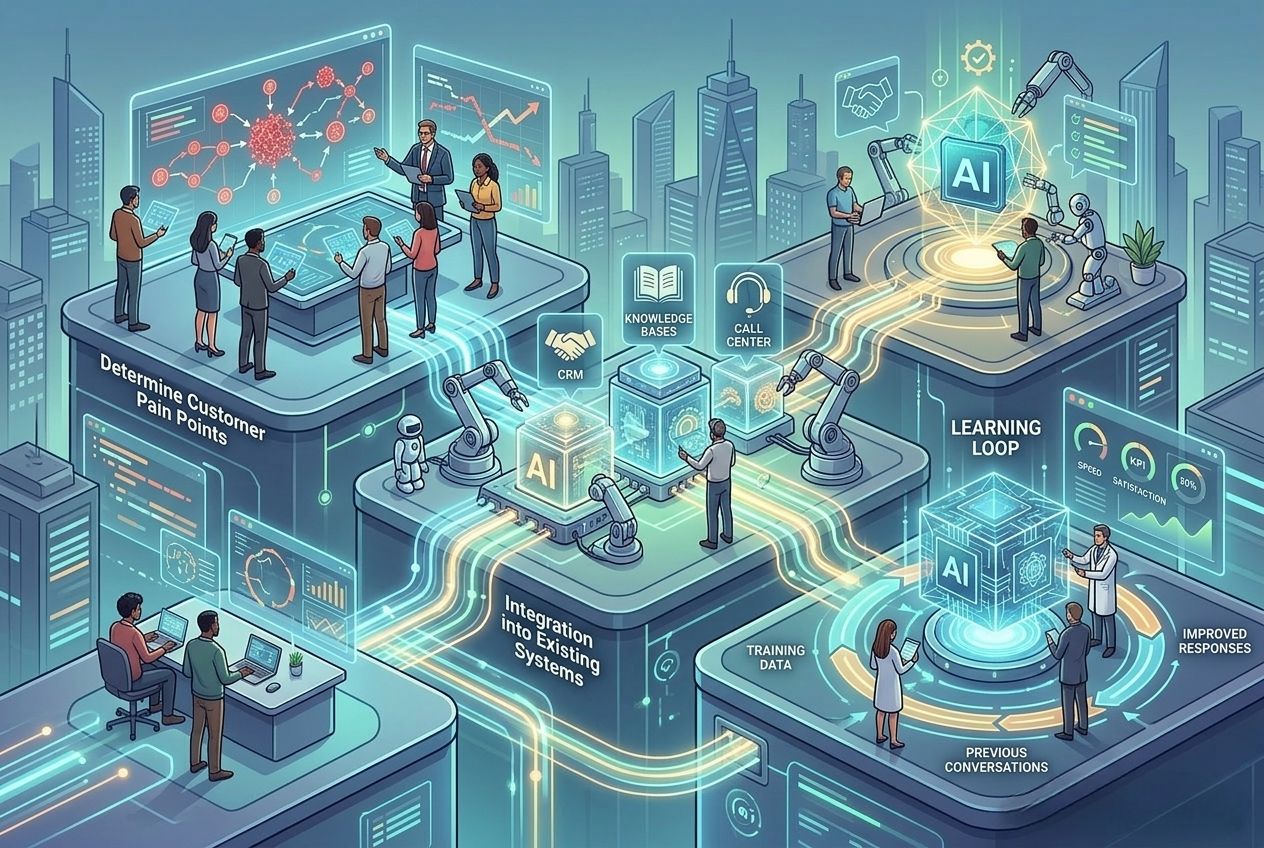
Step 1: Determine Customer Pain Points
Start by mapping major queries, bottlenecks, and areas of customer frustration critically. This way, the businesses will have a clear picture of what the users require, which is needed to design effective interactions based on AI. Moreover, early detection of pain points enables solutions that can significantly improve customer satisfaction and operational efficiency.
Step 2: Businesses should integrate AI chatbots into existing systems
Then, provide a smooth integration with CRM systems, call centers, and knowledge bases. This combination enables AI agents to retrieve real-time data and respond appropriately across all channels. As a result, customers will receive contextual responses in real time, enhancing the customer experience and reducing the number of queries. Moreover, integrated systems help teams become more efficient in managing conversations and ensure messages remain consistent across touchpoints.
Step 3: AI Training and Performance Monitoring
Lastly, introduce constant training and performance checks. Through Chatn.ai, the AI learns from conversation history, improves accuracy, and adapts to changing customer demands. In addition, response time, customer satisfaction scores, and engagement rates are key performance indicators that the teams are supposed to monitor. Consequently, companies can optimize their processes, make them more personalized, and make AI-based systems more effective and reliable.
This organized strategy ensures that businesses operate AI conversational solutions efficiently, adaptively, and scalably to maintain value as customer demands rise.
Future Trends in AI Conversational Customer Experience
As technology advances, AI will continue transforming customer experience. Businesses that adopt AI early gain a long-term advantage.
Anticipatory Customer Service
The AI can also predict customer needs before they ask questions. With behavioral pattern analysis and prior interaction history, these systems can provide predictive recommendations and proactive messages that preempt potential problems. The result is that customers find their experience smoother, with less friction and wasted time. In addition, predictive support enables companies to address issues before they escalate, which ultimately contributes to satisfaction, trust, and loyalty in the long run.
Voice-Activated Chatbots
Voice interaction is rapidly emerging as a major part of the contemporary customer experience (CX). By combining AI-powered chat and voice features, companies can provide customers with a natural, hands-free experience. In addition, conversational agents, which enable voice communication, will enable users to multitask and enhance convenience and access. Therefore, customers have quicker resolutions, fewer obstacles, and easier interactions. Moreover, integrating voice and chat enables uninterrupted service across all platforms and eventually increases satisfaction, loyalty, and overall brand perception.
Hyper-Personalization AI Insights
Modern AI tools are proactive in analyzing behavioral data, shopping history, and interaction patterns to provide highly personalized suggestions. With such insights, companies can customize all interactions to each customer’s needs and preferences. AI conversational solutions allow businesses to serve customers with relevant solutions faster, helping them feel better understood and more engaged with the brand. Moreover, hyper-personalization leads to repeat contact, loyalty, and long-term satisfaction. In the future, these advances will redefine customer expectations for digital interaction, compelling organizations to embrace smarter, more responsive, and dynamic AI-driven experiences to keep pace with a changing market.
Conclusion: Why Your Business Needs AI Conversational Customer Experience Now
It is no longer a luxury for businesses to integrate AI conversational systems in today’s dynamic digital environment. On the contrary, it is a catalyst for speeding up responses, creating highly personalized experiences, and providing cost-efficient customer support, all of which result in meaningful, long-term customer engagement. Furthermore, businesses that integrate AI conversational systems, such as Chatn.ai, can improve efficiency, reduce repetitive work, and enable human customer support agents to focus on complex, high-value tasks.
Therefore, businesses can create a smarter, more efficient, and human-centric AI-conversational customer experience, resulting in improved customer loyalty, satisfaction, and long-term success. Moreover, businesses that integrate these AI conversational systems early on can remain competitive, improve customer expectations, and enhance customer engagement strategies. In other words, businesses that integrate these AI conversational systems early on can ensure their brand not only meets but also exceeds customer expectations.