
Introduction: Customer Support Is Reaching a Breaking Point
There is a widespread feeling that Customer Support is becoming overwhelmed. Changing customer expectations is huge. The expectation for immediate replies at all times is the norm today. Most support teams, however, are still using old systems. This causes the number of tickets to grow rapidly, response times to lengthen, and operational costs to keep rising. As a result, many businesses struggle to meet the demands of an expanding market. This is where AI Support Agents revolutionize the entire support model.
AI Support Agents are not just chatbots; they are sophisticated tools that utilize artificial intelligence to deliver customer support. Rather, these are considered intelligent systems that can comprehend the customer’s needs, make decisions, and take meaningful actions. For example, in platforms like Chatn.ai, these systems go beyond basic conversations. They actively handle real support workflows and utilize key processes. Thus, businesses can expand their support operations effectively without compromising service quality or customer experience.
What Are AI Support Agents?
AI Support Agents are intelligent digital systems that can handle customer support tasks end-to-end. They do more than just answer questions. They actively solve problems, automatically activate workflows, and learn from each interaction. Unlike traditional chatbots, AI Support Agents are context-aware and understand the conversation’s context. This allows them to better grasp the customer’s intent, previous interactions, and patterns. They serve as a digital version of service workers involved in the transaction. They can answer questions instantly, create and update tickets in real time, process requests automatically, escalate complex issues, and integrate with business tools to streamline workflows. This integral role makes support easier, smarter, and more scalable for businesses.
AI Support Agents vs Traditional Chatbots
The difference between AI Support Agents and chatbots is structural.
Traditional Chatbots
Bot technology is heavily tied up in scripts. In practice, they adhere to a set of prescribed decision trees that stifle flexibility. This is because when a question falls outside their programmed pathways, they do not respond effectively. As a result, poor customer experiences and increasing customer frustration often occur when people seek accuracy and timely information.
AI Support Agents
AI Support Agents utilize natural language processing capabilities. Unlike previous technologies, they understand what is being said rather than just matching keywords. They adapt as the interaction progresses. This means they can handle complex inquiries without getting confused or losing track of the issue. Additionally, they keep evolving over time through learning from their experiences. Most importantly, each interaction improves their performance.
The Main Distinction
Chatbots only respond to user input. In comparison, AI Support Agents solve customer problems from start to finish. It means that the main distinction is much more than just technological. It is related to the revolution in automated customer service in the modern era. In general, this distinction can be called the new standard in digital support solutions.
How AI Support Agents Work Behind the Scenes
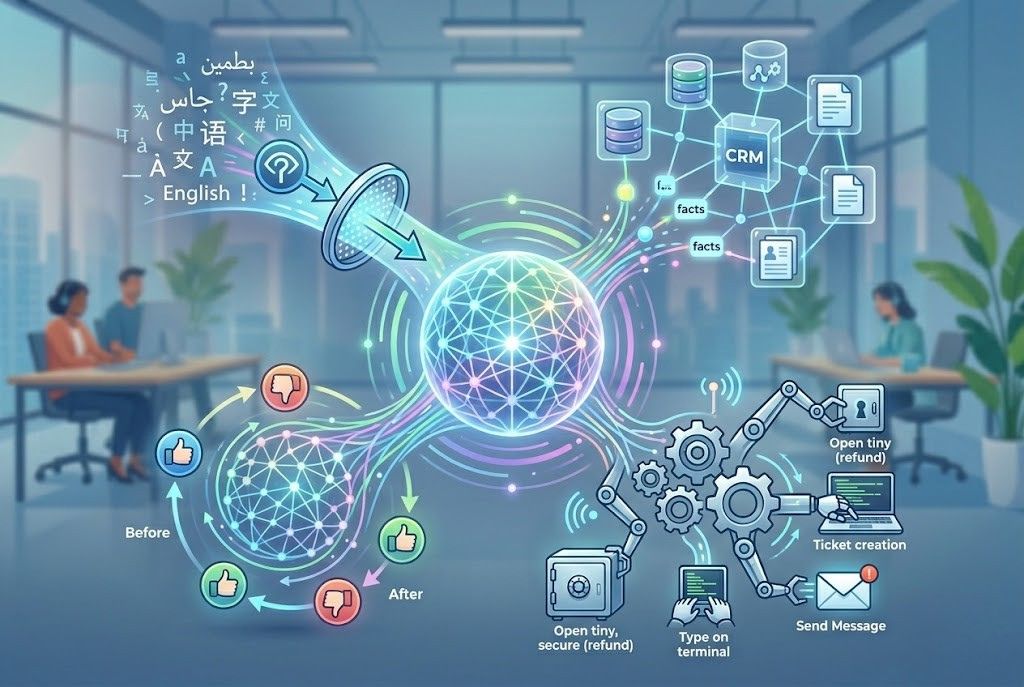
AI Support Agents operate through multiple connected layers.
1. Natural Language Understanding (NLU)
The system begins by deciphering the user’s intent through Natural Language Understanding (NLU). By doing this, it can determine the user’s requirements regardless of the nature of their statement. As a result, this minimizes reliance on the user’s exact wording.
2. Knowledge Retrieval Systems
Now, the AI Support Agent begins searching its internal knowledge database for the most relevant facts. During this stage, it uses intelligent techniques to extract precise answers from various sources such as help desks, CRMs, documentation, and previous support tickets. Hence, the system guarantees that the response will be not only accurate but also consistent.
3. Workflow Automation Engine
In contrast to simple support utilities, AI Support Agents are not limited to providing answers. Instead, they perform actions using the workflow automation engine. Such actions may include creating support tickets, updating account information, initiating refund procedures, and sending system notifications. Consequently, customer support becomes an integrated system that goes beyond just responding to questions.
4. Learning and Optimization Layer
The system learns and optimizes from real-world interactions. It adapts through customer communication, solution evaluation, and feedback. Continuous optimization improves precision, effectiveness, and speed. As a result, each interaction makes the AI Support Agent better at delivering superior customer support.
Key Benefits of AI Support Agents
AI Support Agents deliver measurable business value.
1. Availability Around the Clock
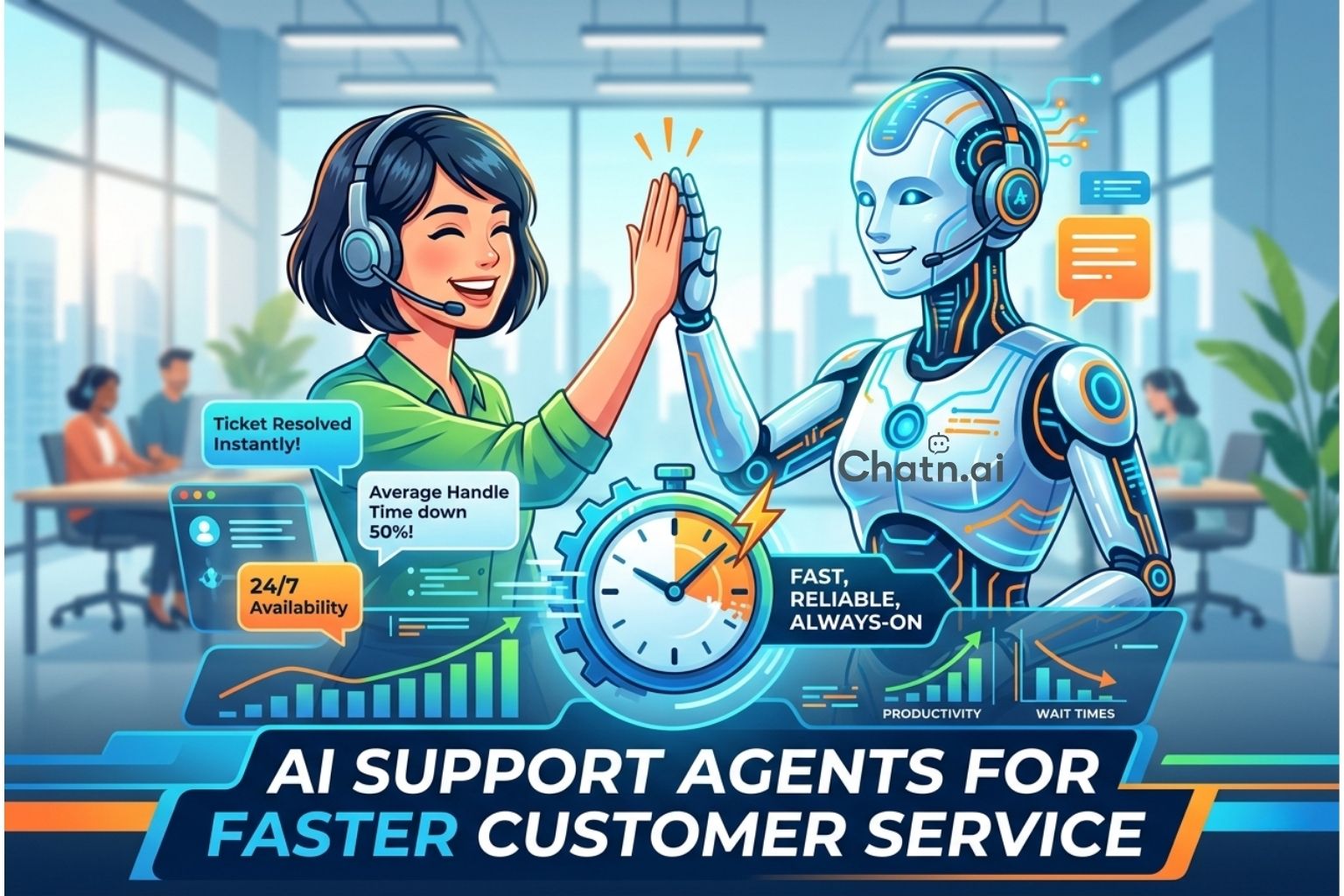
The AI Customer Support operates round-the-clock, with no pauses or breaks. Thus, customers can have their problems solved anytime, no matter where they are. Moreover, this ensures round-the-clock worldwide availability and prevents delays in customer support.
2. Faster Resolution Times
The AI support agents immediately reply to the customers’ requests. This leads to an immediate reduction in waiting time and cuts any unnecessary delays in the process. This, in turn, helps enhance customer satisfaction through prompt service.
3. Reduced Costs in Operations
Using AI Support Agents, support-related activities are automated, enabling systems to handle repetitive processes more easily. This will ensure that support staff focus on complex, high-value customer cases. Therefore, enhance operational efficiency while minimizing the burden of staffing and support.
4. Enhanced Customer Experience
The AI chatbots provide answers that are always accurate and consistent. Therefore, customers can get accurate answers whenever they need assistance. This enhances the customer experience and ensures customer loyalty to the company.
5. Scalability of Support Services
AI Support Agents let businesses quickly scale support as demand rises. Unlike traditional models, companies don’t need to constantly hire to scale operations. Firms can expand customer support without major challenges or increased costs. Scalability is crucial for fast-growing firms.
Real-World Use Cases of AI Support Agents
AI Support Agents are used across industries.
E-Commerce Assistance
In an e-commerce setting, the AI Support Agent will be responsible for handling a variety of customer service functions. These include order-tracking queries, refund requests, and general inquiries about products. This also ensures that companies can address customer demands promptly and effectively. Even more critically, this greatly lightens the burden on customer assistance during peak buying times.
AI Support Agents In SaaS Companies
In SaaS companies, AI support agents assist customers as they use the product. This includes helping them with onboarding, guiding them through features, and troubleshooting problems effectively. Consequently, this enables quicker adoption and reduces customer frustration. This ultimately helps improve customer satisfaction and retention.
Healthcare Services
AI Support Agents streamline essential administrative tasks in healthcare. They handle appointment scheduling, address patient queries, and complete administrative duties efficiently. As a result, healthcare facilities optimize operations and deliver fast patient care. This significantly reduces administrative workload, letting staff focus on patient care.

Problems AI Support Agents Solve
AI Support Agents are not just upgrades. They solve core operational issues.
Supporting Large Volumes of Tickets
AI Support Agents efficiently handle a large volume of customer inquiries in real time. Therefore, they are very effective at minimizing queues and preventing ticket overloads for support teams.
Response Time Issues
The AI Chatbots respond to customer questions instantly. This helps avoid issues with response times and ensures that customers get their problems sorted out right away. Consequently, this improves customer satisfaction and makes the process more efficient overall.
Inconsistent Responses
The AI support agents work to ensure consistency in the answers they give to customers across all communication channels. Thus, the customer receives consistent, reliable information regardless of how the conversation unfolds. This, in turn, leads to higher levels of customer trust in the company’s processes.
How Chatn.ai Powers AI Support Agents
Modern organizations need more than basic automation. They actually require smart support solutions that enable scaling and adaptation to different customer needs.
Chatn.ai offers a solution that becomes the basis for creating such support agents. Thanks to smarter automation, workflow optimization, and intelligent customer communication, Chatn.ai helps companies implement scalable AI Support Agents.
Seamless System Integration
AI Support Agents are seamlessly integrated into the business infrastructure to enable seamless and effective operations. They can easily interact with CRM systems, help desk software, and knowledge management systems on the fly. This leads to the consolidation of all customer data and processes into a single intelligent system. Ultimately, it helps to build a more interconnected support system.
Smart Handling of Conversations
AI Support Agents smartly interpret customer conversations. The system accurately recognizes customer intent and tracks multiple conversations. As a result, customers have smoother conversations and avoid repeating themselves. This leads to smarter, more consistent interactions that save customers time and reduce misunderstandings.
Workflows that go from End-to-End
Unlike merely providing answers to customer questions, the AI Support Agent takes it a step further by fully automating the support workflow. The AI proceeds to perform actions on behalf of its human counterparts based on predefined workflows. This allows the AI support agents to perform tasks, make updates, and trigger actions automatically.

The Future of AI Support Agents
There is currently a rapid shift in customer support across every industry. With the development of such technologies, there will be no need for manual systems to handle customer communication in the future. Instead, companies will increasingly adopt AI-driven systems focused on speed, intelligence, and automation. This means that AI Support Agents will take center stage in defining the future of customer service.
1. Predictive Support
AI Support Agents will transition from a real mode to a pre-strategy. They will monitor customer behaviors and trends to foresee emerging problems. This enables early detection and resolution, preventing customer dissatisfaction.
2. Proactive Customer Engagement
The AI Support Agent would initiate the conversation rather than waiting for the user to contact them. This would engage the user at the appropriate time, in accordance with their behavior and requirements. It ensures that there is much less customer effort involved in the process.
3. Automated Support Layers
Support through AI will be actively deployed to ensure complete automation across support layers, with routine requests handled without human intervention. The effect will be that normal support functions will run smoothly without any human interference. The consequence will be that human agents deal exclusively with difficult and complex cases.
4. Personalized Customer Journeys
The AI Support Agents would provide customers with a personalized service experience tailored to their individual requirements. This way, the customer receives appropriate recommendations, answers, and solutions tailored to their circumstances. Ultimately, this approach helps improve customer satisfaction and build a loyal relationship throughout the whole journey.
Implementation Strategy for Businesses
Adopting AI Support Agents requires structure.
Step 1: Discover High Volume Tasks
The first step is for companies to identify their high-volume, repetitive support tasks within their current processes. Through this, they can effectively determine where their time and efforts are wasted the most. This enables them to concentrate their automation on the specific tasks that can help them achieve maximum results.
Step 2: Connect Knowledge Sources
Afterward, firms should be keen to connect and consolidate all sources of knowledge, such as documents and FAQs. Through this, they will ensure that all knowledge resources are well-structured, easily accessible, and readily available to AI support agents. This process establishes a unified, comprehensive knowledge base.
Step 3: Automation Workflows Definition
Firms can also design automation workflows that direct AI Support Agents. By establishing these workflows, companies delineate the actions AI should execute in specific customer situations. This strategy provides structure, transparency, and increased productivity in support operations.
Step 4: Testing and Optimization
Following that, companies need to test their AI Support Agents in a controlled environment before implementing them at scale. Through testing, organizations can assess their performance and identify areas for improvement. Consequently, the system is optimized over time.
Step 5: Deployment Across Channels
Lastly, companies must make an effort to deploy AI Support Agents across all customer communication channels. Here, efforts include scaling out the solution across various methods such as chatting, email, and internal messaging services. Through this, companies would be able to achieve the highest levels of consistency and efficiency.
Metrics for Measuring Success
To successfully measure the impact of implementing AI Support Agents in a company’s support process, the business organization must monitor a set of critical metrics. Key metrics include first reply time, resolution time, tickets deflected, customer satisfaction (CSAT), and cost per ticket. Such metric monitoring helps identify opportunities to improve performance and streamline workflow processes. These metrics demonstrate business efficiency and ROI.
Final Thoughts: The Importance of AI Support Agents
Traditional customer service no longer has a place; it is now essential, setting successful companies apart from the rest. That said, companies implementing AI Support Agents early gain tremendous benefits.
On the other hand, postponing this process will leave you behind in both customer interaction and operational efficiency. It is essential to recognize that AI Support Agents are more than just a trendy tool. They are now the foundation of modern customer experience and support systems.
By using Chatn.ai services, one can make an active shift from being only reactive to being proactive in addressing customers’ needs.