
Introduction – Why Businesses Are Moving Beyond Static Chatbots
Traditional chatbots use written scripts, so they only respond to specific questions. In real-life conversations, they fall short. Users today want more. They want answers that make sense and feel right. Because of this, businesses are moving to systems that can adapt.
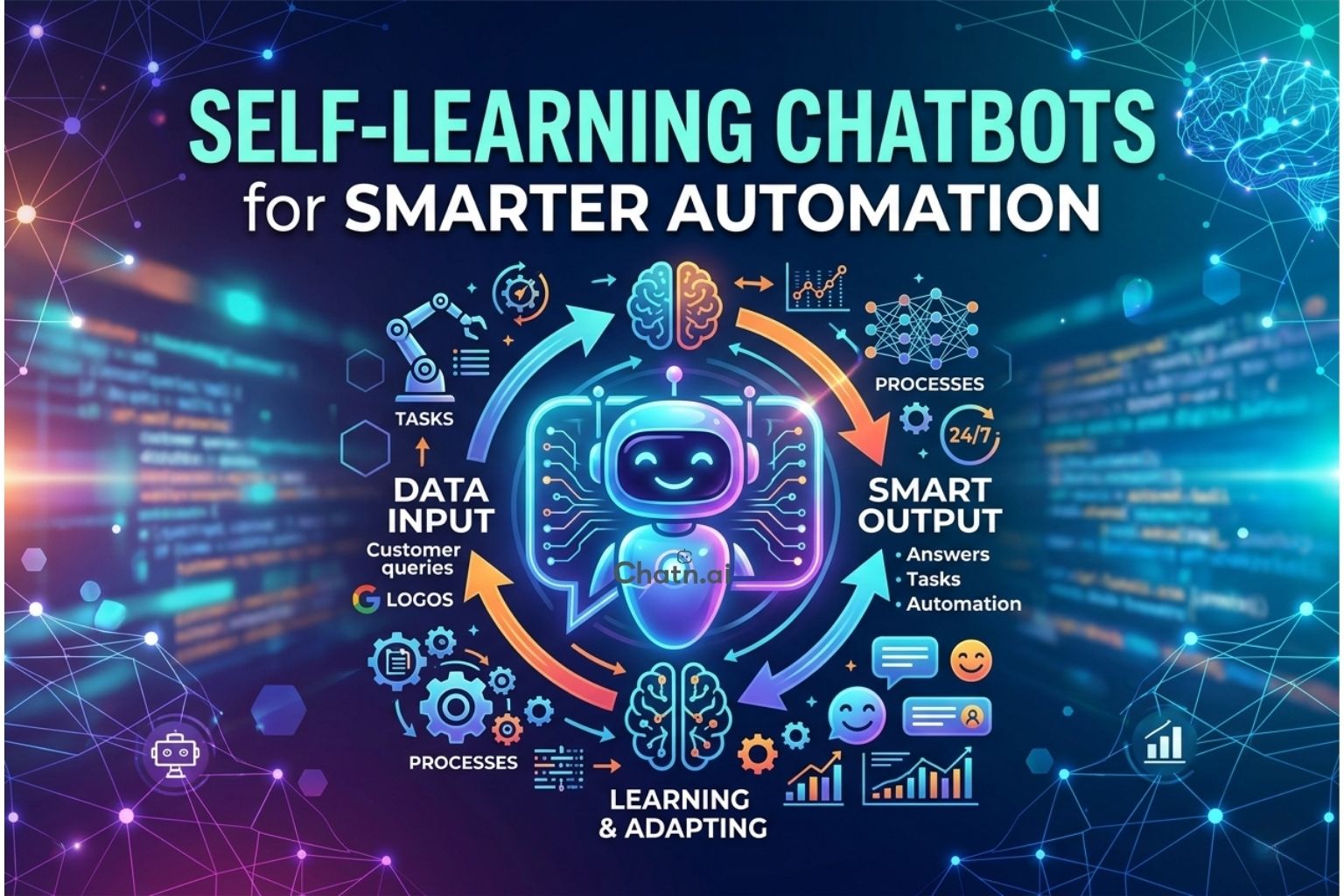
Self-learning chatbots are essential. They improve continually, learning from user interactions and conversation trends. They analyze user behavior and intent to provide better responses. Unlike chatbots, self-learning ones adapt and improve with each conversation. This enables them to offer increasingly accurate and personalized experiences as they interact over time.
This change is not a good idea. It is becoming the norm for automation in businesses today. Businesses are shifting to self-learning chatbots. Self-learning chatbots are the future. They help businesses provide customer service. Better customer service is what users expect.
What Are Self-Learning Chatbots?
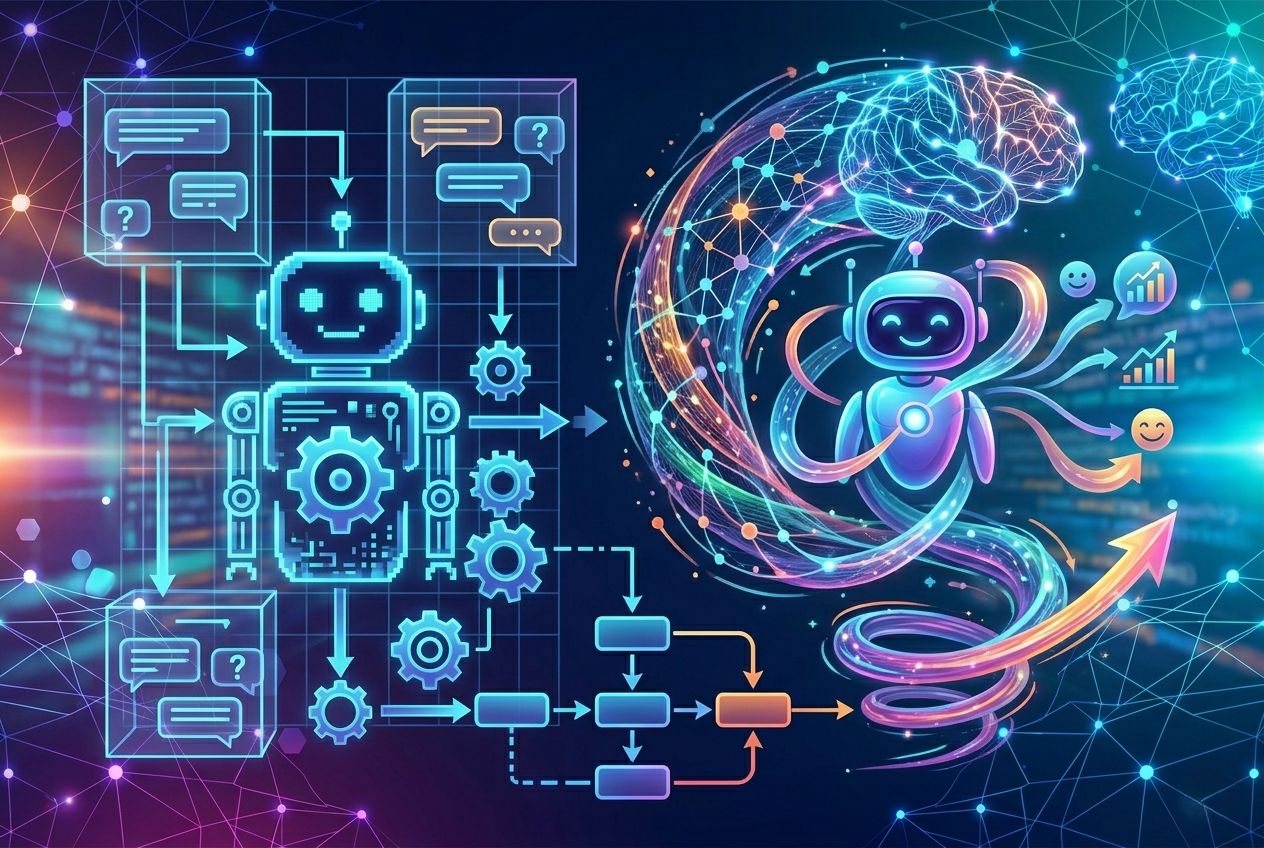
Self-learning chatbots are computer programs that improve at conversing with people over time. They use strategies to understand what people are saying and to respond to them. These systems do not just follow a set of rules. They. Get better with each conversation they have. For example, they listen to what people are saying and try to find patterns in how people talk. They get better at knowing what people want. They give better answers.
This means that self-learning chatbots are not like systems that just give the same answers all the time. Get better so they can have conversations that feel more like talking to a real person. Self-learning chatbots continually learn from the people who talk to them.
Core Definition
A self-learning chatbot is a computer program that improves at understanding what users want and responding correctly over time as it learns from data and becomes smarter. For example, by analyzing user conversations, the chatbot can improve its performance. As the chatbot processes more chats, it gradually becomes better at understanding context and intent. This ongoing learning means the chatbot continues to evolve after launch rather than remaining static. It improves with every conversation, becoming more accurate in its responses as it learns. Moreover, as it learns, the chatbot becomes increasingly accurate in its responses. Through continual learning, it strengthens its ability to understand user intent and respond correctly. The more data and user feedback it receives, the better it becomes at its task, building on previous improvements. As the system evolves and gathers more data, it delivers increasingly accurate responses. Ultimately, as it gathers more data, a self-learning chatbot delivers more accurate responses.
How Self-Learning Chatbots Differ from Traditional Ones
Traditional chatbots operate in a rigid and inflexible manner. They are bound by fixed rules that strictly limit their responses to users. Consequently, they routinely fail or break when confronted with unexpected questions. Constant updates are absolutely necessary just to keep them operating at a minimum.
Self-learning chatbots decisively surpass this outdated model. They dynamically adjust their answers to questions rather than being restricted to set paths. Their direct learning from user interactions dramatically sharpens their responses over time. This advanced learning ability eliminates the need for frequent reprogramming.
- Self-learning chatbots clearly outmatch traditional ones: they handle far more and are far smarter. While traditional chatbots stagnate.
- Self-learning chatbots progress—proving far more valuable in real-world use.
- Self-learning chatbots set themselves apart by continuously evolving and becoming more effective. They relentlessly process input and actively learn from every user interaction. Traditional chatbots remain hopelessly limited, reliant on constant maintenance to function.
- Self-learning chatbots undeniably define the standard for intelligence and scalability.
How Self-Learning Chatbots Work Behind the Scenes
- Self-learning chatbots use many components that work together to provide smart answers. They do not just follow rules like other tools.
- Self-learning chatbots are systems that use machine learning and analyze data to figure things out. This means they can understand information better and give accurate answers.
- Self-learning chatbots are not just for talking to people. They are actually systems that keep learning continuously. Every time they talk to someone, they get a little better.
- Self-learning chatbots look at data. Try to understand it. Then they use what they learned to talk to people.
- Self-learning chatbots get faster and better at talking to people the more they are used. They can even change how they talk to people based on what they learn. This makes Self-learning chatbots very good at helping people.
Machine Learning and NLP at the Core
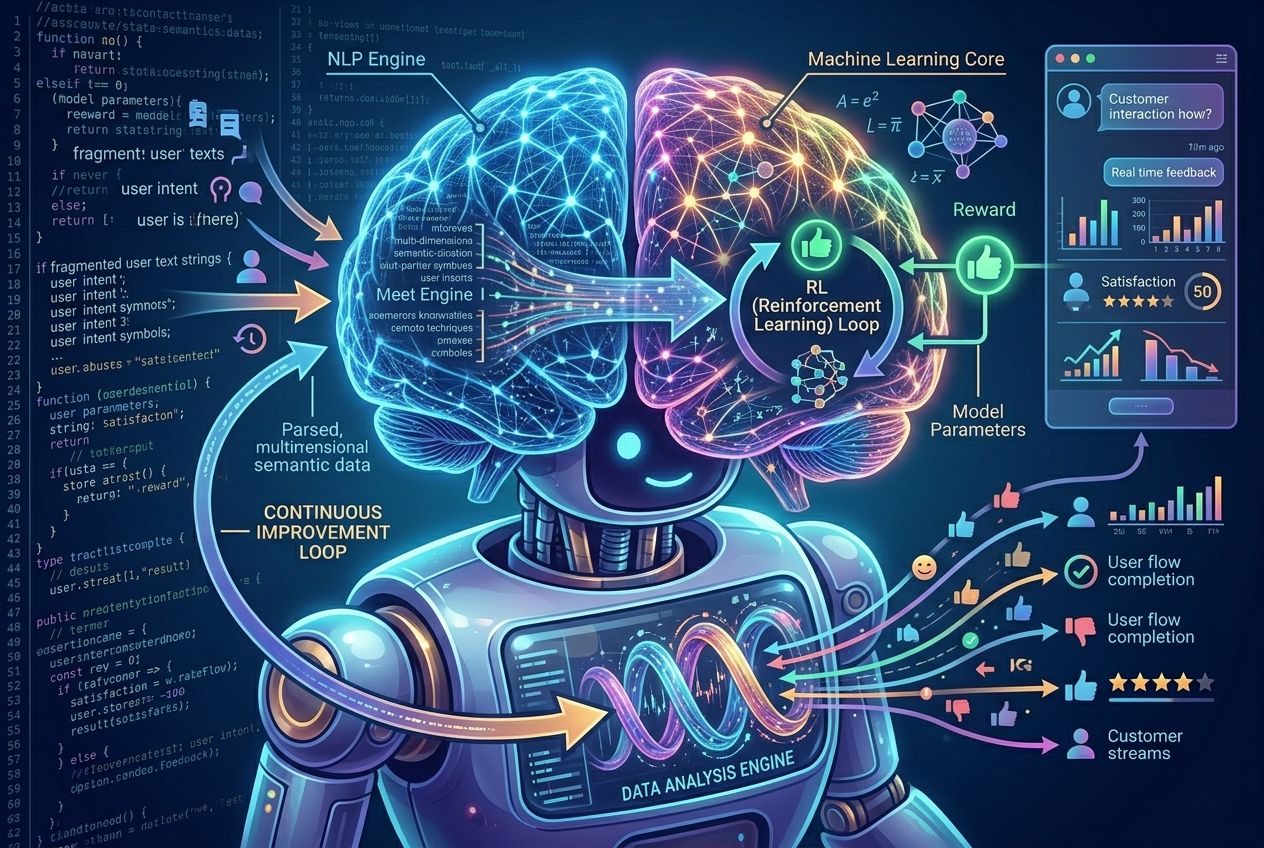
Natural Language Processing (NLP) is essential for self-learning chatbots because it allows the system to analyze language, understand user intent, and interpret meaning and context beyond simple keyword matching. NLP enables the chatbot to grasp not just what is said, but what is meant.
Machine Learning is equally critical, as it enables the chatbot to learn from interactions over time. By analyzing past conversations and identifying patterns, Machine Learning adapts responses to improve accuracy and reliability, making the chatbot smarter over time.
Machine Learning and Natural Language Processing work well together, helping the chatbot do more than just match keywords. With these technologies, the chatbot can truly understand what people want and give responses that feel real and relevant, sounding like a person when it speaks.
Data Collection from Conversations
- Each conversation with the chatbot becomes valuable data for the system.
- The chatbot tracks its understanding of me and assesses my comprehension of it.
- The chatbot monitors my objectives, notes how often I receive answers, and identifies where I encounter challenges.
- It checks if the conversation flows well
- It finds out where users like you drop off
It analyzes how you move through the conversation and where it succeeds or fails. Collecting data improves the understanding of user behavior and expectations. This helps it build a model of user behavior. With each conversation, the chatbot becomes more accurate and adaptive.
Feedback Loops for Continuous Improvement
Feedback loops really help self-learning chatbots improve. They are the reason these chatbots can improve over time. When people tell the chatbot that its answer is correct or point out a mistake, the system uses that information to adjust its behavior. This means the chatbot will be able to answer similar questions in the future.
The system uses reinforcement learning, a technique where it receives feedback on its responses and adjusts its behavior based on what people like and dislike. As a result, this process enables the chatbot to improve its ability to answer questions.
Each time the chatbot receives feedback, it becomes more precise and provides clearer answers. Feedback loops enable the chatbot to hold accurate, meaningful conversations with users. The chatbot relies on these loops to enhance its performance. Feedback loops are essential for the chatbot’s learning and improvement.
Key Features of Self-Learning Chatbots
Self-learning chatbots introduce capabilities that traditional systems cannot match.
Context Awareness
Self-learning chatbots keep track of what users have said and do not treat each message as a separate thing, using messages together to give better answers. This helps them talk more like a person, respond in a way that makes sense even if the conversation goes on for a while, and connect what users said before to what they say now, which helps them understand what users want. So chatbots with context awareness can have conversations that feel natural and make sense from start to finish, making them more helpful and engaging for users.
Continuous Improvement
Self-learning chatbots continuously improve by learning from user interactions and incoming information, without the need to be retrained from scratch. This means the system changes and improves on its own, so people do not have to fix it all the time. The chatbot remains accurate and relevant because it is always learning, reducing the need for frequent updates.
Companies appreciate this because they do not have to spend much time or money maintaining the chatbot. The chatbot becomes smarter and more efficient over time, which exemplifies Continuous Improvement.
Personalization at Scale
Chatbots now adjust their responses based on users’ past actions and behaviors. Rather than repeating standard answers, they use previous interactions to better understand each individual’s preferences.
This allows chatbots to offer unique responses for each user, leading to a more natural and engaging experience. As usage rises, chatbots become better at delivering personal interactions and making conversations more relevant and enjoyable for everyone. This process is known as Personalization at Scale.
Business Benefits of Self-Learning Chatbots
Self-learning chatbots are not just technical upgrades. They directly impact business performance.
Lower Operational Costs
Chatbots with self-learning capabilities help businesses optimize customer support staffing by automating routine inquiries and transactional tasks. For example, chatbots can answer many questions repeatedly and do so right away. This means that the people who work in support can focus on the questions that need more thought. So when businesses use chatbots, they can save a lot of money because they do not need many people to answer questions. At the time, chatbots ensure customers always receive a consistent level of service, which is really important for businesses like Lower Operational Costs.
Scalable Support Systems
Chatbots that can learn on their own make it possible for support systems to get really big, fast. This is different from teams, which require significant time and money to grow. Chatbots can grow to meet the needs of the people using them. This means they can talk to many people at once without making anyone wait. They also keep working even when many people are using them at the same time.
Scalable Support Systems like these are very important for companies that are getting bigger and need to talk to customers. They need to handle all these conversations reliably, and Scalable Support Systems help them do so.

Real-World Use Cases of Self-Learning Chatbots
Self-learning chatbots are already transforming multiple industries.
Customer Support Automation
Self-learning chatbots significantly improve customer support automation. They resolve tickets faster, handle issues more effectively, quickly identify problems, and provide answers to common questions. This approach reduces backlog and accelerates the entire support process. Chatbots continually adapt by learning from experience, enhancing their problem-solving capabilities over time.
Each time they interact with a customer, they improve at resolving issues. This ensures customers receive a faster, more consistent experience. Customer support automation is important, and these chatbots enhance its effectiveness.
Sales and Lead Qualification
Self-learning chatbots play a powerful role in sales by identifying high-quality leads. They do this by analyzing what people do, what they want, and how they interact with things. This way, they can find customers without someone having to manually check every single person.
They also help people move through the sales process by providing information at the right time. Sales and lead qualification are made easier because chatbots handle inquiries from people interested in buying. They make sure these people get the information they need and stay interested in what’s being sold. So, using chatbots that can adapt to situations makes it more likely that people will actually buy something. Sales and Lead Qualification become easier. People have a better experience when buying because it is more personalized and smoother.
HR and Internal Automation
Self-learning chatbots really help with HR and internal automation. They answer employee questions away and get it right. Employees do not have to wait for someone from HR to help them. They get the answers they need immediately.
Self-learning chatbots also help employees when they join the company. They show them what the company rules are and what they need to do. They tell them what they need to know. This makes it easier for new employees to get started.
HR and internal automation are a help. It makes things easier for the HR people. It makes sure employees get the help they need when they need it. HR and internal automation are really good for everyone in the company because they help streamline HR processes and improve internal efficiency.
Challenges of Self-Learning Chatbots
Despite their advantages, self-learning chatbots also present challenges.
Data Quality Dependency
Self-learning chatbots need data to give correct answers. With the right facts, the system learns better and improves over time. It is like studying for a test. You use books and notes to learn everything.
But if the data is bad or misplaced, the chatbot learns poorly and gives wrong answers. It then becomes less useful. It is important to add information so the chatbot can adapt and improve the user experience. Data quality matters for chatbots to work well. We must ensure the data is accurate.
Bias in AI Models
AI models, like self-learning chatbots, base their responses on training data. The quality of this data impacts what the chatbot says. If the system learns from data that’s unbalanced or unfair, it might say things that aren’t fair either. The chatbot needs ongoing monitoring to check for biased or nonsensical responses.
We have to make changes to the model all the time so that it keeps saying things that are accurate and fair, and so that it does what we want it to do: follow the rules we set for it over time. Bias in AI models is a problem, and we need to keep an eye on the chatbot to make sure it is working the way it should, which is to give fair and balanced answers, and that is why regular checks are necessary for Bias in AI models.
Privacy and Compliance Risks
Self-learning chatbots handle a lot of user and business data, including personal information. So they have to be careful with this information and keep it secure at all times. This also means that there are privacy and compliance risks if the data is not handled properly. This is why businesses must ensure they protect user information and handle data securely. Organizations must ensure they comply with legal rules and industry standards. They also need to keep an eye on how data’s being used to make sure everything stays safe and legal over time. Organizations must do this to maintain trust and security, including user information, privacy, and compliance risks.
Conclusion –Why Self-Learning Chatbots Define the AI Era
Self-learning chatbots represent a major breakthrough in artificial intelligence. They do not just do the things over and over. Self-learning chatbots. Get better with every conversation. They adjust constantly, helping companies operate more efficiently and faster. This also increases customer satisfaction.
Companies that adopt self-learning chatbots early will be ahead of the others. This is because self-learning chatbots help companies work smarter. Platforms such as Chatn.ai facilitate the integration of self-learning chatbots for organizations.
The future of intelligence is not just about automating things. The future of intelligence is about self-learning chatbots that get smarter and smarter. This makes things better for users. Self-learning chatbots are the future of intelligence.