

HR departments shoulder numerous responsibilities within any organization. They support employees, oversee HR policies, coordinate onboarding, and provide answers to numerous queries. However, modern HR departments encounter a particular problem — employees need prompt answers, whereas HR specialists do not always have enough time.
A small query about leaves, bonuses, and company policies might take an hour or more. Furthermore, employees often have to wait for responses when HR departments deal with something more urgent.
An AI HR Assistant can help address this issue. Rather than looking for answers in numerous databases, employees will be able to pose their questions using natural language and access required information. However, the real power of an AI HR Assistant lies not only in providing prompt answers. A good AI HR Assistant helps people get in touch with all relevant information, processes, and further actions. Thus, organizations will be able to boost their employee support and decrease HR requests. The most important point is that artificial intelligence will not replace HR specialists. It will simply handle routine tasks for them.
What Is an AI HR Assistant?
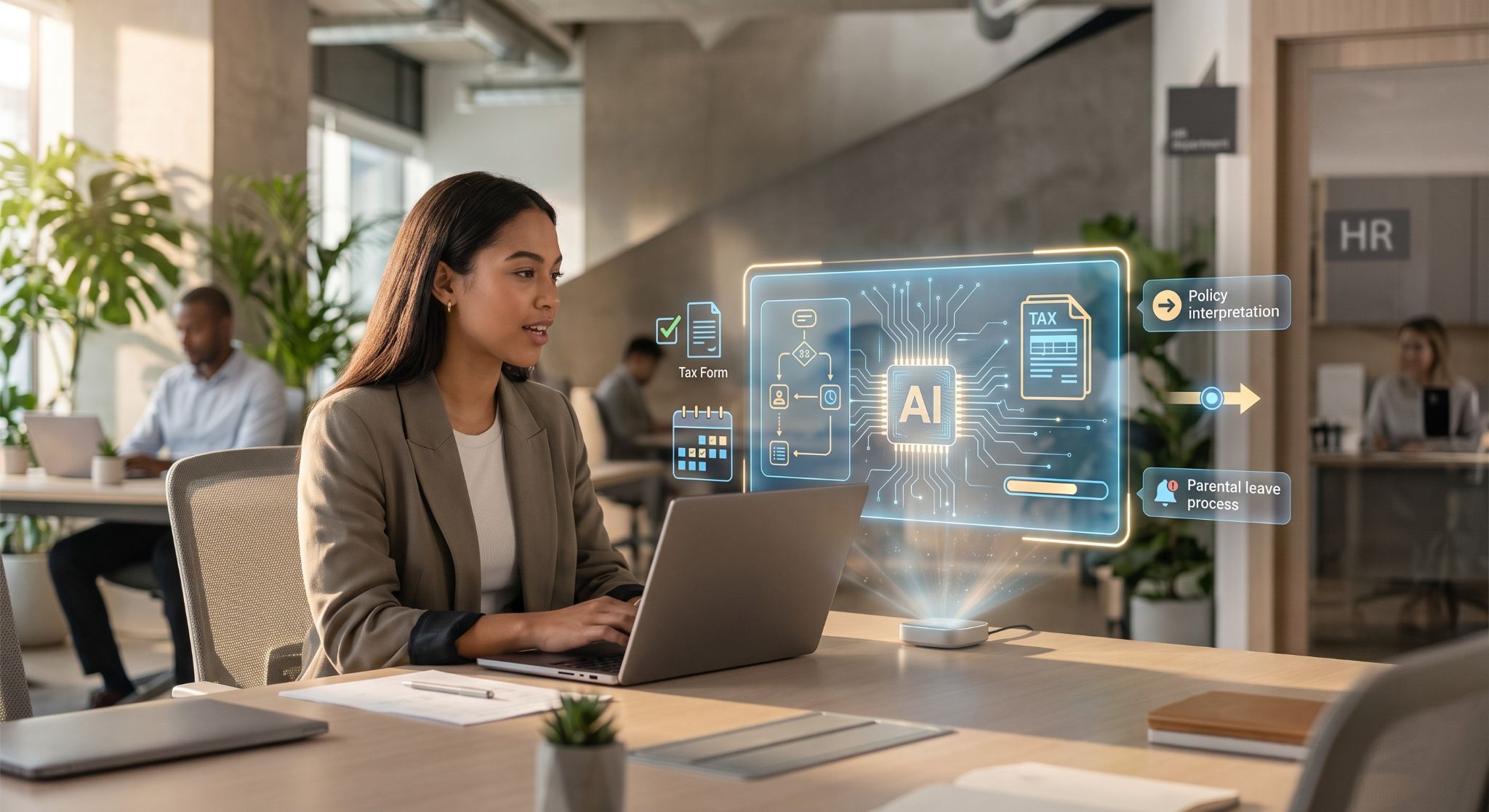
An AI HR Assistant is an AI-powered system that helps employees receive answers to their questions and understand how to conduct certain organizational processes. It differs from the regular search system because an AI assistant interprets natural language questions and gives the correct response. As a result, employees will not have to remember where organizational data is stored.
For instance, the employee can ask “How to take time off?” An AI HR Assistant will immediately provide them with the relevant answer based on the approved organizational data. Moreover, the assistant will help the employee proceed with the process. Similarly, the employee will be able to ask about their benefits, organizational policies, the onboarding process, etc. Consequently, the person will not have to look for the information in different systems and contact HR with every regular question. Finally, an AI HR Assistant will help employees get the necessary information.
AI HR Assistant versus Conventional HR Support
The typical conventional HR support includes the following process. An employee will think of a query and conduct a search on the company intranet or write an email to HR. Even though such a process works well for complicated issues, it might take too long for simple queries. In addition, HR specialists might spend their valuable time repeating answers to the same questions.
An AI HR Assistant serves as a supplementary resource that helps employees find the necessary information. Rather than using various platforms for the same purpose or waiting for an email answer, the employee will ask questions verbally. The AI HR Assistant will be able to give answers, provide information about various resources, or refer an employee to the appropriate source. Therefore, employees will obtain the needed information faster. At the same time, the HR team will save its time, which would otherwise be wasted on answering the same queries over and over again.
HR Chatbot vs. AI HR Assistant
There might be a temptation to equate an HR chatbot and an AI HR Assistant. Nonetheless, these two terms might represent entirely different functions and types of assistance. The HR chatbot would usually focus on conversation-based interaction. Thus, it provides an opportunity for employees to interact with the system and get answers to typical questions. Hence, it can help provide a faster response and better support for employees.
On the contrary, an AI HR Assistant can do much more than that. Besides answering questions, an AI HR Assistant can assist employees in obtaining information, using self-service, navigating HR processes, and understanding the next steps. In short, the term ‘chatbot’ would represent a conversational interaction, while an AI HR Assistant will assist in more aspects. This difference is important because companies need not only automated conversation but rather intelligent technologies that would help employees not just ask the questions but also take action. In other words, an AI HR Assistant could provide an opportunity for employees to find information, follow workflows, and use appropriate resources while HR teams focus on more complicated issues.
Why HR Teams Need a Smarter Support Model
HR teams are often seen as the first point of contact for inquiries from employees. Such a task is important in terms of providing support to employees and ensuring the smooth operation of a workplace. Repetitive queries take time and effort away from employees.
Examples of repetitive inquiries include:
- Leave policy-related information
- Benefits-related information
- Information about the onboarding process
- Information about workplace policies
- Information about internal resources
- Other common HR-related inquiries
Even though each inquiry does not seem too demanding, they can form a large workload. What’s more, HR specialists spend hours replying to the same inquiries instead of engaging in activities requiring their knowledge, experience, and skills. That is why organizations require a smarter support system that will allow employees to get the necessary information quickly and save HR teams from repetitive inquiries. To do this, organizations can use an AI HR Assistant.
Repetitive Questions Waste Precious HR Time
The main function of HR professionals is not to answer routine questions that employees can solve on their own. Rather, HR professionals should use their time effectively to perform tasks that will benefit the organization in the long run.
HR personnel can use their time to perform tasks such as training employees, planning for the organization, engaging the workforce, and solving complex issues related to the employees. But repetitive questions may sometimes divert their attention from such tasks. Thankfully, an AI HR Assistant can play a key role in balancing the equation. This AI will handle repetitive questions and help employees get the necessary information quickly. Ultimately, HR professionals can focus their time on tasks that require human judgment and empathy.
Employees Often Struggle to Find the Right Information
Important information is often kept in several different places within organizations. This means that employees may have to search an intranet, an employee portal, a document, or the HR department to find the correct information. Additionally, as organizations expand, employees will have increasing trouble finding specific information.
An AI HR Assistant would facilitate information search by creating a conversational access layer. Rather than asking “Where can I find this document?”, employees can ask “What should I do?”, and the AI HR Assistant will help them find information and take action.
Even though the change may look rather small, it can make a lot of difference when it comes to employees’ interaction with the information at work. In addition, such a change will help employees save time and reduce the number of routine information inquiries made to HR departments.
Inconsistent Information Leads to Disruption
For employees to move around their workplace successfully, they need trustworthy, consistent answers to their questions. Nonetheless, if organizations collect their policies and processes in various places, they risk creating inconsistency. Thus, employees might encounter contradictory information or struggle with the choice of which direction to take.
By using an AI HR Assistant, organizations could provide consistent, credible information from approved, reliable sources. Hence, employees would receive more straightforward access to reliable guidance. Besides, by using conversational AI, employees would be able to find the necessary information without having to search across various platforms.
Nonetheless, organizations would have to take care of the information behind the AI assistant. Since AI cannot fix outdated policies, inconsistent documents, or other information problems, HR teams would have to manage information carefully.
How an AI HR Assistant Changes the Employee Experience
Employee experience often depends on small moments. An employee needs an answer. A new hire needs guidance. Someone needs help finding a policy. When these moments become easier, the overall workplace experience can improve.
Employees Get Answers in a Conversational Way
Employees may not always use keywords when searching and often ask questions in their own words based on their tasks. An AI HR Assistant supports this conversational approach, making it easier for employees to get assistance. Rather than navigating complex menus or multiple systems, employees can state their queries directly. The AI HR Assistant will understand their needs and provide relevant information. This approach enables employees to receive answers quickly without spending excessive time searching for information.
Employees Can Access Support When They Need It
HR teams cannot always respond to employee questions immediately. However, employees may need important information outside traditional working hours. In these situations, an AI HR Assistant can provide digital support for routine questions and help employees access basic HR information when needed.
Moreover, employees can ask questions in natural language instead of waiting for an HR professional to respond. As a result, they can find relevant information more conveniently while HR teams focus on higher-priority responsibilities.
Nevertheless, organizations should not automate every HR interaction. Sensitive, complex, or personal situations still require human involvement and careful judgment. Therefore, organizations should use AI to support routine employee needs while ensuring employees can connect with HR professionals for personalized assistance when needed.
Employees Waste Less Time Looking for Information
Sometimes, employees spend their precious time looking for workplace-related information. In this case, long search periods become an obstacle and may decrease productivity. Specifically, employees may look through numerous documents, platforms, or sources before finding an answer to a question. Some employees can choose to give up and turn to HR teams for help.
However, conversational AI makes the process of searching easier and more efficient. With the help of conversational AI, employees can ask questions in natural language without searching for information on multiple platforms. The AI HR Assistant will be able to provide employees with the necessary information. Thus, employees can find answers faster and avoid spending extra time looking for them. At the same time, HR teams can get fewer routine information queries.

What Can an AI HR Assistant Actually Do?
Organizations can use AI HR Assistants for many employee support scenarios. However, the best starting point usually involves high-volume, low-risk interactions.
Answer General HR Queries
There is an AI HR Assistant that could provide quick information to employees on common HR queries. Some of the common HR questions that employees may ask include those relating to company policies, benefits, leaves, attendance, and work practices. Employees do not have to search through different documents and contact HR every time they have such questions, as they can use conversational AI for this purpose.
In addition, the AI HR Assistant could also direct the employee to other sources of help. As a consequence, the employees would be able to get their answers more easily, and HR teams could spend less time addressing repetitive queries. Overall, this solution will be beneficial for both sides as the HR teams could focus on other tasks.
Promote Employee Self-Service
Employee self-service is where employees can find information on their own without seeking assistance from HR on all issues. Nonetheless, employees may find it difficult when the information is scattered across various systems. In this regard, an AI HR Assistant would help make self-service more convenient, more conversational, and faster.
In such a case, employees do not need to navigate various systems or search through extensive documents; they can pose their inquiries in simple sentences. Besides, an AI HR Assistant would be in a position to provide information or point them in the right direction. Thus, employees will become more self-reliant and will spend less time asking questions. At last, this would promote employee self-service and lower requests for HR that are repetitive. This means that HR specialists will have more time to handle complex cases.
Support Onboarding for Employees
Onboarding often raises many questions for new employees, who need to learn company policies, workplace procedures, and available resources. Accessing this information can be challenging, especially at the start. An AI HR Assistant can simplify onboarding by offering guidance and information throughout the process. New employees can ask questions in natural language, access relevant details, and learn where to find additional resources. The assistant also addresses routine onboarding inquiries, reducing the workload for HR staff. As a result, new employees gain quick access to essential information, helping them feel more comfortable in their roles. AI supports onboarding while maintaining a personal touch.
How Chatn.ai Can Help Create Smarter Employee Support
Organizations require more than just technology solutions. What they need, however, is intelligent tools that enable their employees to access information, find answers, and navigate workplace processes. By making the employee experience more conversational and accessible, an AI HR Assistant can help achieve this objective. With strategic use of AI, organizations can optimize employee support and minimize unnecessary friction.
For instance, an AI HR Assistant could assist employees in locating relevant information, answering frequently asked questions, and accessing the right resources. Furthermore, it has the potential to support employee self-service and guide employees to the appropriate next steps. This makes it easier for employees to access support when they need it, and helps HR teams prioritize more complex requests.
AI should, however, augment humans, not replace them. HR still has to manage sensitive situations, navigate difficult decisions, and handle significant employee conversations. So, intelligent automation needs to be combined with human assistance; organizations should plan for a balance.
Chatn.ai empowers companies to delve into conversational AI for employee interactions and process automation. In the end, companies need to automate what makes sense and maintain the human aspect of work.
Conclusion: Building a More Accessible Future for HR Support
The future is on the horizon, and that future is more accessible. The future is coming, and it’s a more accessible future for HR Support.
The future of HR isn’t about technology vs. people. Rather, it demands that they make use of technology to increase the availability and value of human expertise.
An AI HR Assistant can help workers quickly locate information, navigate common procedures, and get assistance when needed. Meanwhile, HR can focus on tasks that call for empathy, judgment, critical thinking, and a human touch. The actual challenge is in finding the right balance, therefore. AI shouldn’t replace the human element in HR. Rather, it should eliminate needless effort and repetition, and free up HR professionals to devote more time to what matters most. Furthermore, companies that use AI wisely can establish a better equilibrium of intelligent automation and human support. They can provide employees with quick access to information and help HR teams work more efficiently and strategically.
In the end, the aim is quite straightforward: Free up human time for what truly matters — let AI handle the repetitive work.