

Customers now expect immediate results, and employees require instant access to information to stay productive. Delays caused by email responses, lengthy knowledge bases, or extended support calls are no longer acceptable. Businesses must therefore reconsider how they deliver support and information.
AI Self-Service has become essential for businesses. It understands human speech, personalizes responses, and manages repetitive tasks more effectively than traditional self-service options. This enables users to resolve issues quickly without relying on human agents.
AI Self-Service extends beyond customer service, offering intelligent, 24/7 support for sales, HR, IT, and operations. This allows staff to save time on repetitive tasks and focus on higher-value work. However, these features alone do not ensure chatbot success. To fully leverage conversational AI and enable continuous improvement, organizations must integrate four key elements: conversational AI, centralized knowledge, workflow automation, and continuous learning. This discussion will cover what AI Self-Service is, its advantages over traditional self-service, and how AI can enhance both customer and employee experiences.
What Is AI Self-Service?
AI Self-Service allows customers and workers to self-serve and automate answers, tasks, and even problems using artificial intelligence. Rather than relying on keyword searches or long FAQs, it understands user intent and provides timely, accurate, personalized responses. Furthermore, it integrates all of the following elements in a single solution: conversational AI, natural language processing (NLP), machine learning, knowledge management, and workflow automation.
Customers will be able to see the status of the orders or appointments, and employees will be able to reset passwords, view company policy, and submit HR requests. This, in turn, minimizes repetitive questions and increases departmental productivity. Also, with every interaction, AI will learn and become more accurate in future responses. Unlike traditional self-service, which involves manually sifting through static knowledge bases, AI Self-Service offers conversational and context-aware assistance. As a result, users can solve problems more quickly and with less effort. In the end, companies are improving customer satisfaction, enhancing their staff, and creating smarter, more efficient self-service experiences.
How AI Self-Service Works
AI Self-Service may seem simple, but it integrates multiple intelligent technologies to provide quick, personalized assistance. Some key points about Natural Language Processing (NLP) in AI: Let’s look at some of the key points regarding Natural Language Processing (NLP) in AI. Then, AI will determine users’ intent and retrieve the most relevant data from reputable knowledge bases, FAQs, and business systems. Furthermore, AI streamlines common tasks such as support ticket generation, appointment scheduling, password resetting, and customer record updates. This means users can get their issues resolved faster, and support can handle fewer repetitive requests. If a complicated problem comes up, AI can smoothly switch to a human agent and pass along the conversation history to ensure a seamless experience.
AI systems are continually refined and enhanced through machine learning and analytics to better understand knowledge gaps and improve responses. As a result, with each interaction, the accuracy of the interaction increases. In short, AI Self-Service is an intelligent assistant that provides information, automates tasks, and assists users throughout their entire process.
Why Traditional Self-Service No Longer Meets Customer Expectations
In this blog post, I share some reasons why traditional, customer-service-oriented self-service no longer meets your customers’ needs. Customers’ attitudes have shifted significantly. In today’s digital era, customers expect immediate responses, tailored assistance, and seamless digital experiences with any brand they engage with. But many organizations still maintain knowledge bases and lengthy FAQ pages that users must sift through to find information.
Besides, customers don’t want to navigate multiple pages to find answers to their questions. Similarly, workers require easy access to policies, technical documentation, and business systems to remain productive. Unfortunately, the traditional self-service approach can slow both groups and add to frustration. These become more challenging as businesses expand. As product catalogs grow and knowledge bases expand, manual searches become less effective. As a result, users give up on their search, file repeated support tickets, or go to other providers that offer a better experience.
AI Self-Service addresses these issues by interpreting user intent, providing relevant answers immediately, and assisting users through each interaction. This, in turn, enhances customer satisfaction, reduces support costs, boosts employee productivity, and delivers quicker, more personalized self-service experiences.
The Hidden Costs of Poor Self-Service
Too many companies overestimate the benefits of having an outdated self-service system. These solutions may appear cheap, but they can actually increase costs and be less efficient. Users aren’t able to get answers quickly, and support teams have time they could be using to resolve complex issues that are repetitive questions. Furthermore, employees’ productivity decreases when searching takes too long. Employees are required to interact with multiple systems, interrupt other employees, or wait for help to complete a simple task. This causes delays to build up and results in poor business performance.
Customer satisfaction is reduced, too. If users are frustrated, they can leave their purchases, cancel their subscription, or look elsewhere for a company that provides faster support. Also, it causes information silos and duplication across multiple subsequent conversations. AI Self-Service addresses these challenges by providing accurate, consistent, and timely support. It offers customized responses and automates repetitive tasks, rather than requiring users to trawl multiple sources. As a result, businesses become more efficient, less expensive to support, more customer- and employee-centric, and better able to devote their human experts to more valuable interactions.

Common Mistakes Businesses Make with AI Self-Service
There are many organizations out there that invest in AI Self-Service but hope for quick results. Technology, on its own, however, is no guarantee of success. If not managed carefully, businesses can create user journeys that are difficult to navigate, thereby impacting adoption and return on investment (ROI) and ultimately hindering AI’s full potential. Fortunately, by identifying common implementation pitfalls early, organizations can help avoid these challenges. This way, they can create a self-service AI solution that will be valuable to them, delight their customers, and help them grow their business in the long term.
Treating AI Like a Basic FAQ Bot
A common error is to consider AI as a searchable FAQ page. This solution allows you to automate basic questions but does not provide the intelligent, conversational user experience expected today. Because of this, consumers frequently become frustrated when they go online and find articles rather than information that helps them achieve their objectives. Rather, businesses should aim to develop AI Self-Service that grasps user intent, identifies context within a conversation, and provides guidance to complete an entire task. For instance, instead of just telling the user how to reset a password, the AI can check whether a reset is required and trigger the reset procedure if so. Moreover, AI should be able to respond to follow-up questions without having to repeat themselves. This means that users spend less time looking for information, have their problems solved faster, and have a smoother, more personal experience. In the end, businesses enhance customer satisfaction, minimize repetitive support inquiries, and boost efficiency.
Relying on Outdated Knowledge
Even the most sophisticated AI Self-Service requires up-to-date data. Yet inaccurate policies, insufficient documentation, or inconsistent information prevent AI from delivering consistent results. This way, users get misleading information, become dissatisfied with the system, and start reaching out to human agents. Support teams handle routine requests, and the value of the entire AI is undermined. Hence, it is necessary to regularly review and update the company’s knowledge base. Also, having one central place to store all information would help eliminate duplicate entries and ensure consistency across departments. And finally, proper content management would help ensure that the information remains aligned with company policies, products, and services.
Using an updated knowledge base allows AI Self-Service to provide quick and accurate responses. In other words, having up-to-date information means higher customer satisfaction, greater adoption of self-service technologies, and more effective customer and employee experiences.
Neglecting the Human Factor in Handovers
The AI should serve as an assistant for humans rather than completely replace them. While AI can help automate simple tasks and answer standard questions, there are cases where it cannot understand or solve a problem because of human empathy or the need for analytical skills and specific knowledge that only a person can provide. Thus, organizations should understand the limitations of AI and use it in ways that complement the support team. That is why the organization should define an effective and easy transition process. If AI is unable to answer a question, it must hand off the dialogue to a human agent and provide them with the full conversation history and customer data. Consequently, customers do not have to explain their situation once again, and agents will be able to continue the dialogue knowing all the details. In addition, an efficient handover increases customer satisfaction, reduces time to resolution, and improves the quality of support.
How Chatn.ai Delivers Intelligent AI Self-Service
A good AI Self-Service solution cannot just be a chatbot. Organizations need an intelligent solution that brings people, knowledge, and business processes together under one roof. This is precisely what sets Chatn.ai apart from the rest. Chatn.ai integrates conversational AI, workflow automation, and knowledge management capabilities to help companies offer faster, smarter, and more personalized service.
In addition, Chatn.ai enables organizations to provide fast, conversational support not only to customers but also to internal teams. Without the need to toggle between systems or look up numerous documents, Chatn.ai understands user intent, retrieves the right information, and performs routine actions in natural conversations. This helps to solve issues faster on behalf of the user while saving employees’ time on handling repeated requests. Whether it’s customers’ need for product information, status updates on orders, or help with their accounts, or employees seeking assistance with HR, IT, or business processes in general, Chatn.ai provides relevant answers immediately. It automates workflows, increases productivity, and ensures consistency across all processes.
Knowledge Centralization for Smarter Responses
Business knowledge is often spread across documentation, knowledge bases, CRMs, help desks, and internal applications. As a result, employees and customers spend extra time searching for information. Disconnected sources can also cause duplication, inconsistency, and outdated content. Chatn.ai integrates multiple knowledge sources into a unified platform, eliminating these challenges. Users no longer need to search each source individually. Chatn.ai identifies their needs, retrieves relevant data, and delivers accurate answers through conversation. It also ensures consistent responses regardless of the original source. This allows users to access information quickly and accurately, while organizations benefit from better knowledge management and greater operational efficiency.
AI Chatbots That Know What the User Is Looking For
People today converse naturally and do not always use exact keywords in their questions. Instead, they expect AI to comprehend the natural language they speak and respond just as any human would. However, regular search engines require exact-match keyword phrases, which makes it difficult for users to get the needed information promptly.
Chatn.ai solves this problem by understanding conversational language, recognizing user intent, and maintaining context across all interactions. This means that instead of looking for exact keywords in questions, the AI understands the user’s meaning and replies accurately. Moreover, Chatn.ai can remember previous inquiries, so users can ask related questions without repeating information. In this way, the conversation becomes more natural and efficient. Businesses will be able to offer prompt service and high customer satisfaction.
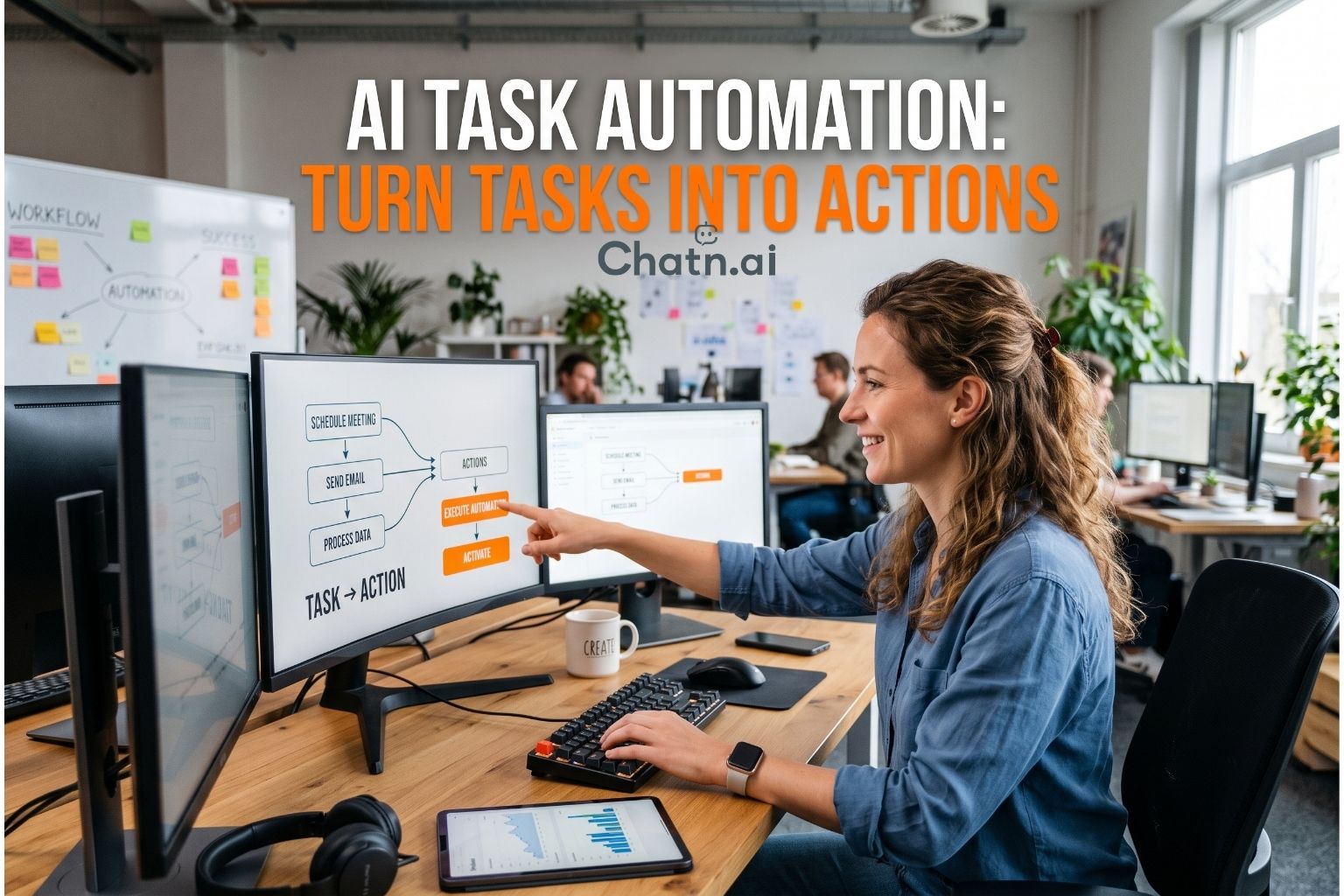
Time-Saving Workflow Automation
Supplying information is just one element of a successful AI Self-Service solution. Nowadays, people expect AI not just to give them information but also to perform tasks quickly and correctly. Therefore, companies need a solution that integrates intelligent conversation with workflow automation.
Chatn.ai saves time and streamlines processes by automating repetitive workflows, enabling employees to focus on more productive activities. Such features include:
- Appointment scheduling
- Lead qualification
- Creation of support tickets
- Collection of customer information
- Routing of requests to the right teams
- Updating of business systems
- Internal approvals workflows triggering
Also, Chatn.ai does all the listed actions instantly, saving effort and eliminating human errors. Thus, employees can eliminate repetitive administrative tasks, and customers will receive faster, more accurate service.
Future Trends Shaping AI Self-Service
AI Self-Service continues to evolve rapidly. Organizations that prepare today will remain competitive as customer expectations continue to rise. Several emerging trends will shape the next generation of intelligent self-service.
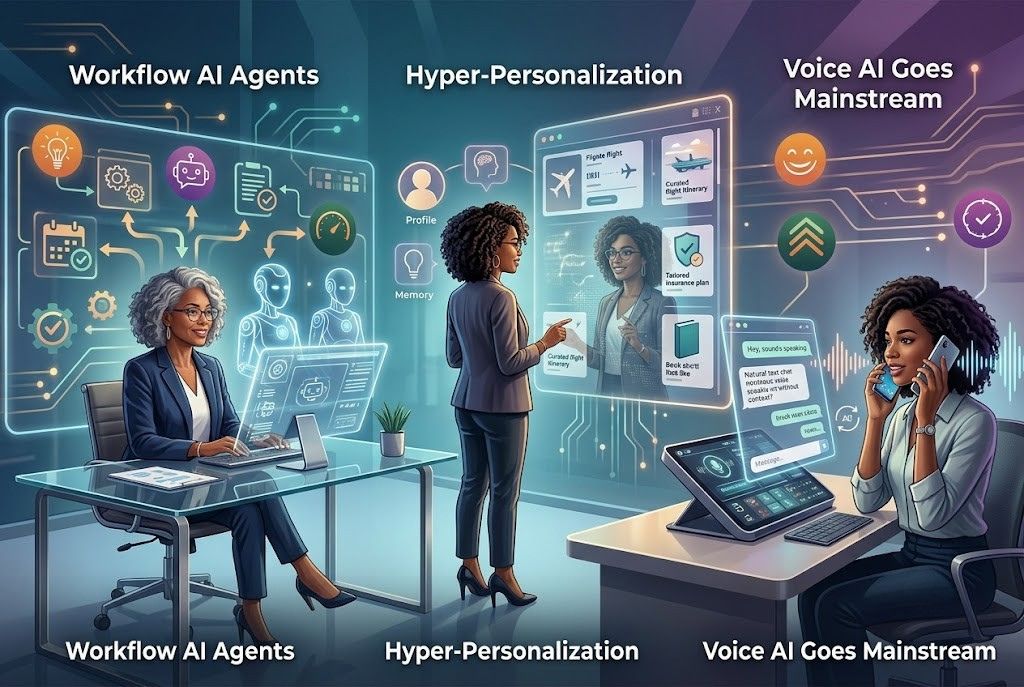
AI Agents That Handle Whole Workflows
In addition to its current capabilities for responding to inquiries, AI Self-Service will in the future involve much more comprehensive solutions. The intelligent agents of tomorrow will be able to handle whole workflows of business processes requiring little human input. Instead of just sharing information, these AI agents will automatically make appointments, process requests, update records, approve certain actions, and connect various systems within business processes. Simultaneously, they will inform users of every step of the process in real time and notify them when the procedure is complete. Consequently, such solutions will help businesses reduce manual labor, speed up operations, and ensure a better customer experience.
Hyper-Personalized Experiences
Customer requirements keep changing, which is why there is a need for greater personalization. As a result, the AI of the future would make recommendations based on the customer’s history, preferences, prior interactions, and behavior. Rather than giving generalized responses, the AI will provide tailored recommendations and personalized solutions based on each individual’s specific requirements. In addition, it will constantly learn from every interaction, and future responses will be even more precise and relevant. Therefore, every single conversation would become more interesting and valuable.
Voice AI Goes Mainstream
Voice artificial intelligence is changing the way people use technology. With voice assistants becoming mainstream, users expect companies to offer instant, easy-to-use solutions through natural communication. For that reason, businesses will integrate voice AI with text options to provide a seamless experience across all channels. Furthermore, users will be able to seamlessly switch between voice and chat without losing context or entering redundant data. Therefore, companies will become more accessible, respond faster, and offer greater convenience for their customers and employees. In conclusion, the integration of voice and conversational AI technologies will enable companies to develop more intuitive self-service AI solutions.
Getting Started with AI Self-Service
There is no need to make all your business processes automated immediately when creating an effective strategy for AI Self-Service. On the contrary, it is better to follow a strategy-oriented and step-by-step approach focused on continuous improvement. Starting with something simple will help you lower the risk of failure, encourage user adoption, and achieve quicker results.
First, assess your existing support experience to identify recurring customer questions, inefficient workflows, and other bottlenecks that cost your employees precious time. Then, structure your knowledge as a centralized, accurate, and constantly updated base, because high-quality information is the key to success in each AI implementation.
After that, select an appropriate AI platform that provides features such as conversational AI, automation capabilities, system integration, analytics, and enterprise-level scalability. After implementation, be sure to carefully monitor the process’s performance by analyzing customer interactions, identifying knowledge gaps, and optimizing responses. Finally, consider your AI Self-Service as a business initiative, not a single technological project.
Conclusion
Current customers and employees want only searchable FAQs and help center content. Instead, they need quick, personalized service that helps them achieve their goals easily and effectively. With ever-increasing customer expectations, companies need to adapt in order to stay competitive. By using AI Self-Service, businesses can offer conversational interfaces, intelligent information retrieval, and automated workflows. This means that companies can save money on support, optimize processes, enable employees to work faster, and deliver better customer experiences. To get the most from AI, however, it is important to ensure up-to-date knowledge bases, automate key workflows, and continuously measure and improve everything.
With the Chatn.ai solution, companies have an opportunity to turn standard self-service into a smart, scalable product that connects information, automates mundane tasks, and conducts conversations naturally. Those who embrace AI Self-Service now will be able to provide better customer experiences, increase productivity, and become more competitive in the future.