
Introduction
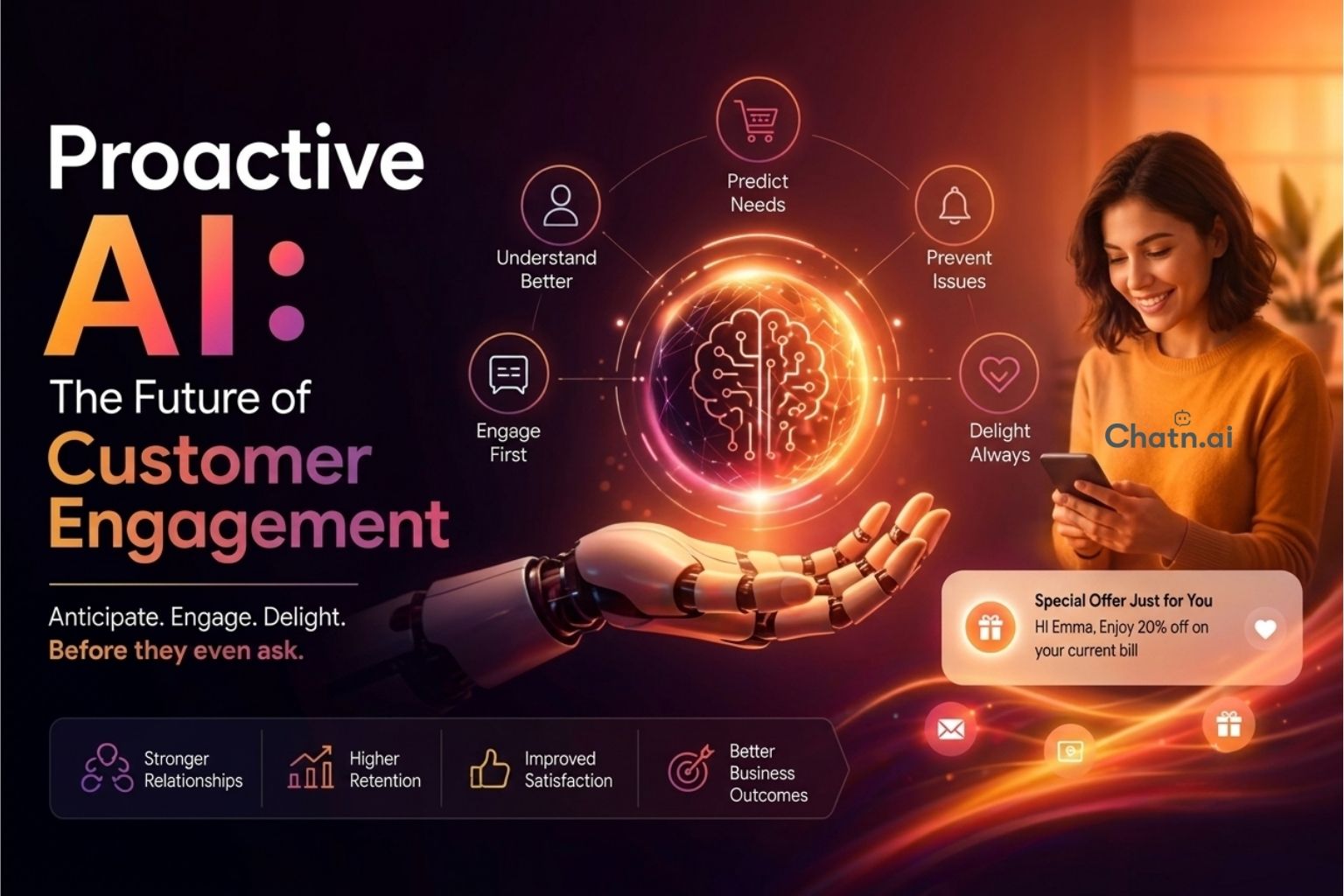
Most organizations continue working in response mode. Customers experience issues, reach out to support, and receive assistance. After that, one of the organization members takes action to solve the issue. This is the way companies have operated for years to meet customers’ expectations. However, things have changed drastically today. People expect companies to provide immediate assistance, personal experience, and fast interaction. Furthermore, customers no longer want to waste time solving their problems or getting answers to their questions. They want companies to understand their needs and provide fast and prompt solutions. Thus, there is an increasing demand for more efficient, smart, and personalized services from customers to organizations. On the other hand, through digital interactions, organizations receive large volumes of customer data. It allows companies to make a step towards a smarter service provision. This has increased the demand for a new generation of technologies. Namely, companies need solutions that can detect customers’ needs, predict potential issues, and act immediately. It is here that Proactive AI comes into play. Proactive AI is technology aimed not at responding to customers’ requests but at analyzing their behavior, detecting patterns, and predicting future needs.
What Is Proactive AI?
Proactive AI is the ability of AI systems to predict future events and take action before the user requests it. In other words, these systems identify opportunities, anticipate problems, and act in advance without waiting for the customer to ask for help. Traditionally, an AI system performs an action in response to a command or user input. For instance, a chatbot provides an answer only when the customer asks a question. Although this method improves efficiency, it depends on the customer’s first move. Proactive AI operates in a completely different way. Unlike in the previous case, the system does not wait for a request; it keeps analyzing data, predicting outcomes, recommending the best actions, or even performing them automatically. In this way, businesses can contact the customer at the right time and provide the most relevant experience. Also, with Proactive AI, companies can shift from reactive problem-solving to predicting and solving potential issues. It makes business activities more efficient, reduces delays, and improves the customer experience through better interaction.
Reactive AI vs Proactive AI
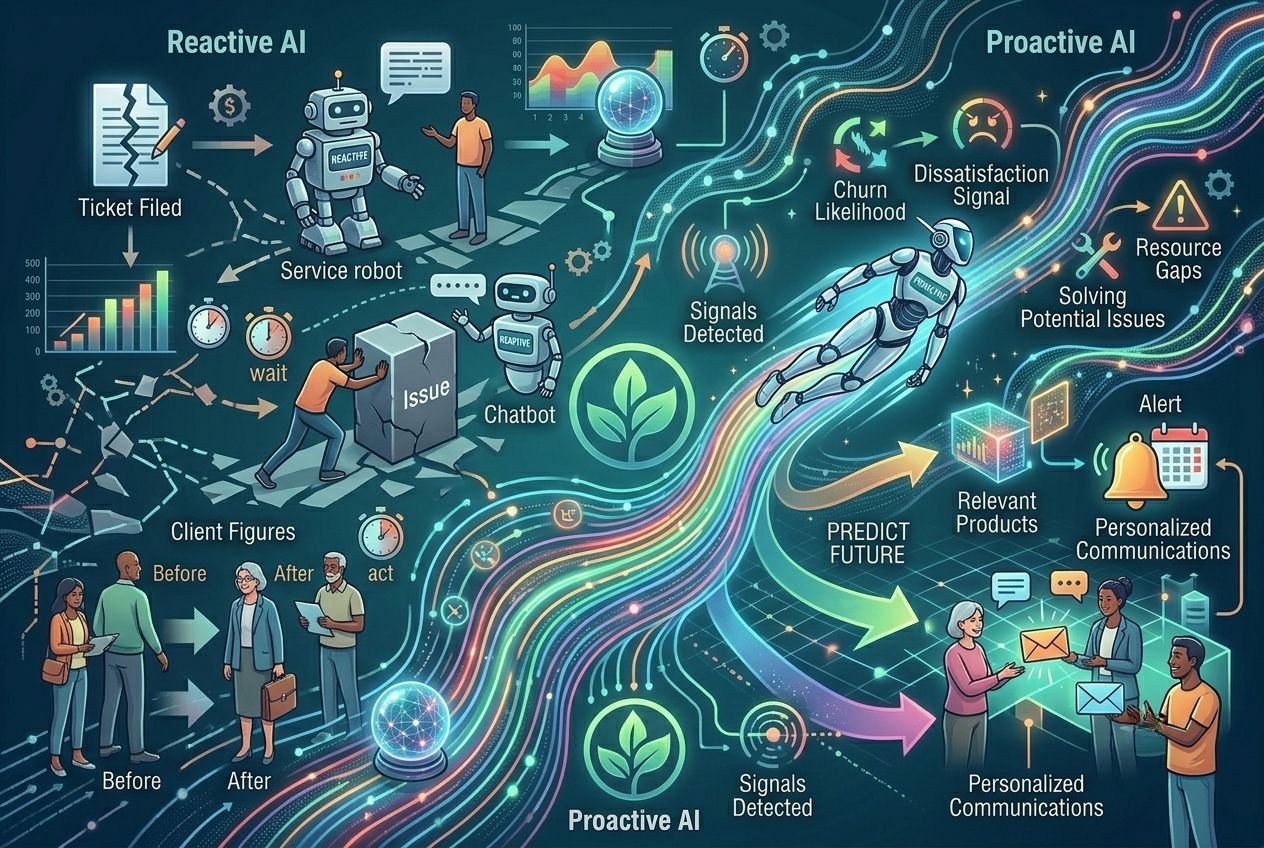
There is a big difference between reactive and proactive AI systems. While both use artificial intelligence to enhance business processes, these types differ dramatically in how they interact with customers. Reactive AI acts only in response to some events. This means that AI waits until the customer, employee, or system takes action and then provides an appropriate response.
Examples include:
- A chatbot answers a question when a customer asks.
- A support team solves the issue after a ticket is filed.
- A sales rep follows up after a prospect makes contact.
While using reactive AI can help organizations increase their efficiency and responsiveness, they still have to wait for someone to act first. Proactive AI, on the other hand, detects signals in advance and acts before problems happen. Instead of waiting for requests, it constantly analyzes information, recognizes patterns, and predicts the future. Active AI can:
- Recognize customer dissatisfaction even before the complaint comes in.
- Predict the likelihood of churn before the client considers canceling a subscription.
- Recommend relevant products even before clients start their search.
- Trigger personalized communications before the value.
Why Traditional Automation Is No Longer Enough
Traditional automation executes actions based on set conditions and rules. For example, if a client performs Action A, the system responds with Action B. While these solutions offer benefits such as increased efficiency and reduced manual effort, their adaptability is limited. Traditional automation meets current business needs but struggles to adjust to changing conditions and evolving customer behaviors. Client expectations and behaviors are constantly evolving. As a result, static workflows often miss opportunities and fail to address emerging demands. Traditional automation cannot detect patterns, predict scenarios, or adjust actions, as it relies solely on predefined rules that may become outdated. Proactive AI addresses these challenges. Unlike traditional solutions, Proactive AI analyzes context, evaluates customer behavior, and learns from historical data. It also continuously monitors new information to identify trends and opportunities. Thus, businesses get. This provides businesses with a more intelligent and adaptive solution.
How Proactive AI Works
Behind every proactive system is a combination of data, analytics, and automation. The process begins with gathering information from multiple sources.
Data Collection and Analysis
With the advent of modern technology, companies now deal with large amounts of data daily. Indeed, every interaction with customers involves gathering valuable information that companies can use for decision-making and client engagement.
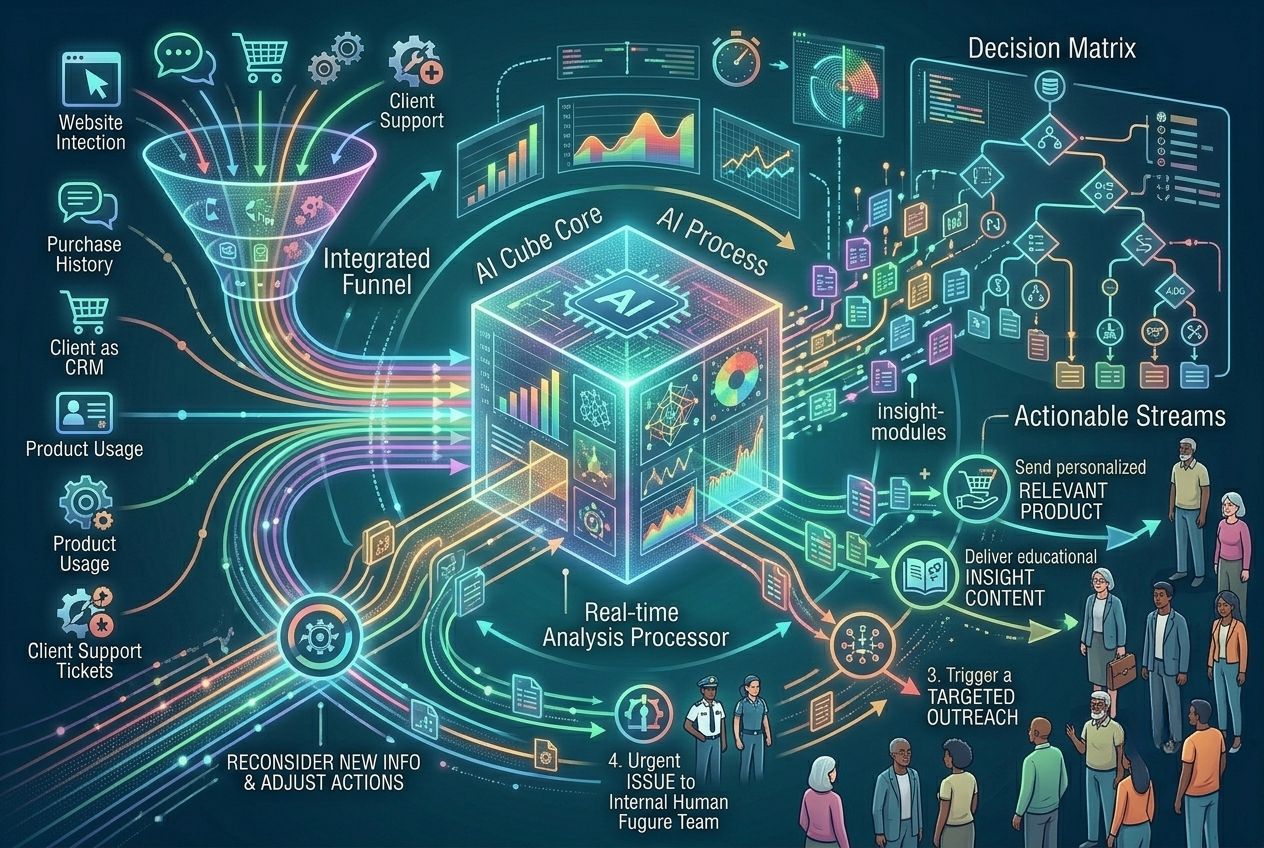
The following list shows different sources of data collection:
- website interaction
- chat conversation
- purchase history
- CRM
- product usage
- client support tickets
As data volumes increase rapidly, Proactive AI continuously gathers and analyses it in real time. Moreover, instead of considering each interaction separately, it uses information gathered from multiple touchpoints to ensure the full picture of customer behavior is captured. Besides that, Proactive AI studies the relationships among actions, preferences, and outcomes. Thus, it manages to uncover certain trends and patterns that can remain unnoticed during manual analysis. As a result, companies can gain better insight into their customers’ needs, behaviors, and intentions. It means they will be able to make better-informed decisions based on the current situation.
Automated Decision Making
Prediction makes sense in this context. The insights gained from analysis are certainly valuable but require proper and timely action by companies to produce tangible results. And here is where the power of Proactive AI comes to play. Proactive AI not only identifies issues, patterns, or trends but can also automatically respond to the findings in ways that align with the company’s objectives and goals. No human action is required – the decision is made in real time as a consequence of insight and pre-established goals.
Proactive AI can do the following:
- Send recommendations to the customer.
- Initiate a targeted outreach campaign.
- Assign urgent issues to the responsible team.
- Provide educational content based on user behavior.
- Inform internal teams about certain risks and opportunities.
Moreover, Proactive AI can always reconsider new information and adjust its actions accordingly. Thus, the business can provide relevant experience to customers without delay or manual effort. Thus, thanks to automated decision-making, the company can work more effectively, quickly, and consistently. It is no longer necessary to rely only on human actions to translate.
The Shift from Customer Service to Customer Anticipation
Customer service is evolving. Historically, support teams focused on resolving issues. Today, leading organizations focus on preventing them. This shift represents one of the most important changes in customer experience.
Customers Expect Faster Responses Than Ever
In the modern world, consumers live in an environment where convenience and speed matter for pretty much everything they experience. With technological development, the requirements for business performance grow higher every day. Customers don’t evaluate other companies against just their direct competitors any longer. Instead, they evaluate each business against the convenient services and fast experiences they had before. This means that customer service requirements will continue increasing. When the customer expects prompt help from the company and fails to get it, disappointment grows. Therefore, customer confidence decreases, the purchase is abandoned, and the consumer goes to another company. However, customers require personalized answers to their problems. This means the company should not only respond quickly but also make its response valuable. That is why the solution should be found in anticipation of customers’ needs and proactivity.
Why Waiting Creates Friction
Often, a reactive approach creates unnecessary complications that make the customer journey difficult. Even though the company will finally solve the problem, customers may face numerous difficulties throughout the process.
Namely, they may experience:
- Long waiting for replies from support;
- Repeated discussions in different channels;
- Delayed solutions of important problems;
- Wasted time when looking for information.
Thus, as more obstacles arise, the overall quality of the customer journey begins to deteriorate. In such circumstances, the likelihood of customer dissatisfaction is high, and customers are unlikely to communicate with the company again. However, the continuous delays may not only lead to customer dissatisfaction but also affect customers’ trust and loyalty. In addition, the reactive approach poses certain difficulties for the company. Namely, it forces support representatives to spend their time resolving problems that could otherwise have been prevented. It results in increased costs for the support department and decreased efficiency of support representatives. It is also possible to say that unaddressed friction leads to lost opportunities, reduced retention, and even a negative brand image.
Anticipation Creates Better Experiences
First, by being proactive in their operations, companies can eliminate most of the impediments that frustrate customers during their interactions. There is no need for clients to complain; businesses can spot all the problems and solve them before anything happens. Hence, customers will be able to get their questions answered and their problems solved before they become major obstacles. This way, companies can minimize customer effort. What is more, proactive communication allows organizations to address customer demands and problems at the right time. In other words, organizations can anticipate problems and solve them rather than reacting to customer dissatisfaction after it occurs. This approach helps businesses facilitate smoother interactions and establish stronger connections with customers. Even more important is that customers feel understood and valued by companies. They feel special, which means that they can trust the company more and be loyal to it.
Key Benefits of Proactive AI
Organizations adopting Proactive AI often experience measurable improvements.
Quick Problem Solving
The other major benefit of Proactive AI is that it allows for quicker problem-solving. Instead of relying on customer complaints about problems, Proactive AI constantly analyzes data to detect issues at an early stage. Thanks to this, companies get an opportunity to solve problems before they become serious. Moreover, the team will be able to act quickly to prevent any problems. In such a way, with the help of Proactive AI, it becomes possible to offer solutions to customers before they ask for help. Therefore, customers will have more time to reach their goals instead of wasting it looking for help. What is more important is that quick problem-solving leads to a better user experience. At the same time, companies get an opportunity to be more efficient and responsive.
Higher Customer Satisfaction
Customer satisfaction is all about convenience, speed, and personalization. As customer demands keep rising, it becomes necessary for companies to innovate new methods to engage with them. The proactive approach makes interactions between the company and customer more efficient, quicker, and more pleasant. As a result, customers spend less time searching for solutions and more time achieving their objectives. In addition, customers can avoid many problems that might arise during interactions with a company through proactive engagement. This helps in making the whole process less frustrating and more convenient. Thus, customers feel that they are being helped, listened to, and appreciated. At the same time, they gain confidence in the brand and become loyal towards it. In conclusion, an anticipatory approach greatly increases customer satisfaction.
Increased Customer Retention
Proactive engagement will ensure that businesses develop stronger, more effective customer relationships. This is because proactive engagement makes it easy for an organization to meet customers’ needs without them having to ask for assistance. Customers will always feel valued and attended to. Additionally, through proactive engagement, customers can recognize that a company is aware of their needs and willing to help them succeed. Through consistent, proactive engagement, businesses will earn the trust and satisfaction of customers, who will eventually become loyal to the business. On the same note, proactive engagement prevents small problems from escalating into bigger ones. This is because the problem is identified at an early stage and resolved. Proactively communicating with customers will not only ensure that challenges are resolved but also that customers remain loyal to the business.

In summary, Proactive AI represents the future of customer engagement
Customer demands are increasingly complex, and reactive approaches are no longer sufficient. Proactive AI anticipates and prevents issues, moving beyond traditional customer service. Proactive AI enables businesses to analyze data, identify patterns, make predictions, and act in real time throughout the customer journey. This reduces friction, increases efficiency, and delivers more personalized experiences.
Proactive AI allows companies to move beyond basic automation. Intelligent systems learn, adapt, and make ongoing decisions based on customer behavior and business context. This enables faster responses, stronger customer connections, and the discovery of new opportunities.
Proactive AI strengthens the relationship between businesses and customers. Addressing concerns proactively, offering timely support, and ensuring seamless interactions enhance satisfaction, increase retention, and support long-term growth. As competition intensifies, companies that anticipate customer needs will gain a significant advantage. Organizations that address issues proactively will lead the future of customer engagement.
Chatn.ai’s intelligent automation, predictive insights, and proactive engagement help businesses adopt this transformation. By turning data into action and conversations into results, Chatn.ai enables smarter, faster, and more personalized customer experiences at scale. technological advancement. It is a paradigm shift in how businesses establish relationships, generate value, and provide outstanding customer experiences in the fast-changing digital environment.