
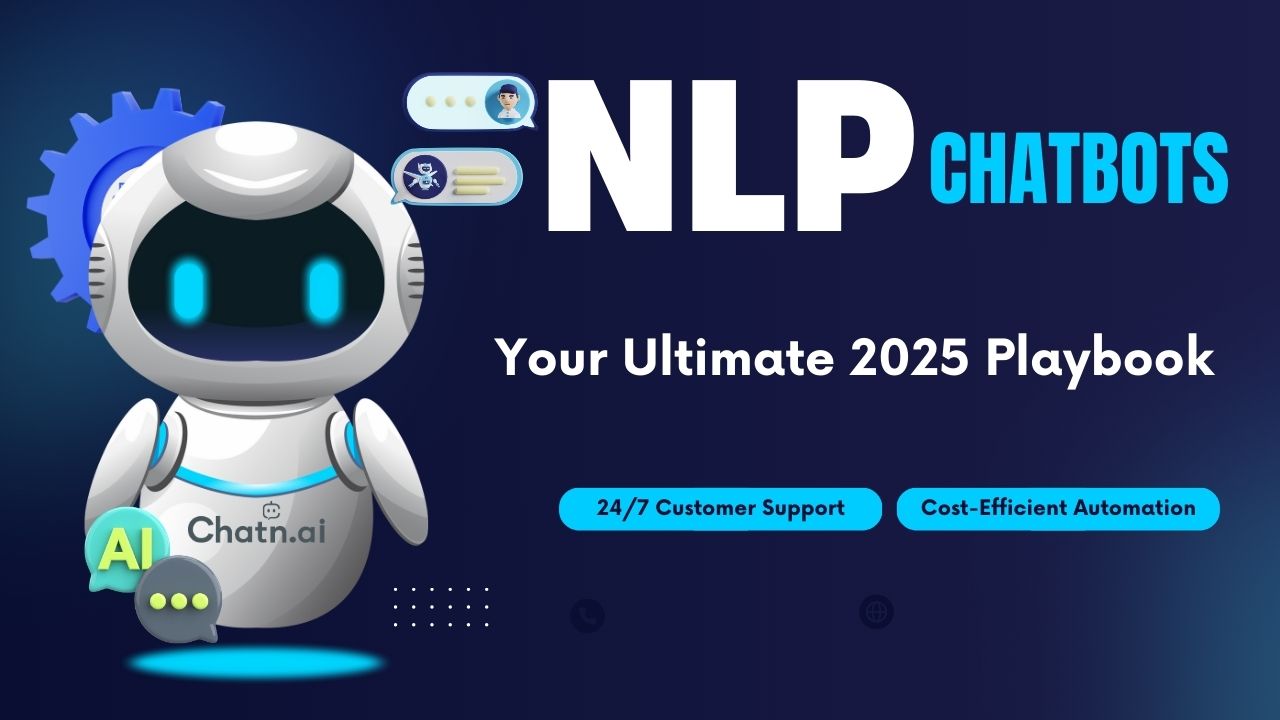
As we step into 2025, NLP chatbots are already reshaping the way businesses communicate. These advanced AI-driven tools have become faster, smarter, and more efficient, setting new standards for customer interactions and operational workflows. With only the first days of 2025 behind us, it’s clear that NLP chatbots are poised to dominate the landscape, offering unparalleled opportunities for businesses to enhance their service, engagement, and efficiency.
This playbook is your comprehensive guide to understanding and leveraging chatbots in this transformative year. Whether you’re new to the technology or looking to refine your existing strategies, we’ll walk you through everything you need to know to stay ahead of the curve in 2025. From understanding their capabilities to exploring practical applications and future trends, this guide equips you to make the most of chatbots as they continue to evolve and redefine the possibilities of human-machine interaction.
What Are NLP Chatbots?
NLP chatbots represent a breakthrough in conversational AI, using Natural Language Processing (NLP) to understand and respond to human language in a way that feels intuitive and natural. These chatbots go beyond the basic functionality of traditional chatbots, enabling businesses to deliver seamless, engaging, and personalized user experiences.
Understanding NLP Chatbots
These chatbots are powered by advanced algorithms that analyze and interpret text or speech, enabling them to grasp the intent, sentiment, and context behind user inputs. Unlike rule-based systems that follow rigid instructions, they can handle complex, nuanced language. They understand variations in phrasing, recognize slang, and even pick up on emotional cues, making interactions more fluid and human-like.
For example, when a customer asks, “Can you help me with an issue with my order?” an NLP chatbot doesn’t just focus on the keyword “order.” It understands the user’s intent—to resolve a problem—and might follow up with a contextual question, such as “What seems to be the issue with your order?” This capability significantly improves the user experience, reducing frustration and providing more meaningful assistance.
How NLP Chatbots Differ from Traditional Chatbots
Traditional chatbots operate on predefined scripts and decision trees. They follow a linear process where every possible interaction must be anticipated and programmed in advance. While effective for simple, repetitive tasks, they fall short in handling ambiguous or unexpected inputs. For instance, if a traditional chatbot is asked a question it wasn’t explicitly programmed to recognize, it might respond with a generic error message or fail to provide a meaningful response.
NLP chatbots, on the other hand, are powered by machine learning and AI models trained on vast datasets of human language. This allows them to:
- Adapt to User Input: NLP chatbots can understand variations in phrasing. For instance, whether a user says, “What’s the weather?” or “Tell me today’s forecast,” the bot provides the same relevant response.
- Interpret Intent and Context: Beyond recognizing words, NLP chatbots identify the intent behind them. If a user says, “I can’t find my delivery,” the chatbot understands that the user is likely seeking tracking assistance.
- Learn from Interactions: These bots continually improve by analyzing past conversations. Over time, they become better at predicting user needs and responding more effectively.
- Handle Complex Queries: By analyzing sentence structure, grammar, and context, NLP chatbots excel at answering multi-part questions and resolving intricate issues.
This adaptability makes these chatbots significantly more dynamic and capable than traditional chatbots. Instead of being confined to narrow, predetermined scenarios, they engage in more robust, meaningful conversations that meet the diverse and evolving needs of users.
The Rise of NLP Chatbots
As businesses increasingly prioritize customer experience, the demand for NLP chatbots is skyrocketing. Their ability to provide instant, contextually relevant support not only enhances user satisfaction but also drives operational efficiency. For organizations looking to stay competitive in 2025, integrating them is no longer optional—it’s essential.
By blending the capabilities of machine learning, artificial intelligence, and natural language understanding, NLP chatbots represent the future of automated communication, bridging the gap between human and machine interaction.
The Evolution of NLP Chatbots in 2025
NLP chatbots are evolving at an unprecedented pace, redefining how businesses interact with their customers. Fueled by groundbreaking advancements in artificial intelligence, these chatbots are becoming smarter, more intuitive, and increasingly indispensable for businesses striving to deliver exceptional customer experiences.
Advancements Driving NLP Chatbot Growth
In recent years, breakthroughs in AI and Natural Language Processing (NLP) have revolutionized chatbot capabilities. The rise of generative AI and advanced language models, such as GPT-based systems, has empowered NLP chatbots to deliver more human-like interactions.
These technologies enable chatbots to:
- Understand Nuance: Accurately interpret user intent, even when phrased in complex or ambiguous ways.
- Adapt Contextually: Provide meaningful, context-aware responses that adapt to the flow of the conversation.
- Deliver Real-Time Solutions: Process vast amounts of data instantaneously, ensuring users get quick and accurate answers.
For example, a user might ask a chatbot, “Can you help me figure out the best insurance plan for my family?” Modern NLP chatbots can analyze the context, understand the user’s requirements, and provide tailored recommendations—all within seconds.
Key Trends to Watch in 2025
As we move through 2025, several transformative trends are shaping the future of NLP chatbots:
Multilingual Capabilities for Global Reach
Businesses are expanding their reach by deploying NLP chatbots with multilingual support. These chatbots can seamlessly switch between languages, enabling companies to engage with diverse audiences without language barriers. This capability is particularly valuable for global enterprises looking to personalize interactions in different markets.
Hyper-Personalization to Enhance User Experience
Personalization has moved beyond addressing users by name. In 2025, NLP chatbots leverage advanced data analytics and AI to offer hyper-personalized experiences. They can recommend products, services, or solutions tailored to individual preferences, past behaviors, and even predicted needs, making every interaction feel uniquely relevant.
Emotional Intelligence for Deeper Engagement
Emotional intelligence is a game-changer for NLP chatbots. By analyzing tone, sentiment, and word choice, these chatbots can detect user emotions—such as frustration, excitement, or confusion—and adjust their responses accordingly. For instance, if a user expresses dissatisfaction, an emotionally intelligent chatbot can empathize and provide reassurances to de-escalate the situation.
Seamless Integration Across Platforms
In 2025, NLP chatbots are increasingly integrated into omnichannel ecosystems, allowing users to engage across multiple platforms—websites, social media, messaging apps, and voice assistants—without losing continuity. This seamless integration ensures a consistent and convenient user experience.
Greater Accessibility and Inclusivity
Advancements in NLP are also making chatbots more accessible. Features like voice recognition, text-to-speech, and support for diverse communication styles ensure that NLP chatbots can cater to users of all abilities, expanding their reach and impact.
Why These Trends Matter
The evolution of NLP chatbots is not just about technological innovation—it’s about meeting rising user expectations. Customers demand quick, accurate, and personalized interactions, and these trends ensure businesses can rise to the challenge.
By embracing these advancements, companies can build stronger relationships, improve operational efficiency, and maintain a competitive edge in an increasingly digital marketplace. In 2025, the evolution of NLP chatbots represents not just a technological shift but a fundamental transformation in how we connect and communicate.
Benefits of NLP Chatbots for Businesses
Why Businesses Need NLP Chatbots
NLP chatbots have become essential tools for businesses striving to enhance efficiency, improve customer experience, and stay competitive. Their ability to understand and process human language brings transformative advantages:
Enhanced Customer Service
With faster response times and 24/7 availability, NLP chatbots provide instant support to customers. They handle high volumes of queries simultaneously, ensuring no customer is left waiting. By offering personalized and context-aware solutions, these chatbots significantly boost customer satisfaction and loyalty.
Cost Efficiency
Automating routine and repetitive tasks, such as answering FAQs or processing basic requests, reduces the need for extensive human support. Businesses save on labor costs while maintaining high service quality. For instance, a single NLP chatbot can perform the work of multiple agents, optimizing resource allocation.
Improved User Experience
Unlike traditional scripted bots, NLP chatbots engage users in natural, conversational interactions. They adapt to individual preferences, ensuring each conversation feels intuitive and human-like. This seamless communication enhances user engagement and builds trust.
Real-World Applications of NLP Chatbots
NLP chatbots are making a tangible impact across diverse industries, delivering value in various contexts:
E-Commerce
In the fast-paced world of online retail, NLP chatbots assist customers with product recommendations, track orders, and handle returns. For example, an e-commerce leader reported a 30% reduction in support costs after deploying an NLP chatbot to manage customer queries efficiently.
Healthcare
From scheduling appointments to answering patient questions, NLP chatbots streamline administrative tasks in healthcare. They also provide reminders for medication adherence and offer preliminary triage for non-emergency conditions, improving accessibility to care.
Education
Educational institutions use NLP chatbots to provide personalized tutoring, answer student questions, and assist with enrollment processes. By adapting to individual learning styles, these chatbots enhance educational outcomes and reduce the burden on educators.
Financial Services
NLP chatbots in banking and finance help users check account balances, process transactions, and understand investment options. They ensure secure interactions while improving customer satisfaction through immediate assistance.
Travel and Hospitality
Travel companies use NLP chatbots to assist with booking tickets, providing real-time updates, and suggesting personalized travel itineraries. Hotels employ them to handle guest inquiries, making travel experiences smoother and more enjoyable.
Why These Benefits Matter
In an increasingly digital landscape, customers expect speed, personalization, and convenience. NLP chatbots deliver on all three fronts, making them indispensable for modern businesses. By adopting NLP chatbots, companies not only reduce costs but also foster stronger customer relationships, streamline operations, and gain a competitive edge.
The ability to deploy NLP chatbots across multiple platforms ensures businesses can engage with users wherever they are—whether on a website, messaging app, or voice assistant. This adaptability underscores why NLP chatbots are a must-have for businesses in 2025 and beyond.
How to Build and Implement NLP Chatbots
Getting Started with NLP Chatbots
Building an NLP chatbot begins with selecting the right platform and tools to ensure success. Platforms like Chatn.ai offer intuitive interfaces, pre-trained models, and flexible customization options, making it easier for businesses to create chatbots tailored to their needs. The right foundation ensures your chatbot is effective, scalable, and user-friendly.
Key Steps in NLP Chatbot Implementation
- Define Your Goals
Start by identifying the purpose of your chatbot. Is it for customer support, lead generation, or internal process automation? Clearly defining goals ensures that every feature aligns with your business objectives. - Choose the Right Technology
Select a platform that suits your technical expertise and requirements. Tools like Chatn.ai provide robust natural language processing capabilities and integrations with popular business systems, reducing development time. - Data Collection and Training
- Collect Diverse Datasets: NLP chatbots rely on large, high-quality datasets to understand and process language. Gather data that reflects the variety of questions and phrases users might employ.
- Train the Chatbot: Use this data to train your chatbot, teaching it to recognize intents, extract key information, and provide accurate responses. Include diverse scenarios to ensure the chatbot handles edge cases effectively.
- Design Conversational Flows
Create intuitive and user-friendly conversation paths. Map out potential user inputs and the chatbot’s responses to ensure smooth and logical interactions. Incorporate fallback mechanisms to handle unexpected inputs gracefully. - Testing and Deployment
- Rigorous Testing: Before launching, test the chatbot extensively to identify errors, measure accuracy, and refine usability. Conduct A/B testing to compare different interaction flows.
- Deploy Gradually: Roll out the chatbot in phases, starting with a smaller audience to monitor performance and gather feedback before scaling up.
- Monitoring and Optimization
- Analyze Performance: Use analytics tools to track key metrics, such as response accuracy, user satisfaction, and engagement rates.
- Iterate Based on Feedback: Regularly update the chatbot to address user concerns, enhance features, and improve overall functionality. Implement machine learning updates to refine its understanding over time.
- Integrate with Existing Systems
Link your chatbot to CRM systems, customer databases, or other tools to provide seamless service. For example, integrating with e-commerce platforms can enable features like personalized product recommendations or order tracking.
Pro Tips for Success
- Focus on User Experience: Prioritize simplicity and clarity in your chatbot’s interactions. Avoid overly technical jargon and ensure responses are easy to understand.
- Incorporate Multilingual Support: If your audience is global, enable your chatbot to handle multiple languages.
- Leverage Pre-Trained Models: Save development time by using pre-built NLP models that align with your industry needs.
- Ensure Security and Privacy: Protect user data with robust encryption and compliance with relevant data protection regulations.
By following these steps, businesses can create NLP chatbots that deliver value, engage users, and achieve strategic objectives. The combination of thoughtful design, ongoing optimization, and cutting-edge technology ensures your chatbot becomes a powerful asset for your organization.
Conclusion
NLP chatbots are no longer optional; they’re essential. Their ability to revolutionize communication and streamline operations makes them indispensable for businesses in 2025. By leveraging this technology, you can enhance customer satisfaction, reduce costs, and stay competitive.
Explore Chatn.ai’s NLP chatbot solutions to take your business to the next level. The future is here, and it’s powered by NLP chatbots.