
Introduction
Chatbots in healthcare are transforming how patients and providers interact. They deliver quick answers to simple questions, triage symptoms, schedule appointments, and send timely reminders. As a result, healthcare teams guide patients more efficiently, freeing time for complex cases.
Today, organizations deploy both rule-based bots for routine tasks and advanced LLM-powered assistants for more natural conversations. These tools integrate seamlessly with existing systems, ensuring uninterrupted access to care. Research shows growing interest, with promising results emerging across areas such as cancer biomarker monitoring.
In this guide, we explain how healthcare chatbots work, highlight their most valuable benefits, and address the key challenges providers face. We also outline practical steps to implement them safely, ensuring data security and clinical oversight. With the right strategy, healthcare providers can use chatbots to deliver effective solutions, improve patient experiences, and achieve measurable outcomes—making them an essential tool in modern healthcare.
What are healthcare chatbots?
The concept of healthcare chatbots is an innovative and programmed software that communicates with users via natural dialogue. They can direct patients, give health information, and simplify administrative work. These tools extend to something that seems as simple as a scripted symptom checker following a pre-determined pathway, all the way to sophisticated clinical assistants using an artificial intelligence approach capable of engaging in complex context-oriented conversations.
They are available on titles, mobile apps, SMS services, and even voice applications. Irrespective of the channel, they operate by identifying the intent of the user, controlling the dialog flow, and integrating with the healthcare systems using secure APIs. Robust security and compliance controls secure sensitive information. These chatbots can fill the gap between providers and patients by combining conversational AI. They speed up access to information, minimize waiting time, and provide a similar experience across interfaces, thereby enhancing both patient satisfaction and operational efficiency in the environment of modern healthcare.
Types of chatbots
- Rule-based: scripted flows for simple tasks.
- NLP/LLM-driven: natural conversations and context handling.
- Voice assistants: speech-to-text with clinical prompts.
Core components
- NLP/intent engine to parse queries.
- Dialog manager to map the next action.
- Integration layer for EHR and scheduling APIs.
- Security & governance for compliance and audit.
How healthcare chatbots work
Customers initiate a query by using either text, chat, or voice. The NLP engine evaluates the message, guesses the intent, and archaeologically mines any significant information floating through the message of the chatbot at lightning speed. On this basis, the chatbot triangulates the request using a specified set of workflows designed to meet the need.
Subsequently, the system can perform an API call to query medical records, insurance information, or retrieve slots in available appointments. After acquiring the required data, the chatbot can either address the user directly or refer the conversation to a human clinician, where necessary.
Seamless operation depends on integration. Best healthcare chatbots interface with EHR systems, schedules, and secure messaging systems to ensure that data streams are accurate. In addition, a human-in-the-loop design model enables safety since a clinician reviews identified flagged or high-risk cases to find a balance between automation and clinical decisions in patient care.
Top benefits
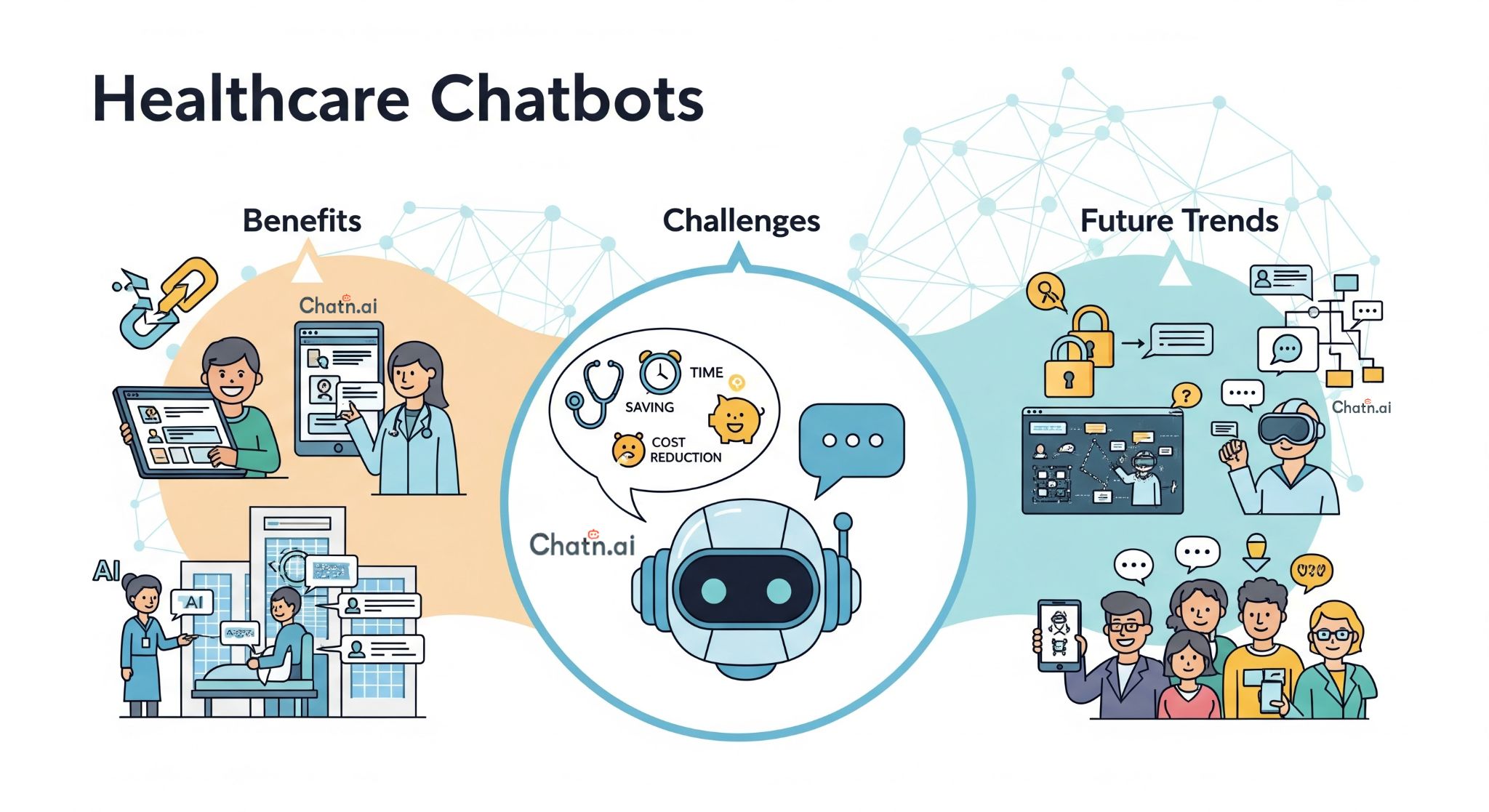
Healthcare chatbots deliver clear, measurable value.
Patient access and engagement
Healthcare chatbots enhance patient access and engagement through reliable 24/7 support. They allow patients to connect at their convenience—whether late at night, during weekends, or in busy clinic hours—without waiting for a live agent. This constant availability reduces wait times, removes scheduling barriers, and delivers quick responses to common questions about symptoms, medications, or appointments.
Chatbots guide patients through each step, whether scheduling visits, tracking symptoms, or accessing educational resources. As a result, patients become more informed and empowered to manage their health. This improved engagement often leads to stronger adherence to care plans and better provider relationships.
Moreover, chatbots address communication gaps by ensuring patients receive the information they need at any moment. By providing consistent, clear, and timely guidance, they help patients make confident health decisions while allowing providers to focus on complex cases that require their expertise.
Operational efficiency
Bots perform intake, scheduling, and follow-up.They reduce the burden of call-center traffic and release personnel. As a result, teams can work on more valuable clinical work.
Clinical support and adherence
Bots provide reminders and follow-ups for medication. They are automated to collect symptom logs and PROMs. This increases compliance and chronic management monitoring over time.
Cost and ROI
There is a workshop-specific pilot that measures cost per contact. Then teams prioritize the workflows with the highest impact. Chatbots reduce operational expenditure when implemented correctly.
(For best practice, always measure baseline metrics before launching.)

High-impact use cases (mini case vignettes)
Patient intake & triage
Problem: clinics face long intake queues.
Solution: a triage bot collects history and routes urgent cases.
Outcome: faster triage and fewer missed symptoms.
Medication adherence & chronic care
Problem: patients miss doses and appointments.
Solution: automated reminders plus short check-ins.
Outcome: better adherence and fewer complications.
Behavioral health support
Problem: demand for mental health care outstrips supply.
Solution: CBT-oriented conversational agents can offer early help.
Evidence shows improvements in mood and engagement in trials. mental.jmir.org
Post-discharge follow-up
Problem: readmissions rise after discharge.
Solution: bots check symptoms and escalate flagged issues.
Outcome: earlier interventions and lower readmission risk.
Provider workflow automation
Problem: clinicians spend time on admin tasks.
Solution: bots pre-fill intake fields and summarize patient replies.
Outcome: faster charting and fewer interruptions.
Implementation best practices
Start at a narrow place and step into the tape. Pick one workflow with well-defined KPIs.
Use a clinical CRO [or] sponsor, and have an IT partner. Define the human escalation path from day one. Beta, beta, test, test, assuming global release.
EA focuses on data-driven metrics and user feedback to iterate.
Checklist snapshot
- Define scope and KPIs.
- Validate clinical content with clinicians.
- Add consent and privacy prompts.
- Integrate with EHR via secure APIs. HealthIT.gov
- Log conversations and keep audit trails.
- Monitor for safety and bias.
Challenges & risks
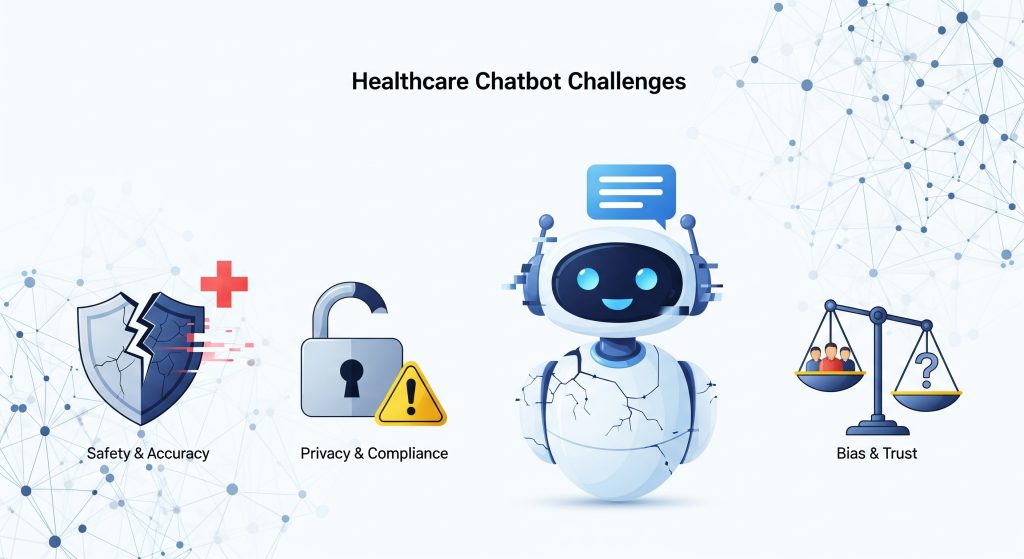
Chatbots generate a decisive advantage. Yet there are some risks. Plan for safety, privacy, and trust.
Safety and clinical accuracy
Unless validating the bot, they run the risk of misdiagnosis. Clinical supervision decreases that risk. Employ protection rails and a guarded triaging reason.
Privacy and compliance
Apps must meet HIPAA and local rules.
Be careful: not all apps fall under HIPAA automatically. HHS.gov
Therefore, evaluate data flows and business associate agreements.
Bias, transparency, and trust
Models can inherit biases from data.
Explain limitations and show clear fallback paths.
Transparency builds patient and clinician trust.
Adoption and clinician buy-in
Clinicians may resist change.
Involve them early and show measurable wins.
Training reduces friction and improves adoption.
Regulatory and privacy considerations
HIPAA and other laws apply in many contexts.
Still, some consumer apps may sit outside HIPAA scope. HHS.gov
Therefore, document where PHI flows and who touches it.
Use encryption, role-based access, and BAAs when needed.
Also track local regulations and guidance. HHS.gov
Measuring success and ROI
Define KPIs before launch.
Then measure continuously.
Key metrics to track:
- Call volume reduction.
- Time-to-first-response.
- Resolution rate without escalation.
- Escalation accuracy.
- Patient satisfaction (NPS).
- Readmission or visit reductions.
Use control groups for rigorous ROI estimates.
Report wins to stakeholders and iterate.
Future trends to watch
The field will evolve quickly.
- Multimodal bots: voice, text, and images together.
- Clinical LLMs with RAG: models that pull verified data.
- FHIR-native bots: easier EHR integration and data portability. HealthIT.gov
- Stronger governance: regulators will demand safety and transparency. HHS.gov
- Personalized patient profiles: bots that follow patients longitudinally.
These trends will shape procurement and product roadmaps.
Practical design checklist (one page)
- Narrow scope to a single workflow.
- Map data flows and PHI exposure.
- Secure APIs and use FHIR where possible.
- Add explicit consent and privacy notices.
- Build clinician escalation and sign-off.
- Monitor KPIs and user feedback.
- Update clinical rules regularly.
- Run external security and privacy audits.
Conclusion & CTA
Healthcare chatbots can improve access, reduce costs, and support clinicians.
Still, they need strong governance and clinical validation.
If you want a low-risk pilot, choose one workflow.
Then measure, iterate, and scale with clinician buy-in.
Ready to test a pilot?
Chatn.ai helps teams design HIPAA-aware chatbots with human fallback.
Request a demo or a pilot playbook to see measurable results.
FAQ (short answers optimized for snippet / schema)
Q: What are healthcare chatbots?
A: Software that uses conversation to support patients and clinicians.
Q: Are healthcare chatbots HIPAA compliant?
A: They can be. Compliance depends on data handling and contracts. HHS.gov
Q: Can chatbots replace clinicians?
A: No. They augment workflows and escalate when needed.
Q: How do chatbots integrate with EHRs?
A: Via secure APIs and standards like FHIR. HealthIT.gov
Q: What ROI should I expect?
A: Expect reduced call volume, faster intake, and staff time savings.
Q: How do I ensure clinical safety?
A: Use clinician review, conservative triage rules, and ongoing monitoring.
References (selected)
- Scoping review: Conversational Agents in Health Care (JMIR). PMC
- Woebot RCT: Delivering CBT to Young Adults via a Conversational Agent (JMIR). mental.jmir.org+1
- HHS guidance on sharing and using health data for AI. HHS.gov
- FHIR overview (HealthIT.gov). HealthIT.gov
- HHS/OHRP and ethics materials on AI governance. HHS.gov