


People often confuse customer success with customer support, but these two serve very different roles. Customer support solves problems as they happen, while customer success focuses on proactively driving results, loyalty, and long-term growth. This isn’t a surface-level distinction—it’s strategic. Failing to recognize it can lead to higher churn, lower adoption, and declining revenue.
In this blog, we break down the real difference between support and success. You’ll also discover why a success-first approach is essential for SaaS and digital-first businesses. More importantly, we’ll show you how to scale both functions with AI tools like Chatn.ai.
Whether you’re aiming to reduce churn, streamline onboarding, or boost customer lifetime value, understanding customer success gives you a clear edge. So, how do you turn happy users into loyal champions? Let’s explore the mindset, tools, and tactics that make the difference—because success isn’t just a goal; it’s a strategy.
What Is Customer Support?
Customer support plays a crucial role in any business. It’s the frontline team that responds when customers face issues—whether it’s logging in, billing errors, or product bugs. Unlike customer success, support is reactive, stepping in only after problems occur.
However, that doesn’t make it any less vital. Strong support makes customers feel heard, valued, and guided through challenges. It also serves as a direct communication link between your brand and your users. When done well, support resolves issues quickly, prevents escalation, and protects trust.
While it may not drive long-term growth on its own, it immediately boosts customer satisfaction. That’s why it remains a core part of the overall customer experience. When paired with a proactive success strategy, support helps build a strong, customer-centric foundation. Together, they create a powerful combination that not only solves problems but also nurtures long-term loyalty.
The Reactive Role of Support
Support teams exist to troubleshoot issues. They work to resolve tickets quickly and keep customers satisfied during stressful moments. While support is essential, it often signals a problem has already occurred.
Common Customer Support Metrics
Customer support teams usually track:
- First Response Time (FRT)
- Ticket Resolution Time
- Customer Satisfaction (CSAT)
- Ticket Volume
These metrics show how fast and effectively issues get resolved, but they don’t measure long-term customer health.
What Is Customer Success?
Customer support plays a vital role in any business. It’s the frontline team that responds when customers face issues like login errors, billing problems, or product bugs. Unlike customer success, support is reactive—it steps in only after problems occur.
Still, support remains essential. It makes customers feel heard, valued, and guided through difficulties. It also creates a direct line of communication between your brand and your users.
When done right, support quickly resolves issues, prevents escalation, and maintains trust. While it may not drive long-term growth, it delivers immediate customer satisfaction.
That’s why support is a key part of the overall customer experience. When combined with a proactive success strategy, it helps build a strong, customer-focused foundation. Together, support and success form a powerful team that solves problems and encourages loyalty.
A Growth-Focused Mindset
Success teams focus on long-term outcomes. They look at how customers use the product and provide tailored support before users experience pain.
Key Customer Success Metrics
Unlike support, success tracks:
- Net Revenue Retention (NRR)
- Churn Rate
- Customer Health Scores
- Adoption and Onboarding Rates
- Upsell and Expansion Revenue
These metrics reveal the true value customers receive and help prevent churn.
Customer Success vs. Customer Support: Side-by-Side Comparison
Feature | Customer Support | Customer Success |
Purpose | Fix problems | Drive outcomes |
Timing | Reactive | Proactive |
KPIs | CSAT, FRT, Tickets | NRR, Churn, Health |
Focus | Immediate issues | Long-term value |
Tools | Help desk, ticketing | CRM, playbooks, AI |
Example | Resolving login error | Coaching on product usage |
Support ensures satisfaction in the moment. Success builds lasting relationships.

Why This Distinction Matters in SaaS
The actual win in the SaaS world is not a one-time sale-it is retention. The model is also based on recurring revenue, hence retaining customers in the long term is where the actual growth occurs. You do not earn once; you earn every time you add value.
And this is why it is so important to grasp the distinction between customer support and customer success. Though the creation of support may resolve the problems, success will make the customers achieve their aims and remain ordinary. Another scenario is with the great product, the best pad did not guarantee success because of high churn and poor adoption without a success-based approach.
In addition, SaaS customers are used to getting value continuously and not in a transactional moment. By focusing on customer success, you create long-term relationships, and that means renewals, upsells, and advocacy. In this competitive world, it is those companies that invest in success that are fast-growing and strong.
Retention Is the New Growth
Support helps customers stay afloat. Success helps them thrive. SaaS businesses that prioritize customer success see:
- Higher retention rates
- Fewer support tickets
- More upsells and renewals
The Cost of Ignoring Success
Without customer success, new users struggle. They don’t realize the product’s value. Eventually, they churn. Support alone can’t stop that.
How AI Transforms Customer Success and Support
AI is the future of customer engagement. With Chatn.ai, teams can scale both success and support without sacrificing quality.
AI for Customer Support
AI bots instantly answer common questions, reducing wait times and freeing up agents. Smart routing sends complex cases to the right humans.
Benefits include:
- 24/7 availability
- Consistent support experience
- Lower resolution times
AI for Customer Success
AI can do more than support. With Chatn.ai, you can:
- Monitor customer behavior in real time
- Send proactive feature recommendations
- Trigger alerts for at-risk accounts
- Guide onboarding with interactive bots
These tools turn raw data into real-time action that drives success.

Real-World Example: Turning Support Into Success
A SaaS company used Chatn.ai to transform their support team. They added intelligent bots to answer Tier 1 tickets and build success journeys for onboarding.
Within 6 months:
- Support ticket volume dropped by 35%
- Onboarding completion rose by 60%
- Net Revenue Retention improved by 18%
The result? Happier customers and a team that could scale without hiring more staff.
Common Pitfalls to Avoid
Too many companies fall into the trap of equating support with success. Here are mistakes to watch for:
Mistake #1: Believing Great Support Is Enough
It is an urban myth: when your support team is Swedish in leisure speed, amicable, and practical, you’ve got it. Great support makes a big difference, but it is not sufficient to retain customers. Support is a response to already occurred problems. So what happens when you have users who do not quite get how to use your product? Or worse, what happens should they never achieve their expected outcomes?
Customer success comes in at that point. It acts in anticipation of problems–helping users, training functionality, and making sure they receive actual, ongoing utility. Otherwise, simply because of that active interaction, users can get lost or detached, no matter how responsive your support team is.
Finally, customers will not succeed with the best support, so churn is inevitable. When they are not achieving what they want, they will quit. Success teams make sure that they do it- and therein comes the loyalty.
Mistake #2: Siloed Teams
Another common mistake businesses make is isolating customer support and customer success teams. When these teams operate in silos, the customer experience suffers. Support handles short-term issues, while success focuses on long-term value. Without collaboration, key insights are lost.
For instance, support may notice recurring frustrations that success could address—if they’re aligned. Integrating these functions ensures a seamless experience. Shared data, tools, and workflows keep everyone on the same page.
Moreover, collaboration allows teams to align messaging, anticipate needs, and deliver consistent service. When support and success work together, every customer interaction becomes an opportunity to build loyalty and satisfaction.
Ultimately, aligning these teams isn’t optional—it’s essential for sustainable growth and a customer-centric approach.
Mistake #3: No Strategy for Retention
Many firms overlook long-term retention strategies and focus too heavily on support. When your main goal is just to resolve tickets, you remain reactive—and fall behind. Support fixes short-term issues, but doesn’t prevent customers from losing interest.
To stay competitive, you must act proactively. That means anticipating needs, spotting risks early, and guiding users through meaningful experiences. With the right tool—like Chatn.ai—you can automate retention, launch engagement campaigns, and monitor account health in real time.
Retention doesn’t happen by chance; it’s intentional. Companies that prioritize it build loyalty, reduce churn, and drive sustainable growth. Now is the time to stop reacting and start planning with purpose.
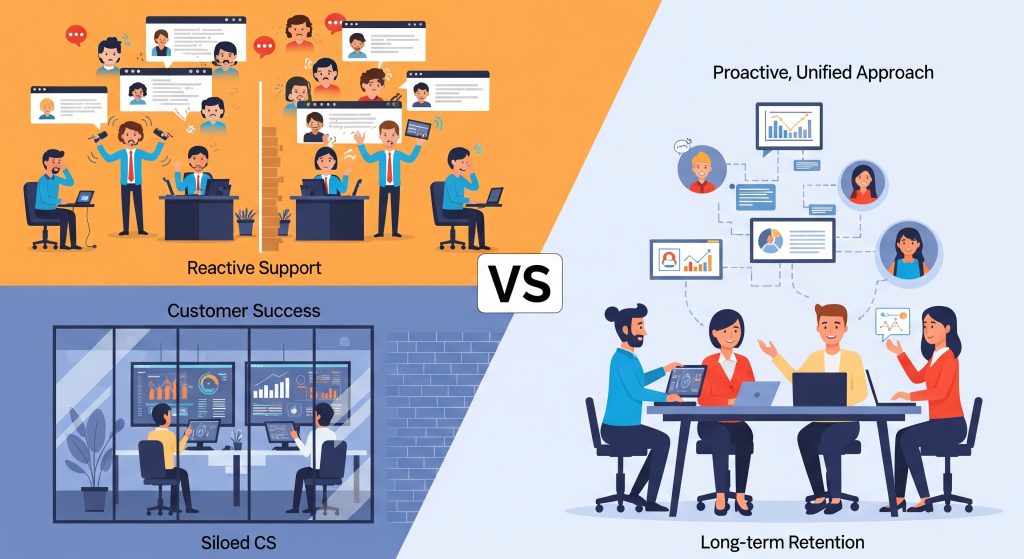
Unifying Support and Success with Chatn.ai
Chatn.ai enables businesses to provide reactive and proactive success at scale. Together with AI-powered bots, customer profiles embedded, and automated playbooks, teams are able to:
- Minimize burnout and manual labor
- Better satisfaction for the customers
- Achieve parallel results
It is not so much about this or that. It is making the balance between the two with intelligence and automation.
Conclusion: Invest in Success, Not Just Support
Support of customers is important. Nevertheless, customer success is a long-term indicator of whether your users will stick around and grow with you, or defect.
Support and success are not simply a matter of semantics. It’s strategic. Businesses that get this right are successful. The others who do not lag behind.
Using Chatn.ai, it is possible to create smart systems that scale support and success. You are able to reduce customer churn, increase revenue, and provide meaningful customer experiences.
Ready to Grow Smarter?
Turn your support desk into a success engine. Book a demo with Chatn.ai and start building intelligent, proactive journeys that retain and expand your customer base.