
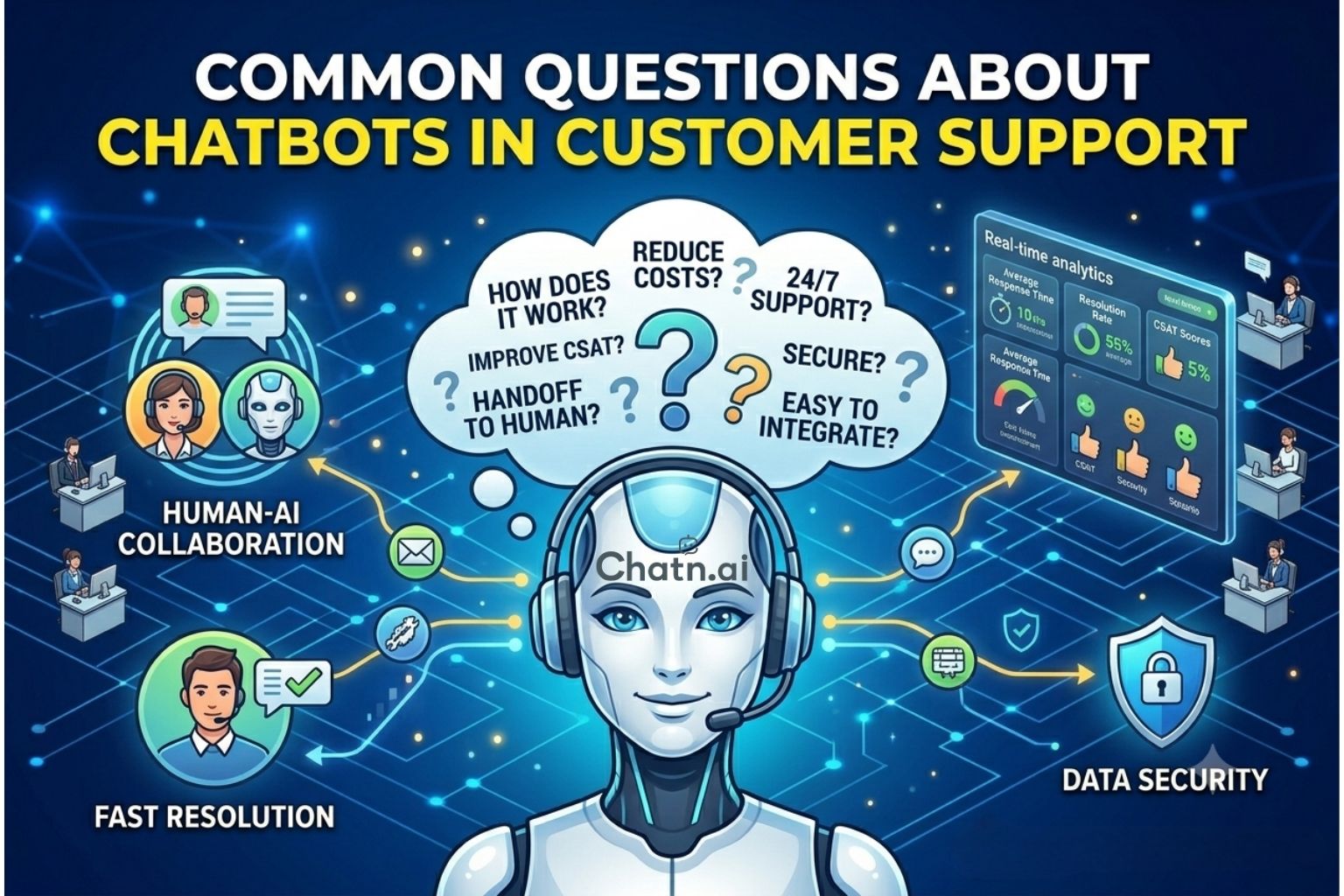
In today’s fast-moving digital economy, chatbots are no longer optional—they’re essential. However, for many organizations, the topic still raises several concerns. Businesses often ask common questions about chatbots in customer support and sales, such as how reliable they are, how they compare to live agents, or what kind of ROI they bring. The latter are matters of relevance because, in the case of ever-soaring customer expectations and increasingly shorter sales cycles, these questions are highly topical. To assist you in this dynamic environment, we have compiled a guide that addresses all the pressing issues. On the way, you will know how modern AI-driven Chatbots offered by Chatn.ai are changing how company deals with customers, speeding up sales and streamlining service processes. Whether you are new to the world of chatbots or considering improving an existing one, the book will provide you with a clear set of answers and practical experience that will enable you to make more informed choices.
Why Are Chatbots Becoming Essential in Customer Support and Sales?
The expectations of the customers are on the increasing scale. People are quick to demand answers, 24 hours a day, seven days a week. The tools that sales teams use must be up-to-date. This is when chatbots come in. They are quick, have high capacities, and offer service and sales support without any hassles.
The Shift to Instant Gratification in Customer Service
Nowadays, customers will not wait on hold or go seeking answers in the FAQs. They demand a response within seconds, not minutes. That is why chatbots are now important. Not requiring any breaks, they provide non-stop support, respond appropriately, and stop burdening live agents. Chatbots will help you maintain a quick, uniform, and enjoyable service experience, thanks to the essential nature of the questions and tasks they handle.
How Sales Teams Use AI Chatbots to Convert Leads Faster
Speed matters in sales. The faster you engage, the more likely you are to close the deal. AI chatbots assist by instantly greeting visitors, identifying their needs, and directing them to the proper resources. They spot actual buyers, get valuable information, and begin selling on the spot. When you are wasting less time on leads that are not qualified, your team can be dedicating more time to leads that do count; leads that matter.
Chatbots can be a lot more useful than reducing time or automating a routine. They enable them to offer better services, facilitate their work, and create a closer association with the clients.
Quick Response Time and Uptime availability
Waiting is the worst thing a customer can experience, and chatbots help them avoid waiting. It takes these digital assistants a few seconds to respond even during the busiest time. Since they work around the clock, they ensure help is always available—even during nights, weekends, and holidays.
Cost Savings vs. Traditional Support Teams
Hiring more staff isn’t always sustainable. Chatbots offer an efficient alternative that scales support without extra salaries. An effective bot accommodates hundreds of users simultaneously, lowering operational costs without compromising quality.
The Sales Lead Qualification and Routing
Sales reps do not need to spend much time on poor leads. Chatbots conduct preliminary interactions, ask probing questions, and eliminate users with low intent. They refer qualified buyers to the correct individual more quickly, which reduces the sales cycle and results in a high close rate.
Personalization at Scale with Conversational AI
Customers want to feel seen, not treated like a number. Chatbots can reference past interactions, tailor suggestions, and adapt their tone using stored data. This creates a personalized experience—without needing a human on the other end.—
How Do Chatbots Compare to Live Chat Agents?
Chatbots don’t replace humans—they enhance what your team can do. Think of them as your frontline helpers who clear the path for your agents to shine where it matters most.
Human vs. Bot: When to Use Each
Chatbots excel at tasks that require speed and repetition. They handle FAQs, track orders, and collect lead data efficiently. However, when circumstances dictate that they address them proactively with sensitivity or subtle judgment, as the system expects in the situation, there is still a need to use a human touch. The most innovative strategy is to seize the moment for change.
Hybrid Support Models (Human + AI)
With a hybrid model, you benefit from the advantages of each solution. The chatbots will become the primary point of entry, enabling lawyers to resolve minor issues in a matter of seconds. When the issue falls beyond their grasp, in such scenarios, they transfer the chat to a human where required and deliver speed without sacrificing the human touch. This will provide fast services without reducing care.
How Chatbots Reduce Agent Burnout
Chatbots reduce that pressure by discarding lower-level tickets and resolving more basic questions. This benefits human real agents to work on more valuable, high-impact tasks. This makes teams more energized, engaged, and effective.
Are Chatbots Hard to Implement or Integrate?
Not anymore. With the development of no-code tools and built-in connectors, launching chatbots is now more convenient than ever.
Low-code platforms vs. Built solutions
The game has changed with the no-code chatbot builders. They enable any team to develop and deploy full-featured bots even with no coding experience. These tools offer templates, drag-and-drop flows, and AI training possibilities. At the same time, custom-made bots provide comprehensive customization. They are more controlling and take longer to complete.
Integration with CRMs, Ticketing, and eCommerce
Contemporary chatbots do not require full system reconstruction. They are adaptable to popular platforms such as Salesforce, Zendesk, Shopify, and HubSpot. Support ticket or online stores, it takes just a few clicks to connect your bot with the rest of your existing tools and workflows.
Deployment Process and Schedule
It is easy to set up. The majority of businesses can start their first chatbot within a week. The first thing to do is to decide which platform to use. Then, design the conversation flow, thoroughly test it, and connect it to your channels. Finally, hit deploy and monitor its performance—no technical team required.—
How Do Chatbots Actually Work?
Human vs. Bot: When to Use Each
Chatbots excel at tasks that require speed and repetition. They handle FAQs, track orders, and collect lead data efficiently. However, when the situation calls for empathy or nuanced decision-making, a human touch is still essential. The most innovative approach is knowing when to switch.
Hybrid Support Models (Human + AI)
A hybrid model gives you the best of both worlds. Chatbots act as the first point of contact, resolving simple cases instantly. If the issue is beyond their scope, they seamlessly escalate the conversation to a human agent. This ensures fast service without compromising on care.
How Chatbots Reduce Agent Burnout
Support agents often feel overwhelmed by volume. Chatbots ease that pressure by filtering out low-level tickets and answering routine questions. This lets human agents focus on more meaningful, high-impact work. As a result, teams feel more energized, engaged, and effective.—

Can Chatbots Really Handle Sales Conversations?
Absolutely! AI chatbots are fast becoming indispensable digital sales assistants. They don’t just chat—they guide, recommend, and convert in real time.
Use Cases in B2B and B2C Sales Funnels
In both B2B and B2C surroundings, chatbots play essential roles at numerous touchpoints. They welcome visitors, qualify them, and guide them through the funnel. Chatbots can track intent and automate follow-ups, speeding up the entire sales process and making it less challenging.
Booking Demos, Answering Objections, and Upselling
Chatbots today are capable of performing more than just answering simple questions. They help customers book a product demo, overcome objections, and suggest appropriate upgrades or add-on services. These measures increase the size of deals while also enhancing the level of engagement.
How to Script High-Converting Sales Bots
To convert effectively, sales bots need a strategy. Speak in a clear language, helpful and persuasive. Aim qualifying questions at the start, customize replies based on user input, and include a powerful call to action. The tone you use should be friendly yet provide direction to the discussion, just like a guide.
What Are the Limitations of Chatbots?
Chatbots are useful technologies, yet they are not perfect. They excel in many areas; nevertheless, there are also spheres where a human touch is still required.
Averting the Uncanny Valley Effect
Chatbots sometimes feel uncomfortable when they attempt to simulate user behavior too closely to that of a human. Customers can detect that something is wrong with a response. The most effective strategy is to make chats with the chatbots informative, objective, and natural. A friendly and professional tone works best—it builds trust without appearing overly formal.
When to Hand Off to a Human
Some issues need a human touch. For example, emotionally sensitive topics or complex product issues often exceed the capabilities of bots. Cutting-edge systems are alert enough to take a conversation to the next level. Providing a choice to talk to someone demonstrates the values of your brand, which include sensitivity and genuine support.
Difficulties involved in Complex Queries and Emotion Tone
AI has advanced significantly, yet it remains challenging to discern emotions, particularly in cases where there is little to no emotion or highly technical issues. Bots will misinterpret tone or fail to grasp the context. This is the reason why human agents are still necessary in circumstances that require judgment or discretion. This equilibrium ensures the best experience for all customers, allowing them to receive what they need.
Support ticket Deflection Rate
Chatbots can take up to 80 percent of even a typical support request. That would imply fewer tickets for your live agents and a quicker solution to problems for your customers. Bots can relieve support teams of daily routine tasks, ensuring that operations become smoother without requiring an expansion of staff size.
TTR and CSAT Performance
Satisfaction is increased when customers receive immediate answers. Chatbots significantly reduce time-to-resolution by responding immediately. By reducing the amount of waiting time, the scores of the CSAT tend to increase due to the rapidity and uniformity that chatbots introduce to each interaction.
Conversion Rate Uplift and Revenue Attribute
Sales bots not only assist them; they sell. By and large, they are likely to improve conversion rates by 10 to 30 percent by influencing the buying decision and converting leads in real-time. Attribution tracking is also popular on many chatbot platforms, making it simple to track the immediate effect on revenue and growth in pipelines.
What Should You Look for in a Chatbot Platform?
Choosing the right chatbot platform isn’t just about features—it’s about finding the right fit for your team, your goals, and your customers.
Essential Features to Look For
The foundation of a smart chatbot starts with solid capabilities. Look for natural language processing (NLP), rich analytics, full conversation history, and integration with your existing tools. The ability to support multiple languages is also a key benefit—especially if your customer base is global. These features ensure your bot isn’t just responsive, but truly useful.
Customization, Reporting, and Omnichannel Support
Your brand has a unique voice, and your chatbot should reflect that. Look for platforms that allow tone and personality customization. Also, make sure you get access to detailed reporting so you can track performance and make informed adjustments. Omnichannel capabilities are equally important—your bot should work consistently across websites, mobile apps, and messaging platforms like WhatsApp or Facebook Messenger.
Why Chatn.ai Delivers Smarter Conversations at Scale
Chatn.ai blends advanced AI with user-friendly design so you can build and scale smarter bots fast. Our platform includes real-time analytics, drag-and-drop workflows, NLP out of the box, and seamless integrations with CRMs, eCommerce tools, and support platforms. With Chatn.ai, businesses get the speed of automation and the intelligence of AI—without losing the human touch.—

Real-World FAQ: Fast Answers to Top Chatbot Concerns
Let’s rapid-fire through some common worries and give clear, honest answers backed by real-world insights.
Will Chatbots Replace Humans?
No, they won’t. Chatbots are designed to handle routine work, freeing up humans for more meaningful tasks. When bots manage simple interactions, agents can focus on cases that require empathy, critical thinking, or personal touch—creating a more balanced and efficient support experience.
Are They Secure?
Yes—if security is prioritized during development. Platforms like Chatn.ai follow industry best practices. We encrypt all conversations and user data while maintaining strict access controls. With regular updates and compliance monitoring, your information stays protected from day one.
What’s the Best Industry Use Case?
Chatbots aren’t just for tech companies. They thrive in industries with high customer interaction like e-commerce, SaaS, healthcare, and finance. Whether it’s answering questions, booking appointments, or assisting with purchases, bots provide real value across diverse business models.
How Long Does It Take to See Results?
Most companies start seeing measurable improvements within 30 days of deployment. Faster response times, reduced support costs, and increased engagement often happen early on. With regular optimization, performance continues to improve, especially in conversion and satisfaction metrics.—
Final Thoughts: Are You Ready to Use Chatbots to Scale Support and Sales?
The digital landscape is evolving fast, and customer expectations are rising just as quickly. Instant replies, helpful service, and seamless experiences are no longer optional—they’re expected. Chatbots make it possible to meet these expectations without overburdening your team or inflating costs.
With a well-built chatbot, you can provide fast answers, qualify leads, and maintain round-the-clock availability. This means happier customers, more efficient support teams, and greater sales opportunities. And you don’t need to be a tech expert to make it happen—modern platforms simplify every step.
Whether you’re aiming to streamline support or close more deals, the path forward is clear. Embracing AI-powered chatbots isn’t just about automation—it’s about staying competitive, scalable, and human at the same time.
Whether you’re trying to reduce costs, increase efficiency, or drive more conversions, chatbots offer a clear path forward. The key is choosing a smart, flexible platform that makes the journey easy.
Ready to See a Chatbot in Action?
Book a free demo with Chatn.ai and experience firsthand how our AI-powered bots simplify support, drive conversions, and create human-like experiences at scale—without the overhead or delays.