

The modern business world is dynamic, and customer demands are ever-increasing. Therefore, clients desire immediate 24/7 responses with no more long holds or unresponsive responses. Meanwhile, the support staff cannot keep up with the volume of tickets and still provide quality service. Recruiting additional agents, however, is expensive and unviable. Automated customer support comes in at this point. Through it, businesses can provide quick, secure service, save on operational expenses, and increase customer satisfaction by executing it strategically. Besides, automated customer service enables teams to expand effortlessly as demand increases. This guide will discuss the concept of automated customer support, how it operates, and how to make it a working solution while maintaining the human touch that gives customer interactions real meaning.
What Is Automated Customer Support?
Automated customer support involves the active processing of customer inquiries, tasks, and requests by AI-based systems without the need to involve a human operator. With the new generation of automation, the system not only extracts intent but also understands context and urgency, unlike old-fashioned scripts or a fixed list of frequently asked questions. Consequently, it will be able to resolve problems as they arise and only escalate when it is imperative to provide customers with prompt, relevant service. Also, by leveraging intelligent decision-making and streamlined workflows, automated customer service enables businesses to enhance efficiency while delivering high-quality service.
Automated Support vs Traditional Customer Service
Traditional support relies solely on human availability, which often leads to delays and inconsistent responses. On the other hand, automated customer support is available 24/7 across various platforms, ensuring that staff can attend to customers as soon as possible. It also goes a long way toward reducing wait time and response errors. Meanwhile, automated systems free human agents to focus on complex or high-value issues that require personal attention. Furthermore, automation has consistently delivered precise and reliable answers to queries, enhancing the overall customer experience. Automated customer support, when used to augment human teams rather than replace them, not only improves service efficiency but also customer satisfaction and loyalty.
Why Automated Customer Support Is No Longer Optional
Companies are experiencing a surge in support levels and escalating expenditure pressures. Meanwhile, customer expectations are as high as ever, and the slightest delay may destroy loyalty and trust. Automation has therefore ceased to be a luxury and become a necessity to provide scalable, sustainable services.
- Increasing Customer Expectations.
- Customers now demand: Real-time answers to their queries and issues.
- Round-the-clock availability in the various channels.
In most cases, the information is correct and consistent. When businesses do not live up to these expectations, frustration will escalate quickly, and churn will rise. Luckily, automated customer support can resolve these issues by providing fast, reliable, and scalable services, freeing human agents to focus on complex or sensitive issues.
Pressure on Support Teams Cost
Traditional support costs rise with every additional agent, and the overheads of training, turnover, and scaling add up to extra expenditures. Automated customer support systems, on the other hand, are effective for repetitive processes, and human agents greatly benefit from reduced workloads. As a result, teams can prioritize high-value interactions, solve complex problems, and provide personalized customer care without increasing the number of heads or operational expenses. Automated customer support costs less because it streamlines routine activities and improves overall service quality.
The current working of Automated Customer Support
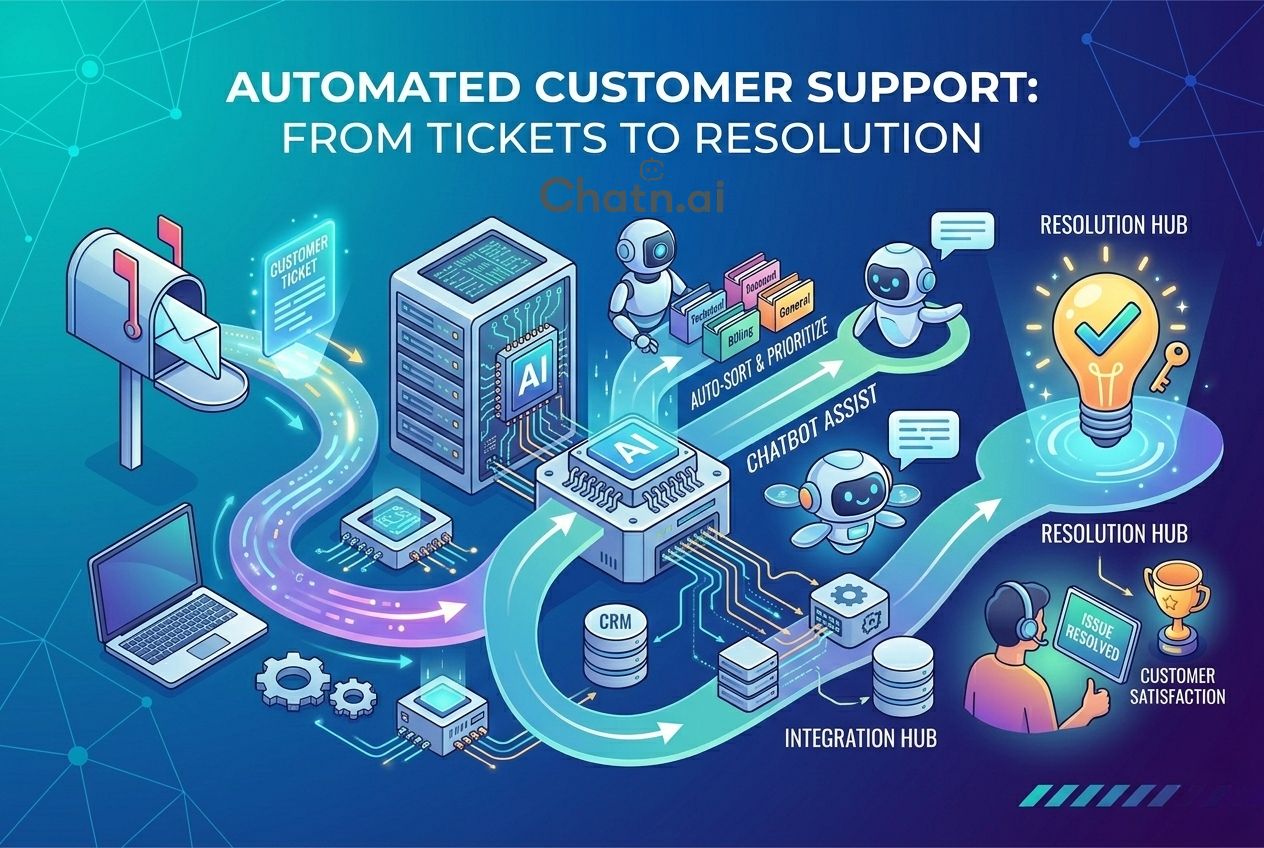
The current level of automated customer service systems is far beyond a simple chatbot. They integrate machine learning, natural language processing (NLP), and workflow automation to address problems throughout the process. In this way, these systems answer common questions and promptly route more complex issues to the appropriate human agent.
Basic Building Blocks of Automated Support
Efficient automated customer care consists of several elements:
- AI chatbots and virtual agents: Proactively respond to questions, provide recommendations, and chat in real-time.
- Knowledge base automation: Rapidly obtains the best information without involving a human operator.
- Ticket routing and prioritization: Forwards complex or urgent matters to the appropriate human agents.
- CRM and system integrations: Provide informed, contextual, and accurate interactions across multiple platforms.
All these elements enable businesses to provide rapid, reliable, and scalable support and to optimize human agent productivity.
Benefits of Automated Customer Support for Businesses
Automation provides measurable benefits that impact cost, service quality, and scalability.
Faster Response Times
In automated customer care, systems can reply to customers in real time, so customers are served immediately. Consequently, customers do not have to wait to be served by human agents, which significantly reduces frustration. Besides, immediate reactions lead to higher satisfaction, greater trust, and greater customer satisfaction. Automated customer service can help businesses remain loyal to customers and build long-term relationships by resolving problems immediately they occur.
Lower Support Costs
Automated customer support systems ease the burden on human agents by processing repetitive tickets. As a result, companies will be able to reduce the number of employees required to make routine inquiries without eliminating the quality of service provided. Moreover, this has reduced manual work, thereby lowering operational costs, allowing firms to invest in more complex matters and strategic processes. In general, automated customer service not only reduces costs but also enhances the team’s service productivity and consistency.
Through steady Customer Experiences
Automated customer care also provides brand consistency and reliability by delivering the same correct response at all times. In addition, it avoids human error and eliminates conflicting information that could confuse customers. Businesses present a consistent voice, which builds trust and improves customer satisfaction. Lastly, automation enables companies to offer reliable experiences that foster loyalty and ensure long-term growth.
Expandable Growth free of anarchy
Automated customer service can efficiently serve customers, reducing the need to recruit additional employees to meet increasing demand. Consequently, support operations increase with customer count rather than staffing, enabling the groups to deliver quality even at peak times. In addition, automation keeps processes organized and consistent, preventing chaos as the business grows. By doing so, companies will expand with confidence and deliver consistent, uninterrupted customer experiences.

Where Automated Customer Support Falls Short (And How to Get It Right)
- Poorly implemented automated customer support, one that has not been appropriately strategized or overseen by humans, can fail, and more often than not, frustrate customers and dent brand trust.
- Over-Automation Risks
- Poorly trained bots deliver incorrect answers, leaving customers confused or dissatisfied.
- Without an effective escalation route, users can feel abandoned when problems are complex.
- Inconsistent communication can disconnect customers from the brand, reducing loyalty and engagement.
- Eventually, over-automation, without thoughtful planning, diminishes the benefits of automated customer support. It is essential to note that integrating AI efficiency with human judgment will make escalations seamless and ensure continuous positive experiences.
The Human-in-the-Loop
The most effective self-service systems incorporate AI efficiency and human oversight to deliver effective solutions. Specifically, these systems should allow AI to address routine complaints and simultaneously refer complex and controversial issues to human operators. Doing this will ensure successful handoff and successful cultivation and maintenance of a positive client connection with each interaction. The system allows firms to maximize efficiency and client satisfaction through AI efficiency and human insight.
Use Cases for Automated Customer Service That Really Work:
The best use of automated customer service is in predictable high-volume situations. One area where such automation is highly effective is in routine tasks, where it saves human resources and time.
Typical High-Impact Usage Examples
- Order Status and Updates: Provide customers with real-time updates.
- Account management and password reset: Enable customers to manage their accounts and reset their passwords.
- Billing inquiries: Handling common payments or billing queries effectively.
- Product FAQs and tutorials: Provide accurate responses and tutorials on product-related FAQs.
By focusing on repetitive tasks, companies have freed up human resources to engage in more sophisticated, relationship-building transactions. Through this, customer service teams can focus on more complex problems, build customer relationships, and retain high levels of customer satisfaction while still optimizing customer support efficiency.
How to Implement Automated Customer Support Successfully
Automation is not just about software—it’s a strategic process.
Step 1: Identify Repetitive Support Work
The initial step in successfully incorporating automation into customer service is thoroughly analyzing previous tickets and conversations. Companies can use this to identify frequently asked questions and repetitive tasks that consume agents’ valuable time. Moreover, companies can prioritize what to implement first to maximize AI’s impact on productivity and customer satisfaction.
Step 2: Defining Clear Automation Boundaries
Further, the business’s needs should be outlined to avoid confusion between the roles of humans and AI. In this manner, customer service via AI can run smoothly, preventing consumers from becoming frustrated. In addition, knowing the scope of the tasks can prevent mistakes, as it ensures the complex concerns of the customer reach the correct human customer service representative.
Step 3: Integrate With Existing Systems
After setting boundaries, companies need to integrate automated customer service systems into their systems, such as CRM tools, help desks, and company databases. The rationale is to provide AI with accurate data so it can produce relevant information in response to customer inquiries. On this note, it is essential to acknowledge that by integrating your systems with AI, automated customer services will perform their duties with utmost efficiency while still maintaining accuracy.
Step 4: Measure and Optimize Continuously
Finally, organizations need to monitor certain key factors such as resolution rates, CSAT scores, and escalation trends. Analyzing this information helps teams identify trends where self-service AI customer support excels and areas that need optimization or improvement. Moreover, such enhancements to refine AI workflows mean the system itself will continue to improve, accurately responding to an increasing number of customer inquiries at an optimal level without unnecessary escalations.

Why AI-Powered Automation Outperforms Basic Support Bots
Rule-based bots fail when conversations vary. AI adapts, learns, and improves over time.
Context Awareness
One of the significant benefits of AI-powered automated customer support is its ability to understand customer intent and recall previous conversations and customer interactions. Because of this, it can provide highly personalized and relevant responses in real time. Also, automated customer support services can provide a seamless customer experience by maintaining a certain level of context during conversations, resulting in strengthened relationships and improved efficiency.
Continuous Learning
Machine learning allows for improvements in the functionality of automated customer support tools. Analyzing data improves the AI system’s ability to handle a wide range of questions. Additionally, machine learning minimizes errors and adapts to shifting customer behavior. This results in a more specific interaction. A business can achieve this by utilizing machine learning. Applying machine learning also increases efficiency and customer satisfaction.
Personalization at Scale
Based on customer context, history, and intent, automated customer service enables personalized replies for each customer. In this way, each customer feels targeted not only by the timing of the interaction but also by each interaction on its own merit. Furthermore, it enables businesses to create customer experiences equal to those provided by human customer service without necessarily compromising speed.
The Future of Automated Customer Support
Automation is evolving from reactive problem-solving to proactive, predictive service.
Proactive Assistance
Automated customer support services enable AI systems to predict problems before customers experience them. Consequently, companies can address issues before they cause interruptions. Additionally, this AI approach not only improves customer satisfaction but also helps reduce customer effort and frustration caused by problems. Automated customer support services enable companies to address issues before customers experience interruptions.
Hyper-Focused Personal
With automated customer service, each interaction is dynamically adjusted based on each customer’s past, preferences, and behavior. Furthermore, with automated customer service, customer service becomes seamless, relevant, and highly intuitive. Also, automated customer service personalization reduces friction, speeds resolution times, and enhances customer relationships. Therefore, with automated customer service, businesses can provide high-quality experiences with a personal touch.
Deeper Business Integration
Over time, businesses will fully integrate automated customer support with revenue, retention, and overall business strategies, rather than treating it as a separate function. Support information will then contribute to business insights, and there will be opportunities for business growth, and the value of the customer lifetime will improve. In addition, businesses will synchronize customer service with their operations, and efficiency and success will be achieved through automated customer support.

Conclusion
Providing customers with automation-powered support is no longer a choice; it is now a necessity that safeguards staff, optimizes the customer experience, and supports sustainable growth. Automated customer support not only helps companies cut operational costs but also provides reliable answers to customers, making it easier for them to be satisfied. Moreover, companies that fail to adopt the technology will be at a loss compared to their rivals, making it difficult for them to reap the benefits of optimized customer relationships. The future is therefore in the hands of companies that optimize AI-powered efficiency with a human emotional approach. Your company can become smarter, faster, and more sustainable by leveraging the benefits of automated customers.