
The healthcare sector produces significant amounts of patient data each day. Hospitalizations, evaluations, physician orders, nursing records, and care plans all add to this volume. Without proper storage, analysis, and timely action, this information has limited value. Many healthcare organizations face challenges with inefficient information management, particularly as patient volumes increase. Consequently, nurses and physicians often spend more time searching for data than delivering care, which raises administrative costs and delays decisions. AI Retention addresses these issues by securely storing, managing, and analyzing information, giving healthcare workers timely access to essential data. This enables informed decision-making, effective collaboration, improved continuity of care, and reduced manual tasks in SNFs, hospitals, and rehabilitation centers.
What Is AI Retention?
AI Retention is the concept of intelligent information retention and use in healthcare. In contrast to typical information storage, AI analyzes the relationships among data and changes in it, providing healthcare professionals with relevant information when necessary. In this way, rather than leaving important information buried within the electronic health record, AI helps to turn it into useful information, both past and current. As a result, healthcare workers are spending more time providing better care for their patients and less time looking for the needed information. Moreover, thanks to AI Retention, healthcare professionals have the necessary information well organized and available whenever needed to take action on behalf of their patients.
AI Retention is More Than Data Storage
Many healthcare facilities believe that information retention involves only storing electronic records. Even though it does remain an important aspect, it is still only a single step in proper information management. In contrast to this idea, AI Retention turns saved information into continuous intelligence about a patient instead of mere archives. Instead of having physicians search for the necessary information themselves, AI will analyze, identify connections, detect patterns, and pinpoint the information that warrants special attention. This will allow clinicians to better understand the patient and avoid wasting time searching through various systems and records. Thus, they will be able to provide better care to their patients.
Process of AI Retention
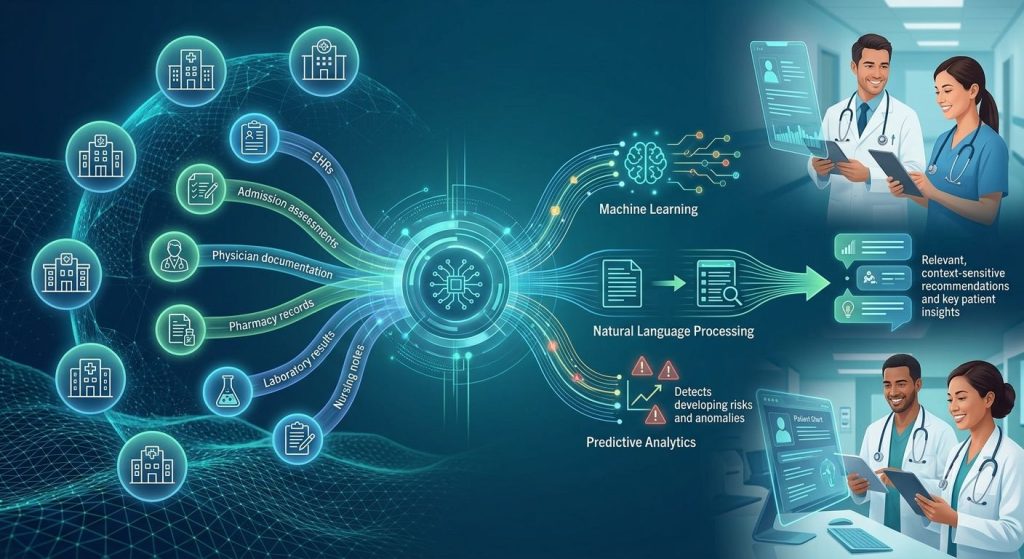
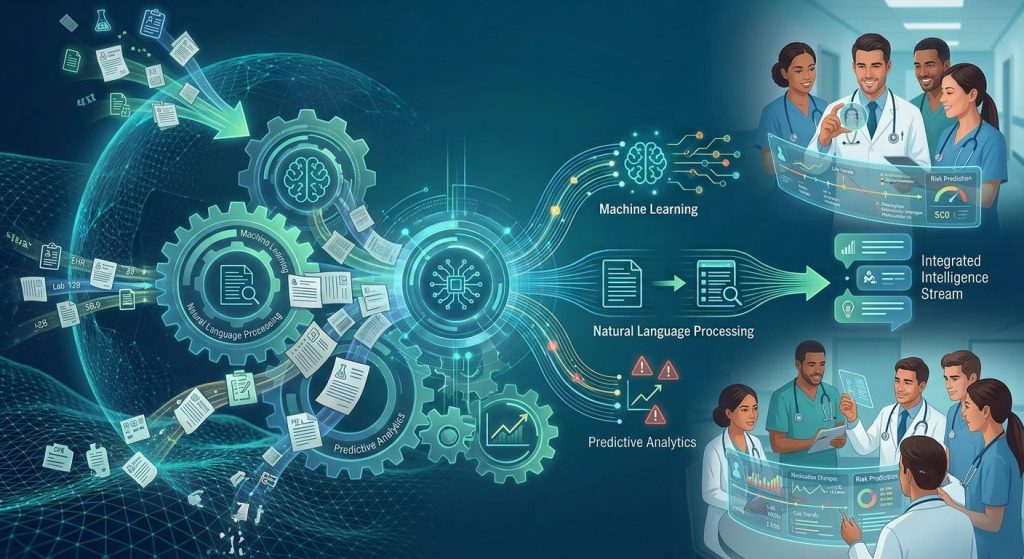
AI Retention is a combination of technologies that work together continuously and intelligently. First, AI technology collects information from various healthcare organizations, including electronic medical records, admission assessment reports, physician documentation, pharmacy records, laboratory test results, and nursing documentation. Furthermore, machine learning helps analyze collected information and uncover relationships and insights to better understand the situation. Also, natural language processing helps interpret unstructured clinical documentation, making narrative notes searchable, organized, and usable. Further, predictive analytics identifies developing risks, anomalies, and gaps before they become clinical issues. The final step is the delivery of recommendations for healthcare specialists within the context of their workflow. Intelligent automation helps deliver the necessary information without disrupting specialists’ routines, and they only need to be provided with it. As a result, healthcare providers work more efficiently and can make better decisions based on the information they receive.
Why Traditional Information Retention Falls Short?
Modern healthcare generates increasing amounts of data, but many organizations continue to rely on outdated processes. Patient information is often stored in separate systems and formats, forcing clinicians to switch between applications. This makes it difficult to locate critical clinical data, increases documentation time, creates communication barriers between departments, and delays the identification of important trends. Traditional information retention also fails to capture the expertise of experienced staff, as decision-making processes are often undocumented. This leaves future caregivers without essential knowledge. AI Retention addresses these challenges by preserving both organizational knowledge and patient information, enabling the company to learn from its collective experience.
Why Modern Healthcare Needs AI Retention
Healthcare organizations face many challenges from multiple directions. Given the growing patient population, the increasing complexity of clinical documentation, and elevated regulatory requirements, healthcare professionals face more challenging situations than ever before. Besides, due to a lack of professionals, they have to do more work than usual. This means there is a need to use modern technologies effectively to solve these problems. Thanks to AI Retention, healthcare organizations can shift their approach from reactive documentation to proactive clinical intelligence. Instead of solving problems reactively, they will be able to identify early warning signs of changes in patients’ condition and the associated risks.
What Makes AI Retention Important for Modern Healthcare Organizations? Healthcare organizations face many challenges from multiple directions. Given the growing patient population, the increasing complexity of clinical documentation, and elevated regulatory requirements, healthcare professionals face more challenging situations than ever before. Besides, due to a lack of professionals, they have to do more work than usual. This means there is a need to use modern technologies effectively to solve these problems.
Clinical Information Is Growing Faster Than Humans Can Process
During every patient encounter, there is always new documentation. For instance, doctors, nurses, and other healthcare workers conduct admission assessments, medication administration records, progress notes, therapy documentation, discharge planning, care coordination, and many other types of clinical documentation. In turn, the volume of clinical information grows rapidly. With time, these ever-growing records become hard for a human eye to process. It is simply impossible to evaluate a large amount of documentation on a daily basis. Luckily, AI Retention solves this problem by continuously analyzing incoming information in real time. Instead of having humans sift through all the information and find patterns, the system analyzes clinical data in the background and brings the most valuable insights to healthcare providers’ attention. As a result, healthcare workers receive well-organized, prioritized information rather than just large chunks of data.

Continuity of Care Depends on Accessible Knowledge
Many medical professionals participate in patient treatment at each stage of the process. It can be a physician, nurse, therapist, care coordinator, specialist, etc., all of whom have something useful to add in terms of observations and expertise. Combining all this information gives an understanding of what is going on with the patient. At the same time, fragmented documentation makes cooperation impossible when information is scattered across various systems. Therefore, doctors will not be able to get full information about the patient’s condition when making clinical decisions. In this way, AI Retention solves the problem not by keeping fragmented records, but by building a connected story about the patient. Besides, each new contact is built on previously documented information. Thus, each caregiver receives information about the patient’s condition and history.
Manual Documentation Cannot Support Real-Time Decision-Making
Clinical staff have to make hundreds of decisions on their shifts. Not only that, but many of the decisions that need to be taken require information that is documented at some earlier point in time – either a few hours ago or a few days back. Regrettably, manually checking large volumes of documentation not only takes time away from the actual task of providing care but also consumes the limited time spent searching through various documents.
Fortunately, AI Retention helps healthcare providers make decisions using available information without wasting time manually checking documentation. Intelligent systems can document all the clinical information based on its importance and context. Thus, healthcare professionals not only save time otherwise spent searching for records but also provide better care to patients because of the process’s timeliness.
The Intelligent Technologies That Power AI Retention
Several intelligent technologies work together to build AI Retention into an intelligent healthcare workflow system. These technologies do not operate in isolation but complement one another to improve how healthcare institutions process their clinical information. Their integration has transformed fragmented healthcare data into actionable insights, helping healthcare experts make timely decisions and improve the continuum of care. Thus, users gain immediate access to relevant data, save time searching for documents, and respond more flexibly to changes in patients’ conditions.
Predictive Analytics Identifies Risks Before They Escalate
Conventional reporting gives information on past events. On the other hand, predictive analytics focuses on future possibilities. By analyzing past and present clinical data with AI, patterns can be identified that may indicate future risks. With such a practice, healthcare professionals receive useful information that helps them address potential problems in advance rather than responding when it is too late. Additionally, such early insights enable faster decision-making and better care coordination among team members. For SNFs, early risk identification enables effective care planning and helps avoid potential complications.
Natural Language Processing Unlocks Clinical Documentation
Natural-language clinical notes contain valuable information, often recorded by nurses, doctors, and therapists as unstructured data. As a result, healthcare facilities may find it difficult to access critical details promptly. Natural language processing (NLP) enables AI to efficiently analyze and extract relevant information from these notes, eliminating the need to manually review lengthy documentation. NLP also organizes data, enhancing efficiency and productivity while ensuring healthcare professionals have timely access to essential information.
How Flowtrics Powers AI Retention
Flowtrics transforms fragmented documentation into intelligent, interconnected clinical workflows. Unlike solutions that function only as documentation systems, Flowtrics integrates healthcare information, reduces repetitive tasks, and supports better decision-making. Its AI-based automation organizes clinical documentation, streamlines admissions, improves information access, and enhances care coordination across departments.
Flowtrics automates time-consuming tasks like patient data documentation, allowing clinicians to focus on patient care. Its intelligent automation improves information accuracy, increases workflow efficiency, and ensures providers have timely access to vital clinical data. This enables staff to work more efficiently, make informed decisions faster, and deliver consistent care. As organizations advance digitally, Flowtrics serves as a foundation for retaining clinical knowledge and optimizing operations.
The Future of AI Retention
Healthcare organizations generate more clinical data each year, creating a need for advanced documentation solutions. AI Retention will offer predictive analytics, workflow automation, and improved interoperability across institutions. Organizations will increasingly use AI for risk detection, personalized treatment plans, and real-time decision support. However, clinicians will continue to apply their expertise and empathy to complement these technologies. AI will enhance decision-making efficiency but will not replace healthcare professionals.
Conclusion
Healthcare organizations can no longer choose between superior patient care and increasing documentation. With AI Retention, they can do both by converting clinical information into actionable intelligence. It enables healthcare providers to gather, analyze, and use available data at every step of the patient journey, preventing valuable knowledge from becoming locked in unconnected systems. In this way, clinicians save time on record searches and use that time to provide care to their patients. In addition, they can enhance collaboration, make more accurate decisions, and respond faster to changes in patients’ conditions. These benefits can improve performance, support operational efficiency, and contribute to better patient outcomes. In other words, healthcare organizations can strengthen resilience and improve performance in the long run. Flowtrics supports healthcare organizations in implementing AI Retention through intelligent workflow automation, integrated clinical data, and optimized documentation. Integrating AI into daily operations helps providers manage information more effectively, preserve critical knowledge, and coordinate care. Together, these benefits help organizations build more connected healthcare systems and move forward with greater confidence.