

New employees must quickly learn company policies, workplace procedures, access resources, and complete training. Although they often have many questions, finding answers is not always straightforward. Most companies store information in handbooks, shared folders, HR systems, emails, and knowledge bases. As a result, new hires often spend valuable time searching for basic information rather than focusing on their roles.
At the same time, HR teams repeatedly address routine questions, leaving less time to manage complex employee concerns.AI Onboarding Assistant can help solve these challenges. Instead of searching through disconnected sources, new employees can ask questions and receive relevant information through a conversational interface. Conversational AI enhances the onboarding process by allowing new hires to request assistance at any time. This enables HR professionals to focus on complex matters that require human judgment. Ultimately, companies should adopt conversational AI to streamline onboarding and improve the overall employee experience.
What Is an AI Onboarding Assistant?
The AI Onboarding Assistant is a digital tool designed to help new employees get familiar with workplace information, procedures, and questions. New employees can use natural language to ask about company policies, benefits, training, and leave procedures.
The assistant analyzes the question and offers relevant information from approved organizational sources. Employees can get the information they need without using multiple systems or waiting for HR assistance. Instead of browsing long documents or multiple sites, they only need to ask the assistant. For example, a new employee may ask, “How do I request time off?”
Instead of going through the employee handbook, the employee can get relevant information and access to the proper sources. Thus, the AI Onboarding Assistant provides new hires with quick, efficient access to the information they need. It completes the onboarding process by giving new hires clear, immediate support.
How an AI Onboarding Assistant Works
The process is simple: the employee asks a question through a conversational interface, and the AI Onboarding Assistant reviews the inquiry and selects relevant information from company-approved sources. After that, the assistant provides the response the employee needs or points them to the right source. This helps employees get the information they need without searching across multiple platforms. In some cases, human help is needed. When that happens, the assistant can redirect the conversation to the right HR and support team. Thus, the AI Onboarding Assistant connects employees with corporate knowledge while keeping human help available.
AI Onboarding Assistant vs. Traditional Onboarding
Traditional onboarding often overwhelms new hires with information through presentations, documents, emails, and training materials at the outset. Employees require specific information at different stages of onboarding. Companies should ensure this information is easily accessible when needed.
An AI Onboarding Assistant creates a more flexible and engaging experience. New hires can ask questions as challenges arise, rather than searching through multiple documents. The assistant guides new hires to relevant resources and, if needed, connects them with the appropriate person. This enables faster problem resolution. Ultimately, an AI Onboarding Assistant streamlines access to essential information.
Why New Employees Struggle With Onboarding
Organizations often struggle with the onboarding process because they deliver information but not support. This can overwhelm new employees as they learn how to work in the organization.
Such as new employees needing to learn:
- Benefits and payroll
- Leave policies
- Workplace procedures
- Company tools
- Security requirements
- Training programs
- Communication channels
- Internal resources
Furthermore, the information is typically spread across a variety of documents, platforms, and systems within an organization. Employees can therefore go through several sources to find a simple answer.
As a result, new employees may spend more time looking for information than learning what they need to be successful in their new position. Organizations can mitigate this friction by making it easier for employees to access relevant resources during onboarding, which will help them feel more confident in the process.
Information Overload Creates Friction
New hires have so much to learn when they join the company. They have to be aware of their duties, familiar with workplace procedures, and adapt to a different setting. Providing them with too much information too quickly, though, can make onboarding even more difficult. So, organizations should offer pertinent information when it is actually needed. Rather than sending new hires a bunch of lengthy documents and many resources, companies can provide timely guidance along a new hire’s onboarding journey.
An AI employee onboarding solution can help with this by providing a conversational interface to access relevant information. For example, when a worker forgets where a particular document is located, they can ask a question and get directed. This means an AI Onboarding Assistant can alleviate information overload, provide easy access to knowledge, and help streamline the onboarding process for new hires.
Repetitive Questions Consume HR Time
Human Resources professionals respond to important queries from employees regularly. However, many employees ask some questions whose correct answer is the same each time. Examples include asking someone where benefits paperwork is located, how to request leave, or where to go to get training materials. While answers to these questions may be clear, HR teams don’t always need to respond to all “standard” inquiries individually. However, employee self-service and conversational AI can help staff answer questions more quickly. Consequently, employees have easy access to important information without having to wait for HR support. Meanwhile, HR can focus on strategic priorities and complex employee needs. In conclusion, an AI Onboarding Assistant streamlines HR support, enhances the employee journey, and minimizes repetitive HR queries.
Onboarding Does Not End After Day One
One of the most common pitfalls is taking onboarding for granted; treating it as a one-off event. But it takes a few weeks or even months after the first day for new employees to learn and adapt. During this period, workers may have new questions after the orientation. They may also need extra support dealing with new or unfamiliar procedures, tools, or workplace policies. Hence, it would be advisable to continue with support after the initial orientation. Companies can support employees as they begin to master their jobs but not end the onboarding process.
An AI Onboarding Assistant can continuously support employees through their journey. This means that new employees can easily find the information they need when they need it, and HR teams can prioritize tackling more complex employee needs. Finally, ongoing support can make the onboarding process smoother and encourage new hires to feel more confident in their new positions.
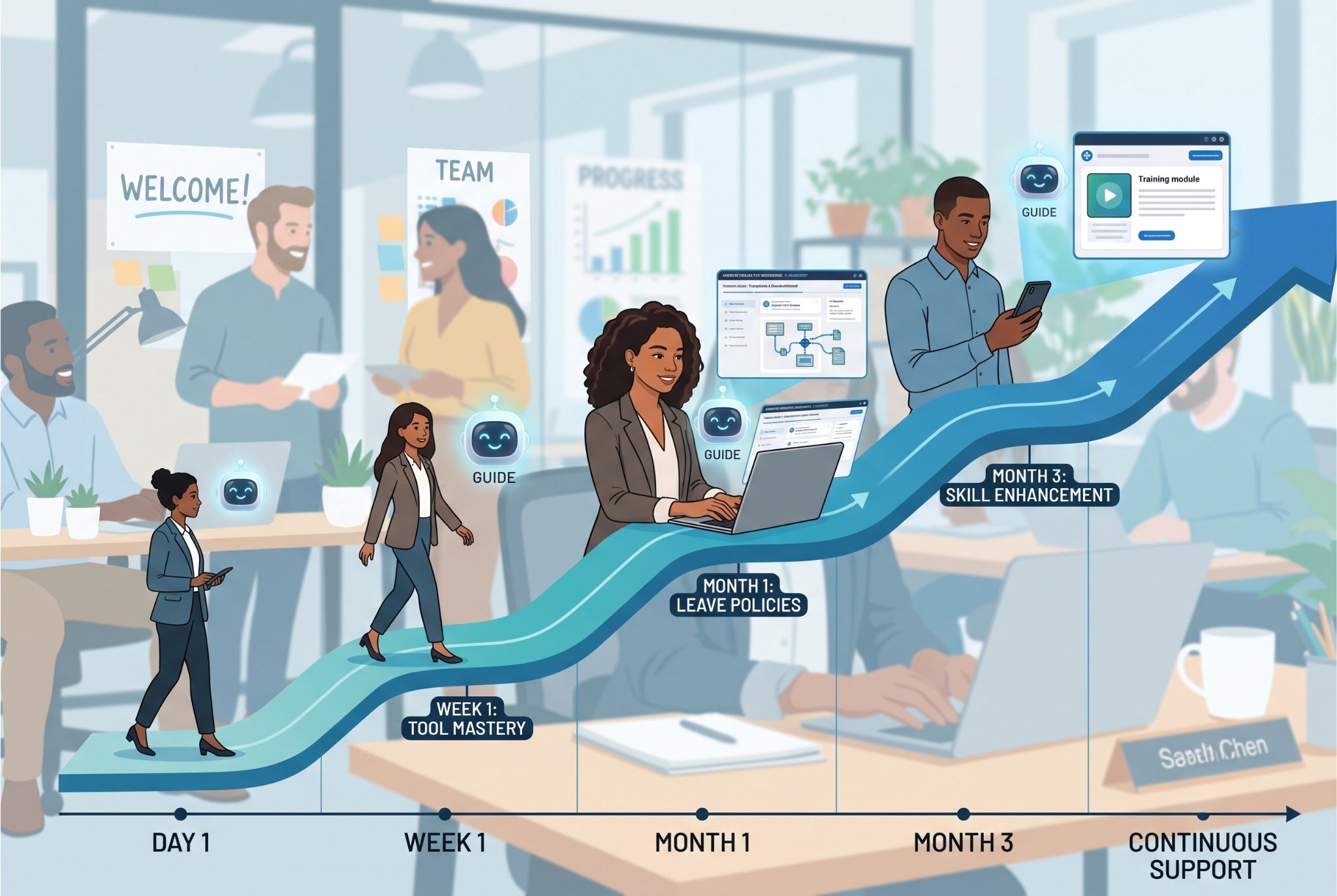
AI Onboarding Assistant Use Cases Across the Employee Journey
The value of an AI onboarding assistant extends across multiple stages of the employee experience.
Before the First Day
Onboarding can start long before an employee comes onto the job. Actually, before they even get to their first day, they may have several questions. For instance, they might need details on the documents they must bring, required training, workplace expectations, or what to prepare beforehand.
As such, the organization should offer ongoing support – in this case, before employees are officially hired. An AI Onboarding Assistant can be beneficial by providing new employees with easy access to the right information whenever they need it.
Additionally, employees do not need to sift through long email threads or various sources to ask questions. This means that new employees will be better able to prepare themselves, be more confident, and less uncertain on their first day.
During the First Week
It is common for new hires to have lots of questions during the first week. They may need help with benefits, company policies, work equipment, training, and in-house processes during this pivotal transition. But searching on several platforms can be easily frustrating and time-consuming. Instead, employees can ask questions and get the information they need more efficiently through a conversational interface. Furthermore, an AI Onboarding Assistant can provide crucial onboarding resources when they are required. This, in turn, will allow staff to save time looking for answers and focus on learning their job. In the end, this can minimize needless hassle, enhance the onboarding process, and enable new hires to feel more at ease during their first week.
During the First 30 to 90 Days
The induction process continues after staff become more self-sufficient. During this period, they assume new responsibilities, learn additional processes, and access new workplace resources. As roles evolve, employees’ questions may also change. The first 30 to 90 days are therefore critical for organizations to ensure support remains available and accessible.
An AI Onboarding Assistant gives employees continuous access to relevant information. Employees can make direct inquiries without searching multiple systems or waiting for HR assistance. This support helps new employees transition from foundational learning to performing their duties confidently. Ongoing assistance increases productivity and allows HR professionals to focus on more complex matters.
After Onboarding
Over time, many staff could view themselves as no longer ‘new staff’. But they still need dependable backing during their organization’s future development. They might ask about benefits, company policy, leave, company processes, or company resources, for instance. Hence, it is important to keep on giving organizations easy access to help even after formal onboarding.
Furthermore, an AI Onboarding Assistant can enhance the conversational support journey across the employee lifecycle. Rather than just the initial weeks, companies can enable employees to have relevant information at their fingertips whenever they need it. This means that organizations can establish a natural link between AI onboarding and employee support in general. In the end, this makes it easier for employees to find solutions and puts HR teams on the case to handle more complex situations that call for human skills.

How Chatn Can Support a Smarter Onboarding Experience
Chatn can help organizations create a more conversational approach to employee support. Instead of asking new hires to search through scattered resources, organizations can provide a convenient way to access essential information. For example, an AI Onboarding Assistant can help employees ask questions naturally and find relevant answers faster. As a result, new hires can spend less time searching and more time learning their roles.
Meanwhile, organizations can reduce repetitive inquiries that often reach HR teams. Consequently, HR professionals can focus on complex employee concerns that require human expertise and judgment. However, the opportunity extends beyond onboarding. As employees become familiar with conversational support, organizations can continue using it throughout the employee journey.
For instance, employees may need help with policies, benefits, procedures, training, and internal resources. Therefore, organizations can treat AI onboarding as the starting point for broader employee support. Ultimately, conversational AI can improve accessibility, responsiveness, and scalability while giving HR teams more time for meaningful work.
The Future of Employee Onboarding Is More Conversational
Onboarding in the future will not consist of merely adding new technologies. Instead, organizations need to reduce friction and make it easier for employees to access any assistance.
Employees do not have to remember where each document, resource, or policy is kept. Instead, employees should be able to find any information at any time. Luckily, conversational AI can help organizations achieve their goals. In particular, an AI Onboarding Assistant can provide employees with more accessible, fast assistance throughout their onboarding process.
In addition, organizations can go beyond onboarding sessions and give continuous assistance to employees. As employees develop and grow in their job, they will have an opportunity to ask more questions and access relevant resources. Nevertheless, technology cannot fully substitute human expertise. Instead, organizations can integrate AI with human assistance to improve employees’ experience. AI can provide speed, accessibility, and convenience, while humans can give empathy, context, and wisdom to the process.
Conclusion: Turn Onboarding Into Ongoing Employee Support
Typically, traditional onboarding stops once the new hire has completed the initial few weeks or months of onboarding. This is just the beginning of the journey for an employee. They will keep on having questions while learning the role, understanding how things work in the organization, and integrating into it.
An AI Onboarding Assistant can help streamline this journey through fast access to information, employee self-service, fewer repetitive HR questions, and directing employees to the right sources of information. Furthermore, organizations need to remember that they should not replace all human interactions with technology but rather use technology to reduce all friction and improve access to support.
If employees have quick access to information related to routine questions, HR representatives will be able to concentrate on cases when human touch is required. Thus, an AI Onboarding Assistant may become a powerful solution that connects employees with organizational knowledge and humans.