
Introduction
Organizations now produce more data than at any other time in history. Nevertheless, finding the right data is still a daunting task. Employees waste precious time searching for information from emails, documents, knowledge bases, and other business applications. Ultimately, this results in reduced productivity and substandard customer experience. Conventional knowledge management systems store information effectively but fail to offer the necessary context that workers need. Traditional search solutions, on the other hand, often provide an extensive list of documents rather than relevant answers.
Fortunately, an AI Knowledge Agent changes everything by offering a solution for accessing and leveraging an organization’s information. It can understand natural language, retrieve reliable data from linked systems, provide contextually aware answers, and even assist users in completing complex tasks and automatically executing business processes. As a result, people will spend less time searching for data and more time acting upon it. Collaboration among teams improves, productivity increases, and customer experience improves noticeably. This article explains how Chatn.ai’s AI Knowledge Agent can help your organization harness the power of enterprise data.
What Is an AI Knowledge Agent?
Today, enterprise knowledge goes beyond shared drives and knowledge bases. Companies store their vital data in cloud applications, internal documents, CRM systems, collaboration tools, and business systems. However, people rarely find it easily and quickly. As the amount of data grows, answering a simple question becomes more difficult.
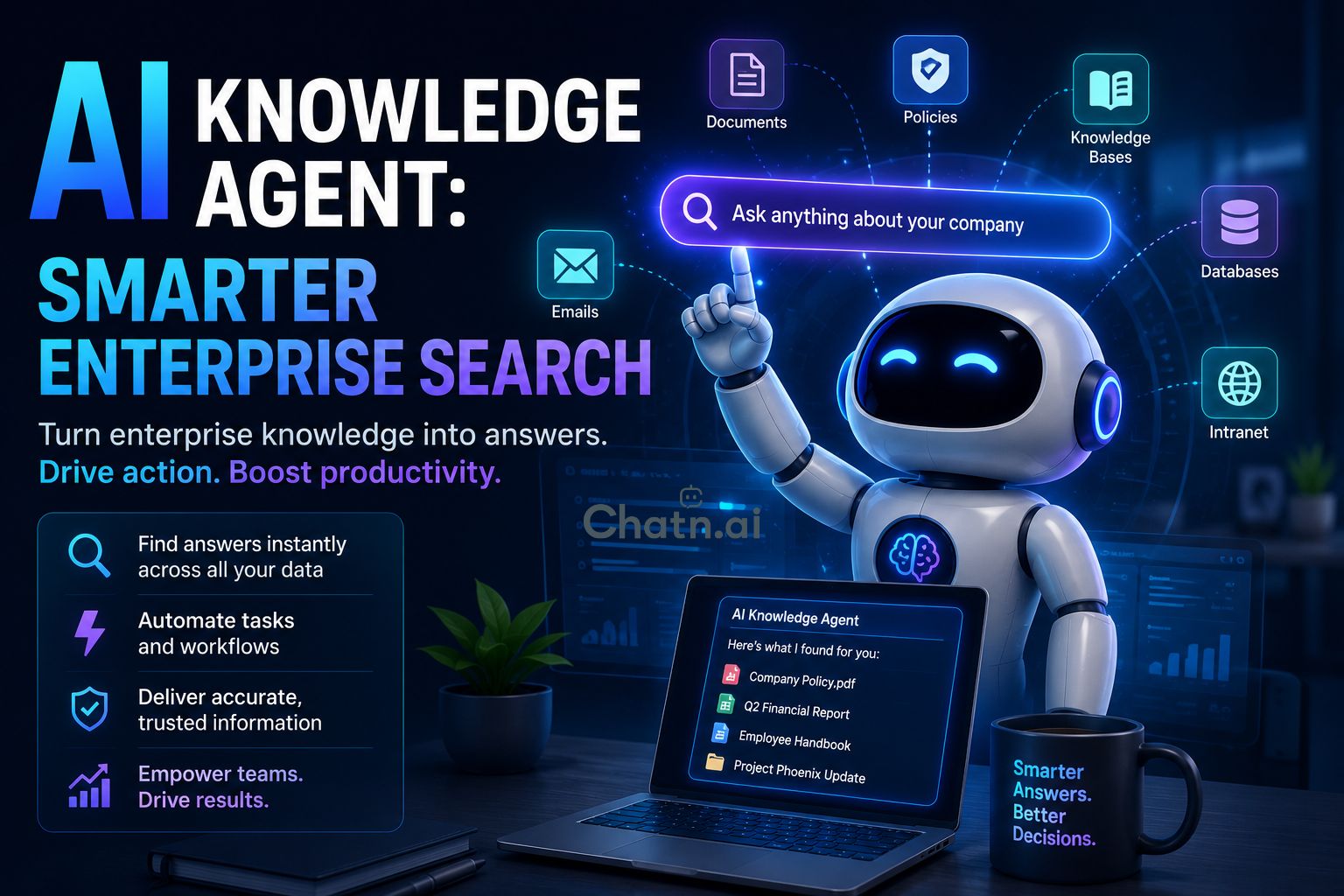
An AI Knowledge Agent is a smart system that understands a user’s query, retrieves verified information from multiple sources, and returns a response in a natural conversational format. Unlike search engines, the AI Knowledge Agent understands what you need, what your goal is, and what context your question is in. As a result, your employees save time on searching and can concentrate on doing important tasks. An AI Knowledge Agent eliminates the need for employees to switch between multiple systems. As a result, you and your employees get all the answers instantly, in a single conversation. Most importantly, contemporary AI Knowledge Agents not only give answers. They also summarize long documents, suggest next steps, automate routine tasks, and facilitate decision-making.
Beyond Search and Traditional Knowledge Bases
Companies are already implementing solutions such as knowledge bases and enterprise search platforms to manage corporate data. Still, they require workers to have all the necessary information about their search needs to start the research. Thus, it takes much longer to find what is required. For instance, when a person uses a traditional knowledge base and makes a simple request, dozens of policies may appear. Workers then browse many pages to find what they need. As a result, they waste time, get upset, and postpone their work. At that, an AI Knowledge Agent operates in a different way. It does not provide a list of numerous documents; instead, it analyzes the request, understands the situation, and provides a clear, trustworthy response based on reliable enterprise data. In addition, it explains complex concepts, summarizes long documents, and generates responses tailored to the user’s role.
How AI Knowledge Agents Work
AI Knowledge Agent combines advanced techniques to provide intelligent, precise, and reliable answers to questions. Instead of mere keyword matching, an AI Knowledge Agent understands user needs, extracts reliable information, and provides context-sensitive answers. Therefore, users get pertinent answers more quickly and with greater reliability. In addition, these functions combine to provide a smooth knowledge experience to the entire organization. Hence, staff become more efficient at their job, and customers get timely and consistent assistance. In other words, an AI Knowledge Agent enables organizations to convert their scattered knowledge into valuable insights.
First, an AI Knowledge Agent understands natural language requests. Hence, users do not have to remember specific keywords or terms. Users are free to formulate their questions as they would when talking to their colleagues. Thus, they can quickly find necessary information.
For instance, an employee may ask the following question:
“What is our reimbursement policy for remote workers?”
As a result, the agent will interpret the request, determine the intent, and identify relevant knowledge sources to answer the question accurately. Thus, users will save their time and make better decisions.
Intelligent Knowledge Retrieval
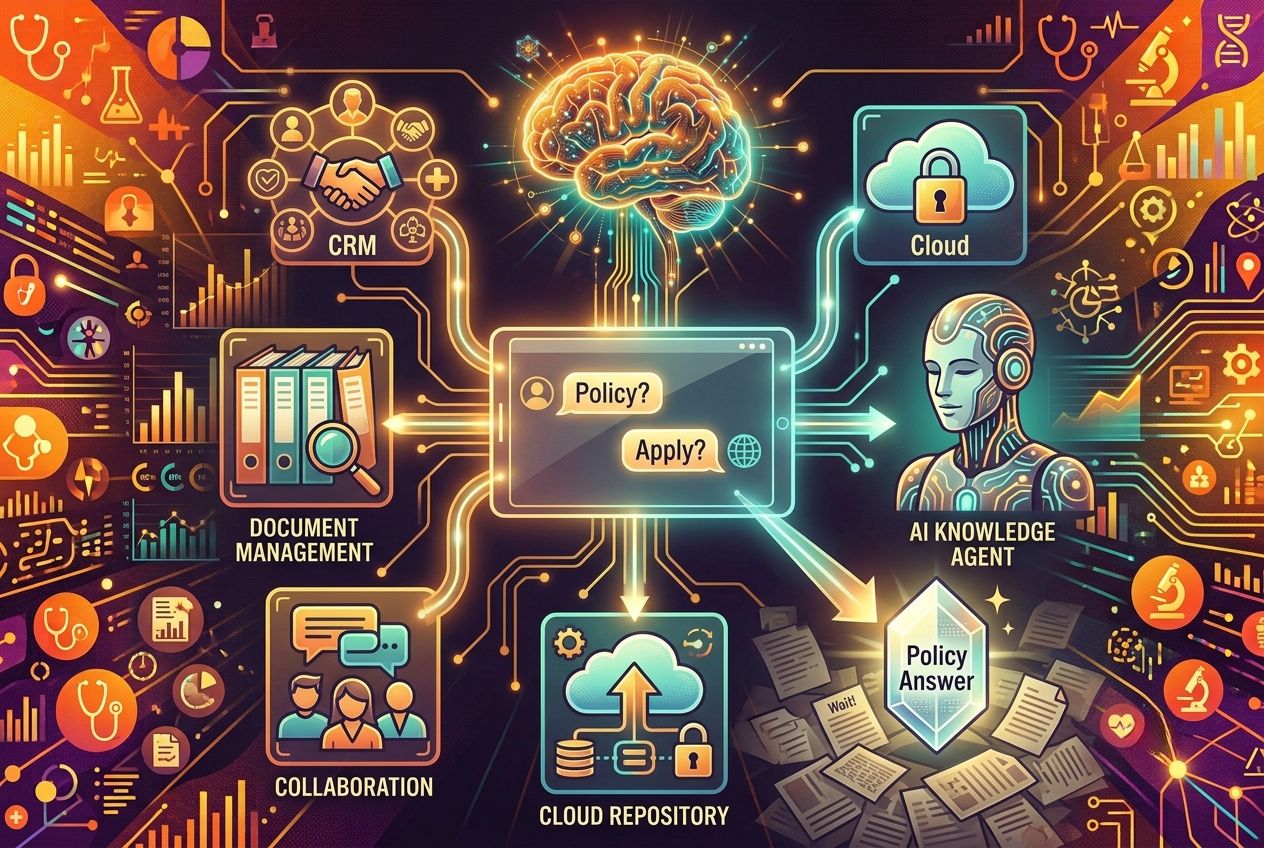
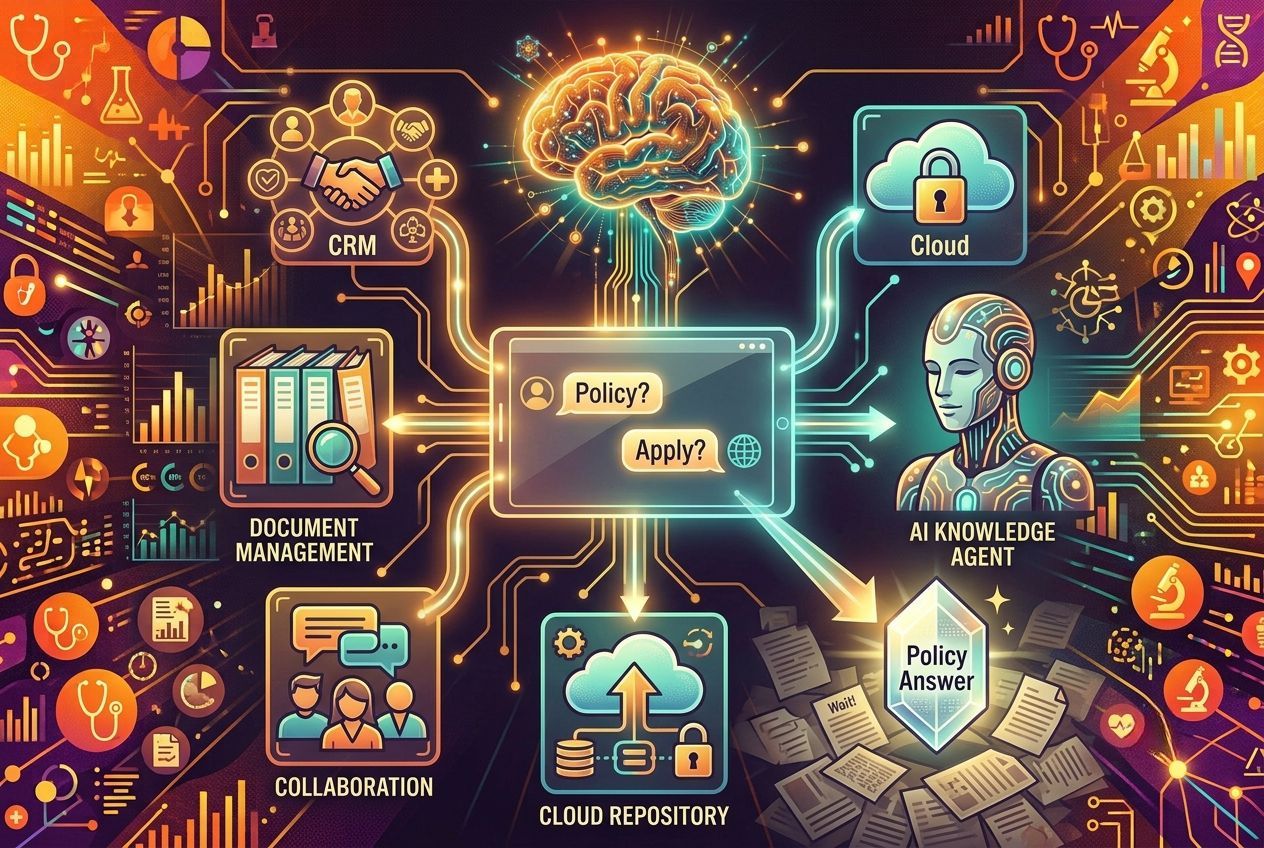
Secondly, AI technology conducts research across multiple enterprise platforms simultaneously. Unlike traditional databases, AI collects trustworthy information from various systems such as:
- Knowledge bases
- Documents
- Customer relationship management (CRM) systems
- Human resources platforms
- Collaboration platforms
- Document management systems
- Cloud repositories
Also, the AI will analyze the information and synthesize all answers into a single coherent response. Employees do not have to switch between applications and manually sift through numerous documents. They can receive a complete answer instantly.
Retrieval-Augmented Generation (RAG)
Moreover, most contemporary AI Knowledge Agents employ Retrieval-Augmented Generation (RAG) to improve the quality of their answers. Instead of relying on pre-existing knowledge alone, RAG combines the capabilities of a large language model with the organization’s information resources, resulting in answers based on up-to-date business information. Besides, the application of this technology ensures that the answer is accurate, up to date, and based on the organization’s approved information. Hence, companies minimize the provision of irrelevant or unsubstantiated information to users. At the same time, employees become more confident in the answers they receive, which helps them make more prompt and informed decisions.
Contextual Reasoning
Unlike classic AI-based chatbots, an AI Knowledge Agent is aware of the context of the whole interaction. It does not treat each query separately; instead, it takes into account the history of past interactions and generates responses accordingly. As a result, it makes conversations smoother, more accurate, and more personalized.
For instance, an employee asks a question about the company’s travel policy and then follows up with “Does that apply internationally?” Unlike classic AI solutions, which would prompt the employee to ask the same question again, an AI agent is aware of the context and can appropriately respond immediately. As a result, employees receive help more quickly and do not need to explain their requests. In this way, context-based reasoning adds an element of intuition to the process and helps employees access reliable information.
Why Businesses Need AI Knowledge Agents
Enterprise knowledge is growing, and knowledge management is becoming more complex. But even with all the efforts to transform the world into a digital environment, employees still struggle to access relevant information in a timely manner. Consequently, they spend a lot of time switching between systems, delaying decision-making, and reducing productivity. Furthermore, today’s employees require correct solutions immediately. Whatever it may be, employees want accurate information without having to search several systems, company policies, product specifications, customer records, or compliance guidelines. The traditional approaches to knowledge management do not necessarily provide this experience.
An AI Knowledge Agent can overcome these challenges by bridging the gap between enterprise knowledge, user intent, and contextually relevant answers through natural conversations. Furthermore, it retrieves reliable information from multiple sources and delivers clear responses within seconds. As a result, companies become more productive, make decisions faster, and streamline work processes across all departments. Ultimately, an AI Knowledge Agent converts information into knowledge that can improve business results.
Knowledge Exists Everywhere—But Rarely Together
These days, a lot of information is stored across various business platforms in modern organizations. While each of them is a valuable component, there’s a gap in information that is hard for employees to bridge. The more enterprise information expands, the more difficult it is to find the correct answer.
Organizations typically have knowledge stored in:
Customer relationship management (CRM) platforms
- Human resources systems
- Internal knowledge bases
- Project management applications
- Collaboration platforms
- Document management systems
- Cloud storage repositories
Standard operating procedures (SOPs)
This often leads employees to use several applications before a complete answer is found. This, in turn, affects them by wasting precious time, causing frustration, and delaying critical work. Furthermore, this disconnect creates knowledge silos that limit collaboration and operational efficiency. Luckily, an AI Knowledge Agent bridges these gaps by integrating enterprise systems into a single intelligent knowledge layer. It pulls trusted information from multiple platforms and provides a single, context-appropriate answer rather than forcing users to run multiple searches. This allows teams to spend less time navigating systems, work together more effectively, and concentrate on work that generates more business value.
Information Delays Slow Every Team
Information is vital for every department to function well and in a timely manner. But the delayed response times can negatively impact business activities, decision-making, and productivity. This means that employees have more time to spend looking for information, but not more time to do meaningful work.
For example:
- Sales teams require real-time pricing, product information, and competitive data to close sales more quickly. Sales teams require up-to-date pricing, product information, and competitor information to close deals faster.
- HR professionals need immediate access to policies, onboarding documents, and employee records.
- Troubleshooting guides and technical documentation help IT teams quickly and effectively resolve issues.
- Customer support staff rely on accurate, consistent information to provide excellent customer service.
- Standard procedures are critical to maintaining productivity in operations teams.
- Compliance teams need immediate access to the most up-to-date regulatory requirements to minimize organizational risk.
Time is wasted when the staff doesn’t have trusted information readily available. This means that customers wait longer, projects are delayed, and operations keep costing more and more. The good news is that an AI Knowledge Agent can cut these delays by providing relevant, accurate information in seconds. Thus, all departments operate more efficiently, more quickly, with greater confidence, and with more informed decision-making.
Employees Need Answers—Not More Documents
Traditional search tools often return excessive results, forcing employees to spend valuable time reviewing them. This lowers productivity, delays tasks, and causes frustration. Today’s workforce expects a faster, simpler experience. Employees want direct access to accurate, relevant information without having to read lengthy manuals or search multiple files. Knowledge Agent tackles these challenges by collecting enterprise information, summarizing key knowledge, and supplying clear, natural-language responses. It explains complex concepts, highlights essential points, and recommends concrete steps tailored to user needs. As a result, teams spend less time on documentation and more time on high-value work.
What Makes an AI Knowledge Agent Different?
AI continues to evolve rapidly, but not all solutions deliver the same features or business value. While chatbots, virtual assistants, and enterprise search tools address specific needs, an AI Knowledge Agent combines these capabilities with advanced reasoning, contextual understanding, and workflow intelligence. This creates a more intelligent and connected user experience.
An AI Knowledge Agent does more than retrieve information. It recognizes user intent, understands trusted enterprise knowledge, and turns information into meaningful business actions. This improves organizational productivity, accelerates decision-making, and enables employees to work more efficiently.
It Understands Context
Traditional search systems treat each question separately, requiring users to repeat information. This slows interactions and leads to frustration. An AI Knowledge Agent is more advanced. It retains previous questions, understands follow-ups, and tracks user intent throughout the conversation. This enables natural, personalized, and relevant responses. This contextual understanding improves responses and reduces unnecessary back-and-forth. Employees can focus on their work instead of repeating requests. As a result, companies provide users with more seamless interactions, greater efficiency, and faster, more consistent support.
It Links Multiple Knowledge Sources
Enterprise knowledge is rarely centralized. Instead, organizations distribute information across cloud applications, business systems, document repositories, and collaboration platforms. As data grows, locating complete and accurate information becomes more challenging.
An AI Knowledge Agent integrates these sources into a single intelligent experience. It delivers trusted information from multiple connected systems simultaneously, eliminating the need for employees to search each system individually. By processing available data, it provides a single relevant answer instead of multiple search results. This approach saves employees time switching between applications and allows them to focus on their core tasks. It also improves collaboration, reduces knowledge silos, and increases efficiency across departments.
It Learns Organizational Language
As time goes on, each organization adopts its own language, acronyms, procedures, and policies. This means that workers frequently use jargon at work that is not necessarily relevant to the AI systems they use. But an AI Knowledge Agent is always training on the organization’s language and using it in all of their interactions. It can understand company-specific phrases, products, departments, and processes, rather than just answering generic ones. Moreover, it can better grasp business situations and respond to the specific circumstances of any organization. This means that employees get more specific, accurate, and individualized responses. In addition, they don’t have to spend as much time describing internal terminology or correcting misunderstandings. In the end, this ability builds user assurance, enhances communication, and helps teams become more efficient across the organization.
Benefits of Using an AI Knowledge Agent
Organizations increasingly invest in AI because they expect measurable business outcomes. Fortunately, an AI Knowledge Agent delivers value across multiple areas of the business.
Faster Decision-Making
When employees have access to accurate information at the moment of decision-making, they make better decisions. They get trusted, context-aware answers within seconds, rather than trawling through several documents and systems. This means they’re spending less time searching for information and more time doing something meaningful.
Moreover, quick access to reliable knowledge enables teams to adapt rapidly to business needs and new opportunities. This means projects are completed with fewer delays, collaboration is enhanced, and employees can make confident decisions based on trusted information. In summary, an AI Knowledge Agent can help organizations become more agile, efficient, and successful in their business endeavors.
Improved Employee Productivity
The search for knowledge consumes a great deal of valuable work time and reduces employee productivity. Therefore, employees are unable to work on important projects because they must navigate several different systems. Fortunately, the AI Knowledge Agent provides a solution. It saves time and effort by providing instant responses to questions. In addition, it extracts reliable information from integrated knowledge resources. As a consequence, employees will be able to focus more on valuable activities that help the company grow and innovate. Additionally, they will work together much more effectively and complete projects more quickly.
Improve Customer Experiences
Customers today have come to expect rapid, accurate, and consistent responses any time they need help. Hence, it is crucial for organizations to provide timely information. Nonetheless, it becomes extremely challenging for support teams to deliver exemplary service when they struggle to obtain relevant information.
The good news is that with the help of an AI Knowledge Agent, support teams can access timely, context-specific information. In such cases, they not only solve customer problems quickly but also provide consistent, high-quality service. In addition, quick and reliable service helps to improve customer satisfaction. Hence, organizations can improve their customer relationships and ensure their loyalty.
Key Features to Look for in an AI Knowledge Agent
Not every AI solution offers the same level of intelligence or enterprise readiness. Therefore, organizations should evaluate an AI Knowledge Agent based on its ability to deliver accurate information, integrate with existing systems, and support business workflows.
Enterprise-Wide Knowledge Search
A good AI Knowledge Agent needs to perform an enterprise-wide search through all available knowledge resources in the organization. It does not confine users to a single source; it fetches relevant information from document management systems, collaboration tools, CRM applications, HR systems, and cloud storage. Additionally, it integrates information from multiple sources to provide users with accurate, context-aware information at once. Therefore, users do not have to switch between apps or repeatedly search for the same information. This ensures that users obtain reliable information quickly and make decisions based on accurate information.
Seamless System Integration
Today’s enterprises rely on multiple software systems for daily operations. An AI Knowledge Agent should complement these technologies rather than require changes to existing systems. This approach maximizes the value of current technology. Seamless integration preserves existing processes and enhances AI capabilities across the organization. Staff can continue using familiar tools while accessing reliable enterprise information more quickly.
Context-Aware Responses
Employees need more than general responses; they require accurate, personalized answers tailored to their specific queries and business context. Companies should choose an AI Knowledge Agent that understands conversational context, identifies user intent, and delivers relevant answers in each situation. The AI leverages previous interactions and enterprise knowledge to provide relevant answers. Employees save time by not repeating information and can focus on their core tasks. This approach increases response accuracy and enhances the overall user experience.
Conclusion
While information gathering has become easier for enterprises, the primary challenge remains turning data into actionable insights. As data volumes increase, companies must equip employees with timely and reliable knowledge. The AI Knowledge Agent offers unified access to enterprise knowledge, interprets user intent, and delivers trusted, context-aware insights through natural conversation. It automates tasks, speeds decision-making, and improves efficiency.
As enterprise AI adoption grows, immediate access to accurate knowledge becomes essential. Investing in knowledge intelligence solutions boosts productivity, encourages collaboration, streamlines workflows, and improves the customer experience. With Chatn.ai, achieve these goals through conversational AI, automation, and workflow integration. Shift from information gathering to informed action and improved outcomes.