

Introduction: The Need for Redesigning Customer Journeys
Customers’ demands have evolved. Quick reactions do not suffice. Personalization is now the minimum standard. Nevertheless, the majority of companies still stick to classical approaches. Traditional journeys consist of linear and predictable stages. Yet, this principle no longer applies.
Instead, people frequently alternate between different media types. They stop their browsing, go back to it, analyze alternatives, and switch devices. In this way, classic funnels cannot cope with these dynamics anymore. This is precisely what distinguishes AI-powered journeys: they uniquely adapt in real time to each user’s actions, unlike static paths.
Furthermore, AI journeys uniquely transform every interaction point into an adaptable and data-driven opportunity. Each customer choice is analyzed in real time by AI, enabling companies to quickly and effectively tailor their responses. With Chatn, firms ditch static funnels and build flexible, evolving AI-powered journeys.
What Are AI Customer Journeys?
- AI customer journeys are flexible, dynamic processes that adapt to user actions, intentions, and situations. Unlike regular customer journeys, which often follow predefined paths, AI journeys use actual user information to personalize recommendations and guidance in real time.
- AI customer journeys do not follow a prearranged set of steps but adapt constantly based on user engagement and interactions with a particular brand. Therefore, every interaction is more individualized.
- AI customer journeys help brands respond faster and even predict clients’ requirements. Companies can adapt their approaches to what their customers need right now.
From Static Funnels to Adaptive Systems
The customer journey is often seen as a rigid funnel.
Awareness > Interest > Decision > Purchase/Conversion
But let’s be honest—real users don’t play by the rules. They jump stages, zigzag through steps, and surprise you at every turn. That wild unpredictability? It’s proof that neat funnels just can’t keep up with the real adventure.
Now imagine flipping the script: An AI-powered journey that’s actually alive. It moves with your users, learns from every twist, and customizes messages on the fly—always tuned into what matters at the moment.
Even better? This adaptive system is ahead of the game—spotting needs, sparking new excitement, and meeting users right where they are, sometimes before they even realize what they’re after.
From Linear Funnels to Dynamic Systems
Customer journey funnels were once strictly linear: Awareness > Interest > Decision > Conversion.
This linear view does not fit reality. People seldom move through funnels in a step-by-step manner. Instead, they cycle through stages, often skipping ahead or repeating actions. As a result, traditional funnels struggle to capture true customer behavior.
In contrast, AI customer journey funnels are dynamic systems. They adjust in real time based on user behavior, so users are no longer confined to fixed paths. Moreover, these systems tailor their messages to each situation and intent.
Building on this adaptability, dynamic funnels can even anticipate users’ actions and predict future moves. This proactive approach enables businesses to connect with customers before decisions are made.
Why Business Needs to Embrace AI Customer Journeys
Businesses are no longer forced to adopt an AI customer journey approach under pressure or customer demand; it is happening out of necessity.
Increasing Customer Demands
These days, customers require instant responses, cohesive communication, and personalization on each step of their journey. Additionally, these interactions need to occur at all times via every possible channel.
Yet if any of the mentioned expectations are not met, a customer’s engagement will quickly be lost, and in most cases, the customer will not return. That is why it is essential that there are no gaps in the customer journey.
In this regard, the implementation of AI customer journeys can prove very useful, as it allows for ensuring all those aspects while adapting to the customer.
Data Without Activation Is Worthless
Every business can collect large volumes of data daily, but most of it never gets used. As a result, important insights might be lost. Actually, the issue does not relate to data gathering. The main issue here is activation. And without it, any data cannot yield results. Here comes the role of AI. AI was designed specifically to transform data into actual actions. At that, AI analyzes signals in real time and makes a real-time appropriate decision.
Manually Scaling Personalization Is No Longer Feasible
Manually scaling personalization is not feasible in the contemporary digital environment because human capabilities cannot meet consumer expectations for appropriately personalizing millions of interactions within a given timeframe. Therefore, some gaps are inevitably created.
Nevertheless, with the introduction of artificial intelligence, businesses can overcome these challenges. Unlike manual efforts, AI analyzes and generates personalized experiences at high speed through data processing.
AI allows organizations to:
- Scale personalized experiences without adding complexity.
- Automate decisions based on user preferences and needs.
- Ensure consistency across various channels.
Besides, artificial intelligence technology enables personalized experiences tailored to customers’ current context and needs. It significantly reduces friction in the process. It means automation can be an effective competitive advantage for companies.

How AI Customer Journeys Work
The AI customer journey process uses a continuous feedback loop to learn from each customer experience and interaction. Unlike traditional rule-based systems, it constantly updates based on behavior and intent. As a result, every move gets smarter over time.
Step 1 – Data Gathering Across Multiple Touchpoints
Firstly, the AI system uses multiple touchpoints throughout the customer journey to collect customer information. These can include website data, chats, CRM data, email engagement, and product usage.
Secondly, signals from clicks, emails, and chats offer a complete picture of customer journeys at any moment.
Thirdly, any interaction provides a valuable signal to the system for understanding the customer’s entire journey.
Step 2 – Real-Time Understanding of User Intent
Building on the previous step, AI now works to understand behavioral signals in real time, rather than retrospectively. As people interact with a certain brand, the machine interprets the signals immediately.
Specifically, AI identifies key signals such as purchase intent, likelihood of abandonment, engagement level, and consumer sentiment. In addition, AI evaluates them together to better understand intent. As a result, the machine understands current user desires instead of relying on past assumptions.
Step 3 – Journey Decisioning Engine
After the user’s intent has been identified by AI, the next step is an instant response via a journey decisioning engine. Unlike the previous process, which prompted users for additional inputs, this engine actively analyses context to determine the best possible move at any given point in time.
It may be sending a message, prompting a bot interaction, or delivering a product suggestion. However, in some cases, it can escalate the matter directly to a support agent. The key takeaway here is that these actions are never arbitrary; they are always aligned with the user’s behavior and their stage in the journey.
Step 4 – Continual Learning Cycle
Lastly, every customer interaction helps to improve the system. The decision-making process does not rely on fixed guidelines but rather on continual learning from customer interactions themselves.
The more interactions that occur, the more the system learns to recognize intent, predict behavior, and select an appropriate response. It even learns from the success of various responses by assessing the outcome.
Consequently, every customer journey powered by artificial intelligence is becoming smarter, more predictive, and more effective with every loop.
Key Components of AI Customer Journeys
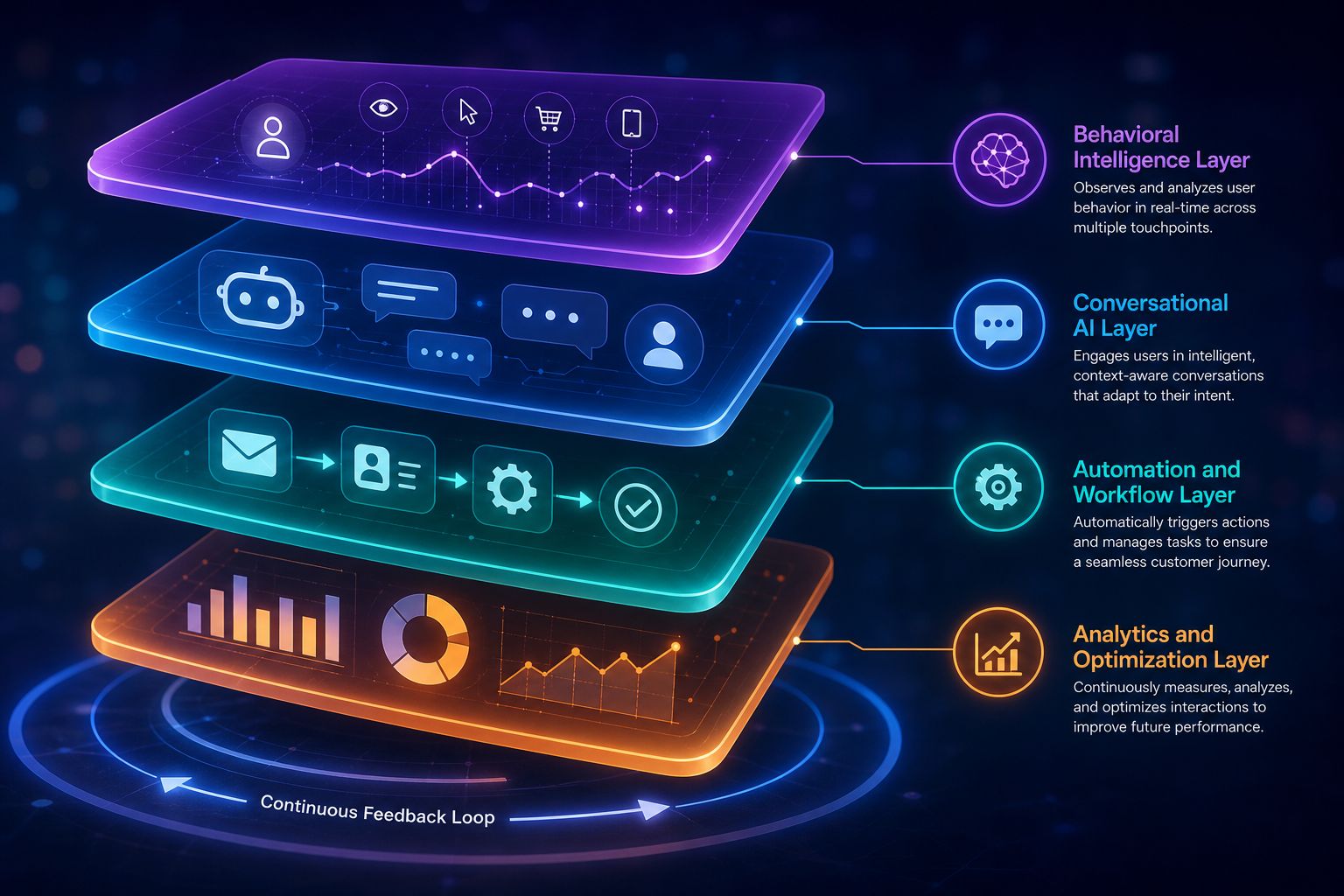
Analyze each element of the AI customer journey separately to better comprehend the process. Each layer actively delivers a seamless, intelligent customer experience.
The Behavioral Intelligence Layer
To begin with, there is the behavioral intelligence layer. It plays an active role by observing and analyzing user behavior in real-time across various touchpoints.
By observing user behavior rather than simply collecting passive data, the system enables clearer identification of patterns, such as recurring visits from users displaying persistent interest, abandoned sessions reflecting hesitance, and high-intent signals showing intentionality. These insights help the system adjust its responses to better support the customer journey.
Conversational AI Layer
Next, the conversational AI layer plays a pivotal role in shaping the customer’s AI experience. Here, Chatn stands out as an effective platform for facilitating meaningful dialogue.
AI-driven conversations will ensure that each user is intelligently engaged, that their questions are answered instantly, that decision-making becomes easier, and that engagement levels remain high. What makes these conversations unique is that they adapt to the user’s intention and context. These interactions are not restricted by flowcharts but continually adjust to provide relevant responses.
Automation and Workflow Layer
Additionally, the automation and workflow layer executes tasks autonomously. Instead of requiring manual input at every step, the software automatically triggers the relevant action based on user interaction.
For example, it might autonomously dispatch follow-up emails, generate CRM records, and launch onboarding for new customers. It also guarantees each task is completed rapidly and uniformly across the system. Overall, this layer significantly reduces redundant labor and boosts efficiency. Ultimately, it streamlines deployment of AI-driven customer journeys.
Layer for Analytics and Optimization
Lastly, the analytics and optimization layer continuously evaluates the AI-based customer journey in real time. Unlike the previous layer, where the collected data is used to create reports, this layer assesses user performance across all interaction touchpoints.
For instance, it assesses conversion rates, drop-off points, and the quality of engagement. In addition to measuring the above factors, it also looks at patterns within them. It also uses the collected data to improve the performance of future AI interactions.
In summary, the process involves a continuous feedback cycle of evaluating AI interactions to improve their performance in the future.
Benefits of AI Customer Journeys
AI-driven journeys create measurable business impact.
Higher Conversion Rates
On average, personalized experiences increase conversion probability. In cases where the firm creates content and delivers it to the consumer, they eliminate the friction involved in making a decision and lead the client.
Furthermore, when a consumer finds content that meets their needs, they respond promptly by engaging and taking action. This means that AI customer journeys help minimize the distance between interest and conversion.
Enhanced Customer Retention
Apart from conversion, another key aspect is enhanced customer retention. The principle of consistency helps build credibility, which in turn strengthens the connection with users.
The more consistently a company communicates with its clients, the more likely clients are to feel appreciated and cared for. In other words, clients will be motivated to continue interacting with the business.
Additionally, AI ensures relevant messages reach users wherever they are in their journey. It avoids generic content and tailors communication to each user’s behavior and preferences. As a result, customers enjoy a more personalized experience, leading to greater retention.
Reduced Operational Expenses
Besides better customer experiences, another way AI-powered customer journeys have benefited organizations is by reducing operational expenses significantly. With smart automation, companies can minimize reliance on large support teams by automating time-consuming tasks.
This helps organizations manage their operations effectively without sacrificing the quality of services they provide to their customers. Additionally, automation enables organizations to handle mundane tasks while leaving complex ones to human workers. In essence, organizations can achieve greater efficiency without compromising performance.
Faster Decision Cycles
In AI-based customer journeys, speed is essential for both experience and results. AI ensures this by processing requests in real time, without human involvement.
Users receive immediate responses and can continue their journey smoothly. Instant replies also help users feel confident at each step. This speeds up customer processes, enabling companies to achieve shorter decision cycles and higher conversion rates.
AI Customer Journeys in Action with Chatn
Chatn enables businesses to build intelligent, adaptive customer journeys without complexity.
Real-Time Interaction Through Channels
Furthermore, Chatn combines multiple customer interfaces into a single cohesive interface. Rather than having separate channels, it ensures they work well together in real time. Thus, users are guaranteed an uninterrupted experience throughout their journey on all fronts. These include web chats, messaging apps, help desks, and CRM processes.
Additionally, channels exchange information and context, making conversations seamless and uninterrupted. Therefore, users experience no gaps in interactions, regardless of the channel they use.
Conversational Intelligence Flow
Unlike other platforms that stick to strict conversational scripts, Chatn engages in adaptive conversations that evolve in real time. The platform constantly changes course depending on how the user interacts.
The response in each case is based on several elements, including user intent, past interactions, and current context. Additionally, Chatn constantly analyzes these inputs to keep the conversation aligned with the user’s expectations.
This makes the conversation more natural and human-like. Therefore, users have better conversations since they are less scripted and more fluid.
Unlike other platforms that stick to strict conversational scripts, Chatn engages in adaptive conversations that evolve in real time. The platform constantly changes course depending on how the user interacts.
The response in each case is based on several elements, including user intent, past interactions, and current context. Additionally, Chatn constantly analyzes these inputs to keep the conversation aligned with the user’s expectations. This makes conversations feel more natural and fluid, resulting in a better user experience.
End-to-End Journey Orchestration
Apart from addressing queries, ChatN not only responds to them but also coordinates end-to-end customer journeys. Instead of taking one action after another, it coordinates them all to create an intelligent flow.
Consequently, it qualifies leads based on their behavioral traits, nurtures them through effective communication, and provides the necessary support when needed. In addition, it keeps inactive customers engaged by reconnecting with them through customized communication efforts. With Chatn, your entire AI customer journey becomes automated and consistent.
Conclusion: Intelligent Customer Experience Journeys
To sum up, the AI customer journey is a completely different way for businesses to interact with customers at every step. Unlike previous approaches, which have become increasingly obsolete, businesses are gradually transitioning to intelligent solutions that adapt and learn from their interactions in real time.
Unlike fixed, rigid funnels, these solutions actively adapt and replace existing frameworks with adaptive ones that work with a user’s needs and goals in mind. Additionally, they replace manual intervention with intelligent processes that operate in an automated and scalable manner.
What is probably the most valuable part of using them is that they create experiences that feel timely, relevant, and natural at every point of the way. Users thus get smooth and enjoyable interaction tailored to their personal requirements.
With Chatn, businesses are empowered to facilitate this process and integrate these technologies, enabling more advanced, connected experiences. Therefore, businesses will be able to provide smarter customer experiences.
In addition to gaining a competitive advantage, organizations will find themselves behind competitors if they do not take action.