

Introduction
Every time a business interacts with a customer, it shapes how people see the company. Slow replies can erode trust, and impersonal conversations may drive customers elsewhere. Today, customers expect businesses to understand their needs and respond quickly on many different platforms. But with higher expectations, more ways to communicate, and more questions coming in, it’s hard to keep the experience consistent. That’s why many companies now use AI Customer Engagement to offer faster, more personal, and smarter interactions. AI doesn’t replace people; it helps them by giving quick answers and supporting real conversations. This way, businesses can connect with customers at every stage and keep communication steady across all channels. AI also helps teams solve problems faster, build stronger relationships, and boost customer satisfaction. In this guide, you’ll find out what AI Customer Engagement is, why it’s important, how it works, and how it can help your business create great customer experiences.
What Is AI Customer Engagement?
AI Customer Engagement refers to the application of artificial intelligence technology to boost customer interactions at all stages of the purchasing process. Unlike conventional customer engagement methods, it goes beyond answering simple queries. It offers businesses an opportunity to automate processes, personalize communication, and engage customers through machine learning and conversational intelligence.
As such, each interaction is more efficient and tailored to customer needs.
The main benefits of using AI Customer Engagement include:
- Offering instant answers to customer inquiries;
- Personalization of product or service offers;
- Giving relevant information on making purchasing decisions;
- Proactively sending updates and reminders to customers;
- Being available to customers 24/7;
- Gathering information about customers and using it for analysis; and
- Maintaining customer relationships.
Additionally, unlike conventional customer service, AI Customer Engagement uses available data to analyze customer preferences and intent and provide relevant, contextual, and personalized responses to customers’ queries. Finally, the ultimate goal of AI Customer Engagement is not just the automation of communication but also building meaningful experiences with customers and fostering customer trust.
Why Customer Engagement Has Changed
Modern buyers do their homework on products online. They consider various brands, read reviews, and expect instant answers to any questions they may have. Therefore, companies should be ready to respond quickly and communicate effectively with potential customers. What is more important, nowadays customers switch between different communication channels, including websites, social media platforms, messaging tools, emails, and mobile applications while doing the same shopping process. Therefore, businesses should provide a similar experience regardless of the communication channel used.
Here is the tricky part.
Every disconnection raises the risk of losing customers’ trust. For instance, customers may start a conversation using a chat widget on a company’s website. After some time, they may continue the conversation via email. Finally, they contact the support team via some messaging application. In this case, each new interaction will start from scratch. This frustrates and disappoints customers. Nowadays, customers expect a business to know about previous conversations and to provide help without rephrasing all the information again. In other words, a company needs technology that allows combining all interactions into one continuous conversation.
Customers Expect Conversations, Not Transactions
Although many companies still focus on sales first and foremost, modern customers are looking for not only good products but also strong relationships. In particular, they expect the company to listen to them, respond fast, and be aware of their preferences. Because of this, customer engagement cannot stop at the moment of buying anymore. On the contrary, successful companies continue to build the relationship by giving recommendations, follow-ups, assistance, and updates to their customers. In this way, they offer much more than a mere transactional experience. Additionally, every conversation builds up customer trust. Over time, these experiences become an incentive for customers to buy again, stay loyal to the brand, and recommend it to others. Luckily, AI Customer Engagement allows you to personalize the experience efficiently. Instead of requiring the employees to manually sort out all the information about customers and their interactions, the AI system does this work for them automatically. Even more importantly, the AI leaves more time for the employees to talk to customers in an empathic, creative, and smart way.
How AI Customer Engagement Works
Although AI Customer Engagement feels seamless to customers, several intelligent processes work together behind the scenes. Understanding these processes helps businesses implement AI more effectively.
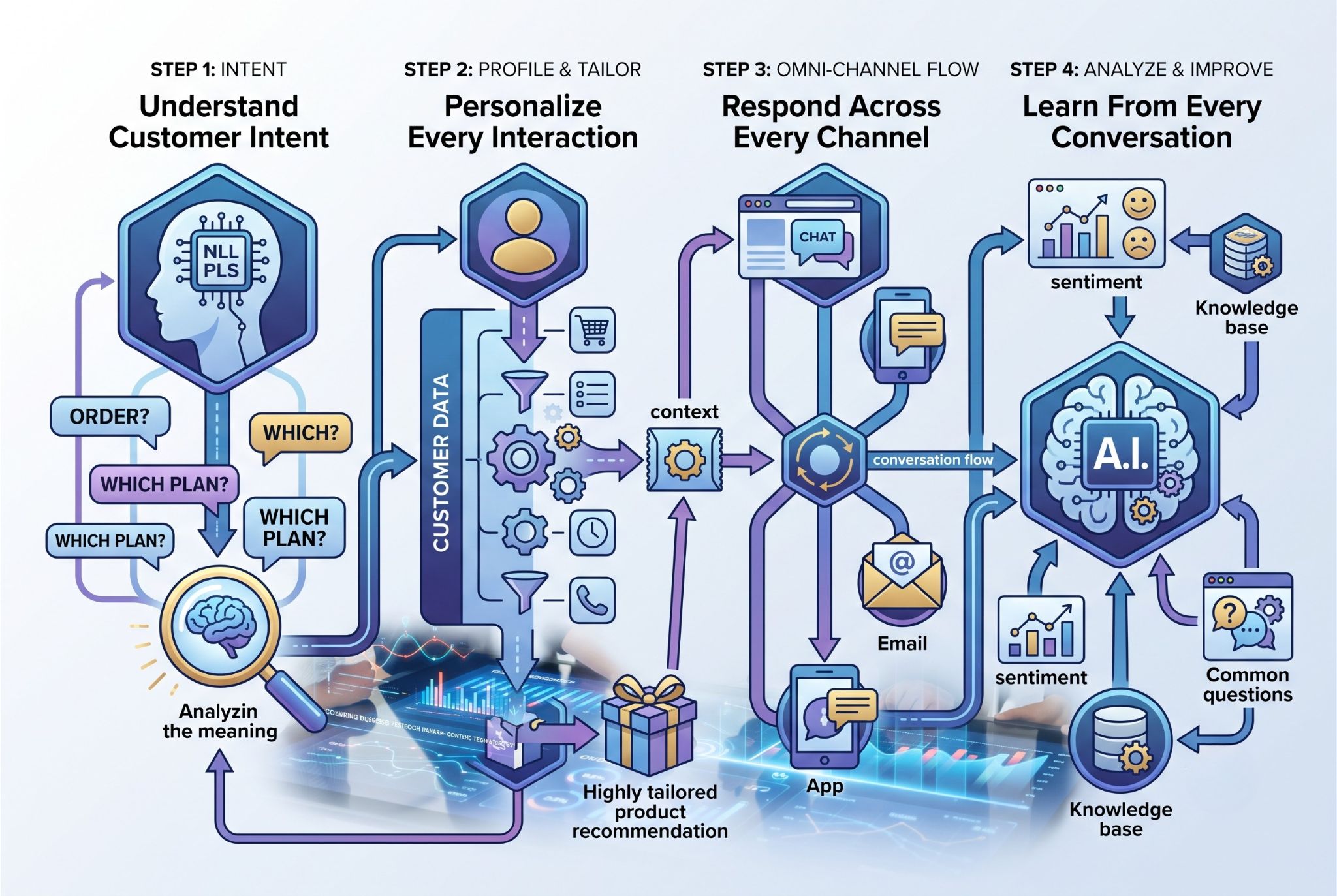
Step 1: Understand Customer Intent
Every good conversation starts with understanding customer intent. Thanks to natural language processing (NLP) technology, AI not only matches certain words but also analyzes the meaning of the customer’s request. That way, AI can understand what the customer wants rather than focusing merely on particular words or phrases.
For instance, when a customer asks “Where is my order?”, he needs delivery information. On the other hand, when a client asks “Which plan is better for me?” The customer wants advice before purchasing something. The ability to understand customer intent allows AI to provide much more accurate, relevant, and personalized answers. In this way, the customer does not have to repeat his request and spends much more time getting necessary information. Ultimately, such an approach will lead to better conversations and improved customer experience.
Step 2: Personalize Every Interaction
Nowadays, personalization has become one of the most powerful drivers of customer satisfaction. Instead of providing the same information to every customer, AI can analyze all available customer data and create relevant interactions. Namely, it can take into consideration the following aspects:
- Previous purchases
- Browsing activity
- Conversation history
- Preferred communication channels
- Popular questions
- Interest in certain products
With the help of the collected data, the business can recommend relevant products and answers, provide more accurate information, and create experiences customized for each client. Moreover, AI adapts to the customer’s context to make every interaction more personalized. Every customer appreciates the business remembering their preferences. As a result, personalization naturally contributes to increased customer engagement and builds customer loyalty.
Step 3: Respond Across Every Channel
Customers now communicate through various channels, including websites, email, mobile apps, messaging, and social media.
AI Customer Engagement integrates these channels to create a seamless experience, allowing customers to continue conversations as they move between platforms.
AI also retains the context of each conversation across all channels. This enables support teams to respond more quickly and personally, so customers do not need to repeat themselves and receive assistance faster.
Step 4: Learn From Every Conversation
Each customer conversation provides valuable insights. Getting information is only the first step. What matters most is understanding how customers think, what they need, and the challenges they face at each stage of their journey. It constantly analyzes the conversations and uncovers trends, customer questions, and sentiments. As a result, businesses can refine their communication strategy based on real customer interactions rather than hypotheses. For example, AI might notice that customers often ask about prices before buying. During holidays, it may be found that shipping questions are more common. It can also show which products need more support than others. With this information, businesses can update their knowledge base, improve marketing, make the customer journey smoother, and solve customer problems more effectively. AI also learns from every conversation. Each new AI learns from every interaction, using new data to improve its suggestions, responses, and understanding of customer needs. Instead, they use each one as a chance to learn and build stronger connections with their customers.
Common Mistakes Businesses Make with AI Customer Engagement
While AI presents incredible possibilities, businesses must use this technology strategically to reap its rewards. New technology alone is not a sure way to improve customer engagement. But many organizations deploy AI without a clear plan for customer engagement. As a result, they frequently overlook opportunities to enhance customer experiences, deepen relationships, and maximize the value of their investment. Fortunately, businesses can prevent these issues by identifying common pitfalls during implementation as early as possible. When organizations proactively address them, they can establish a better foundation for long-term success, provide improved customer experiences from the get-go, and foster more meaningful customer interactions.
Treating AI Like a FAQ Machine
A major pitfall companies often fall into is using AI to handle only simple queries. While FAQs remain valuable, AI offers broader capabilities. Businesses can leverage AI to guide purchasing decisions, recommend products or services, schedule appointments, collect feedback, and support customers throughout their journey. However, relying solely on AI for a digital helpdesk is insufficient. This approach limits the ability to personalize experiences, strengthen customer relationships, and increase engagement. Businesses should view AI as an ongoing customer engagement tool rather than just a support resource. By expanding AI’s role beyond routine inquiries, organizations can foster meaningful interactions, improve efficiency, and build long-term customer loyalty.
Ignoring Human Handoffs
AI shouldn’t make customers more frustrated; it should make it easier. Unfortunately, some businesses make it difficult for customers to reach a human representative when they need extra assistance. This leads to customer dissatisfaction and loss of trust in the company. Furthermore, complicated situations call for empathy, judgment, and critical thinking, which are functions that AI is unable to perform. Organizations must therefore create AI systems able to recognize when a conversation needs a human touch and pass it along at the appropriate time.
Smooth handoffs enable customers to keep the conversation going without having to repeat their information. This effortless transition helps employees better understand the customer situation at the start and better support the customer. In the end, the most effective customer engagement techniques involve smart automation and proficient staff members. When AI and human agents collaborate, it helps businesses provide quicker service, build buyer trust, and elevate customer experiences.
Focusing Only on Customer Support
Many organizations think of AI only when it comes to the customer support team. But customer involvement starts well before a customer makes a support request and extends into the after-sales period. Rather than putting AI to the test on customer support, companies must harness it throughout the customer journey. AI can, for instance, greet new visitors to the website, pre-qualify leads, suggest appropriate products or services, respond to sales inquiries, assist new customers in the onboarding process, and foster ongoing customer loyalty.
Furthermore, AI can proactively interact with customers throughout the process, providing information and recommendations tailored to their needs, and reminding them of important details. This results in more engaging interactions and helps maintain customer engagement throughout their experience. In the end, companies that use AI in customer interactions can provide customers with more uniform and personalized experiences throughout their entire customer journey. As a result, they foster customer relationships, boost customer satisfaction, and provide further opportunities for sustainable business growth.
The Future of AI Customer Engagement
Customer engagement will continue evolving as artificial intelligence becomes more capable. However, future success will depend on using AI responsibly rather than simply increasing automation. Several trends are already shaping the next generation of customer engagement.
Predictive Engagement
With the continued evolution of AI, it will increasingly identify your needs before you ask for help. This will significantly change how businesses operate, moving from a reactive response to customers’ needs to a proactive one. Rather than waiting for customers to make a request, businesses will proactively provide customers with tailored recommendations, reminders, and useful information based on their behavior, preferences, and previous interactions. Moreover, AI can also recognize patterns and anticipate future requirements, enabling organizations to reach out to customers at the proper time and place with the correct information. In doing so, businesses can provide more streamlined and customized customer experiences, build trust, enhance customer satisfaction, and foster long-term customer loyalty.
Smarter Personalization
With the ongoing progress of AI technology, future AI systems will make even more relevant and personalized recommendations, while also taking customer privacy into account. Consequently, businesses will be able to attract customers with engaging experiences without losing trust. Additionally, AI will make more intelligent analysis of customer preferences, behaviors, and interactions to provide timely and relevant recommendations. Meanwhile, organizations have to be transparent about how they gather and use customer data. This will help businesses foster customer trust, loyalty, and better relationships. In the end, companies that value relevance and privacy will certainly win out in a progressively competitive digital world.
Human-AI Collaboration
As AI technology continues to develop, it will be able to perform increasingly repetitive and time-consuming tasks more efficiently. This will enable employees to spend more time on relationship building, strategic discussions, and decision-making on complex issues, which only humans can handle. In the meantime, AI will optimize everyday tasks and deliver important data that enables employees to meet customer needs better. AI is not about replacing human workers, but rather helping teams to work more efficiently while providing more personalized and meaningful customer experiences. By working together, people and AI can produce better customer experiences than they can on their own. Intelligent automation, coupled with human empathy, creativity, and critical thinking, can help businesses foster stronger customer relationships and provide enhanced value throughout the customer journey. By investing in this collaborative strategy now, businesses can deliver the customer service people expect tomorrow, adapt to changing business needs, and drive long-term success and growth.

Conclusion: Build Customer Relationships That Last
Customers remember how businesses treat them. Although fast responses matter, meaningful engagement builds stronger relationships, encourages repeat business, and inspires referrals. Meanwhile, customer expectations continue to evolve, requiring businesses to deliver seamless, personalized experiences across every interaction. Therefore, AI Customer Engagement has become more than a technology initiative. Instead, it helps businesses unify customer interactions into a consistent, personalized journey. As a result, organizations strengthen relationships and create more meaningful customer experiences. Moreover, AI enables teams to respond faster, communicate more effectively, and understand customer needs with greater accuracy. At the same time, employees can focus on conversations that require empathy, expertise, and critical thinking. Consequently, businesses improve efficiency without sacrificing genuine human connections. By combining intelligent automation with personalized service, organizations build trust, increase customer satisfaction, and strengthen loyalty. Chatn supports this transformation by enabling smarter conversations, simplifying customer engagement, and helping businesses drive sustainable growth through authentic customer relationships.