

Introduction
Companies encounter fierce competition, high purchaser expectations, and mounting costs. Additionally, workers spend their precious time on repetitive tasks rather than focusing on strategic processes. Therefore, companies require more intelligent techniques to improve productivity without jeopardizing quality and consumers’ needs. That’s where AI Business Automation helps. Compared with traditional automation, AI-based software can understand users’ requests, analyze data, and automate advanced workflows. Thus, companies work more efficiently and become more responsive to changes.
In addition, AI Business Automation gives workers an opportunity to access data instantly, makes communication more effective, and speeds up the decision-making process. Rather than displacing people, AI performs routine tasks, allowing personnel to focus on more important work. Besides, software such as Chatn combines conversational AI, workflow automation, knowledge management, and integration features to simplify business processes. This guide will teach you how AI Business Automation works, what companies gain by using it, and how to become more productive and efficient.
What Is AI Business Automation?
AI Business Automation uses artificial intelligence to automate business processes, improve decision-making, and streamline operations. Instead of following fixed rules, AI analyzes information, understands natural language, recognizes patterns, and responds intelligently to changing situations. While traditional automation handles repetitive tasks, it often struggles with complex requests. In contrast, AI Business Automation combines intelligent technologies with workflow automation to deliver faster and smarter results. For example, it answers employee questions, assists customers, retrieves business knowledge, and automates routine workflows.
As a result, organizations increase operational efficiency and reduce repetitive administrative work. Employees spend less time searching for information and more time driving innovation, collaboration, and customer engagement. Furthermore, AI Business Automation connects people, data, and technology through a unified digital experience. It centralizes knowledge, automates actions across business systems, and helps organizations scale efficiently while delivering consistent, high-quality service.
Core Technologies Behind AI Business Automation
Several advanced technologies work together to make AI Business Automation possible.
Artificial Intelligence
Artificial intelligence allows systems to perform tasks that usually require human intelligence, such as reasoning, language comprehension, prediction, and decision support. Unlike traditional programming, AI interprets information and makes independent decisions to generate appropriate responses or recommendations. As a result, organizations can make faster, more accurate decisions and adapt effectively to changing conditions.
Machine Learning
AI systems can learn and evolve over time through machine learning. The more interactions it goes through, the more patterns it learns, the more it can learn from new data, and the more it can improve its performance. This, in turn, allows companies to automate processes more accurately and consistently. Furthermore, machine learning can enable systems to learn from and adjust to different conditions, improving their efficiency and effectiveness over time.
Natural Language Processing (NLP)
AI can comprehend regular speech by leveraging Natural Language Processing (NLP). This means that employees and customers can ask questions naturally, rather than using specific commands. The system then recognizes the user’s intention, locates relevant information, and generates meaningful responses. Additionally, NLP streamlines the interaction with AI, enabling business automation to be much more accessible to non-technical users. Overall, this feature enhances the user experience, speeds up communication, and boosts operational efficiency.

Why Businesses Are Investing in AI Business Automation
But today, business leaders are always challenged to do more with less. Meanwhile, customer expectations are constantly changing, competition is increasing, and business complexity is increasing each year. Hence, businesses need to identify more efficient methods to enhance efficiency without compromising quality standards. Meanwhile, staff members devote precious time to mundane paperwork. As a result, such routine tasks hinder productivity, drive up operational expenses, and cost time to strategic efforts.
Fortunately, AI Business Automation helps solve these problems by optimizing business processes and making them more efficient in almost every function. Rather than automating isolated tasks, organizations can automate complete workflows that seamlessly connect people, systems, and information. Moreover, AI continuously mines data, supports informed decision-making, and adapts processes to evolving business needs. Consequently, companies can enhance their operational efficiency, minimize manual workload, and provide superior customer experiences. This is why companies across all sectors continue to invest in AI-driven automation to boost their productivity, competitiveness, and sustainability.
Improve Operational Efficiency
One of the top motivators for implementing AI Business Automation is the boost in operational efficiency. Operational Efficiency is one of the major reasons behind the adoption of AI Business Automation. Many organizations have processes that include repetitive approvals, document reviews, information retrieval, and manual data entry. These activities remain critical and consume significant employee time and resources. Luckily, AI automates these processes, takes over mundane tasks, and speeds up regular decisions. Therefore, organizations finish tasks faster without impacting quality. Additionally, AI can facilitate the smooth transfer of information between departments, eliminating bottlenecks and fostering a more collaborative work environment. In the end, companies boost productivity, streamline operations, and enable employees to concentrate on more valuable strategic tasks.
Reduce Manual Work
Millions of repetitive actions are performed by employees daily. For instance, they review paperwork, respond to basic inquiries, create tickets, edit records, process requests, and schedule appointments. While each may be a simple task, they can add up to significant lost work hours and reduce productivity. Fortunately, AI Business Automation lessens this burden with intelligent workflow automation. Routine steps are automated after a request is made by employees, rather than having to be performed manually. Because of this, teams will finish tasks more quickly, reduce repetition, and reduce the risk of human error. Moreover, workers can concentrate on more valuable tasks, enhancing productivity and job satisfaction while reducing frustration in the work environment.
Provide quicker Customer Service
In today’s world, customers are demanding responses anytime, anywhere. Yet traditional support teams often fail to meet these expectations, particularly during peak workloads. This can lead to long wait times, impacting customer satisfaction and support resources. Luckily, AI Business Automation enables companies to respond instantly with conversational AI. This enables customers to get precise answers, suitable suggestions, and auto support without unnecessary delay. In the meantime, human agents can handle more complex customer problems that require a critical and empathetic approach. This results in faster response times, better service quality, and improved customer satisfaction.
How AI Business Automation Works
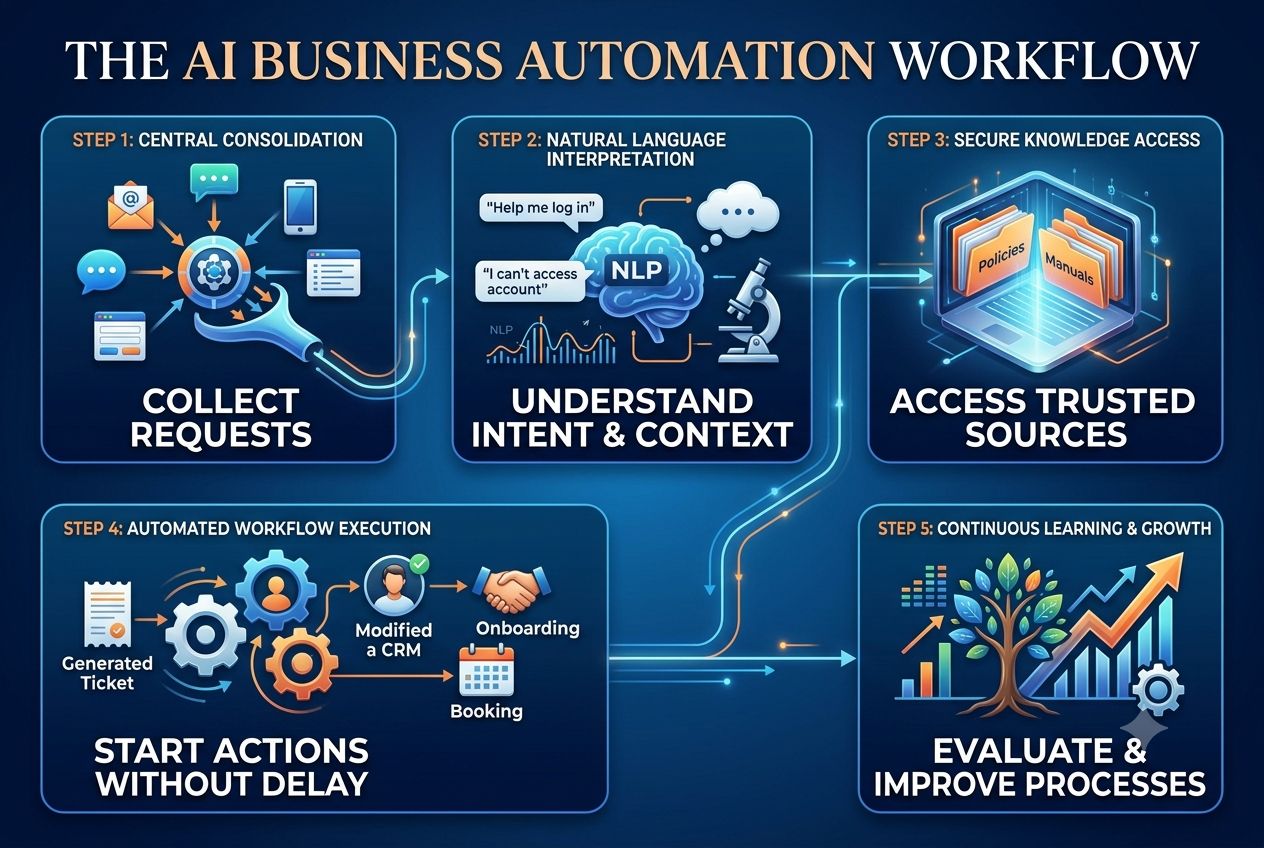
By grasping the concept of AI Business Automation, businesses can identify opportunities to optimize operations across the organization. Most intelligent automation platforms follow a similar workflow, though each is unique. AI processes, automates, and synchronizes information, decisions, and actions between interacting systems at every step. This means that processes are streamlined, decisions are made faster, and overall operational efficiency is enhanced. Moreover, every step leads to smoother workflows, more accuracy, and more consistent business outcomes.
Step 1: Process Requests at a Central Location
All AI Business Automation workflows start with a request. People and users are connected today via websites, live chat, e-mail, collaboration platforms, mobile apps, and internal portals. AI Business Automation consolidates incoming requests into a single system, speeding up and streamlining processing. For instance, employees can ask for information on the vacation policy in Microsoft Teams. All the while, another member of staff can file an IT support ticket on Slack, and a customer can begin a discussion on the company’s website. AI collects, categorizes, and formats the information for intelligent processing, regardless of the source. Therefore, organizations provide a uniform experience across all communication channels. Moreover, this one-to-one strategy reduces communication gaps, improves response times, and ensures that AI forwards every request to the right workflow.
Step 2: Interpret the Question
When a request comes into the system, it processes it using Natural Language Processing (NLP) technology to interpret what was intended in the request and what the message actually means. Unlike traditional keyword-based search, AI understands context, intent, and user needs.
For instance, the following questions are asking for the same thing:
How to reset my password?
I can’t log in to my account.
“Help me log in.”
Irrespective of the language used, AI knows that every request pertains to logging in to the account. This means the platform can provide quicker, more precise, and more relevant replies. Moreover, users can get the help they need without being able to ask the right questions. Overall, this contextual awareness enhances user experiences, boosts accuracy, and makes AI Business Automation more user-friendly and productive.
Step 3: Accessing Business Knowledge
Once the user’s query is identified by the AI, it accesses the most relevant business knowledge from trusted sources. Based on the nature of the query, the business knowledge accessed can be:
- Company policies
- Employee handbook
- Product manual
- Technical guidelines
- Standard operating procedure
- FAQs
Rather than providing hundreds of documents for the user to sift through, AI accesses only the most relevant information and provides concise, accurate answers. Employees save a lot of time accessing the required information, while clients get timely responses. Moreover, having a central repository of knowledge not only ensures that the information accessed is always up to date but also that the response provided is consistent.
Step 4: Execute Automated Workflows
Information provision is just one of many ways that AI Business Automation works. But the main thing lies in acting after all. Once AI comprehends the demand, it immediately starts executing business workflows without any additional effort from users.
So AI will be able to:
- Generate tickets
- Modify CRM entries
- Forward approval requests
- Arrange meetings
- Send notifications
- Assign tasks
- Start the onboarding process for new employees
- Complete service requests
As those workflows are integrated into different business systems, businesses can forget about routine operations that were previously performed manually. Thus, there is no need for employees to use multiple applications for their routine work. Additionally, such an approach enables AI to execute workflows much faster and more efficiently.
Step 5: Learning and Improvement Over Time
Unlike traditional automation, AI Business Automation learns and evolves continuously. Every time AI interacts, it provides important insights that organizations can use to improve their processes. It is possible to measure response accuracy, workflow effectiveness, customer satisfaction, and the frequency of frequently asked questions to assess automation results. The organization can use these insights to improve its workflows, processes, and user experience. This leads to more accurate recommendations, faster responses, and more efficient workflows. Moreover, it adjusts to organizational changes and improves decision-making abilities. In the end, organizations create an intelligent automation strategy that evolves with their growth and is not static.
Conclusion
AI Business Automation revolutionizes organizational operations by leveraging artificial intelligence and intelligent workflow automation. While traditional automation focuses on individual tasks, AI Business Automation integrates people, systems, and business processes to make operations more efficient, intelligent, and faster. Thus, organizations minimize manual work, make better decisions, and provide a better experience for employees and customers.
In addition, AI Business Automation constantly learns and improves. From analyzing user intent and acquiring business knowledge to executing workflows and evaluating performance, AI improves every aspect of an organization’s operations. Consequently, productivity increases, collaboration improves, and businesses become more adaptive to market changes.
As digital transformation accelerates, businesses that adopt AI-powered automation will gain an edge over competitors. With AI-driven processes, optimized workflows, and intelligent decision-making, organizations will be able to scale their operations while keeping effectiveness and the same level of service.
At Chatn.ai, we empower our clients to unlock the full benefits of AI Business Automation through intelligent workflow solutions that simplify complex processes and connect business systems to improve operational performance. Whether you want to automate internal operations, enhance customer service, or accelerate digital transformation, Chatn.ai provides the tools and expertise to help you achieve lasting business success.