

Websites have evolved from static brochures into intelligent systems that think and react in real time. The introduction of an AI Agent for Websites marks a new level in this transformation. The concept goes far beyond just being a chatbot or live chat tool. It not only responds to users but also understands their intentions and makes independent decisions.
In this blog, we will unravel everything about this technology, covering its key facets, including how it works and is implemented, and why it’s becoming a must-have for many companies.
Why Websites Need AI Agents Today More Than Ever
User expectations have changed. Demand immediate responses, personalized experiences, and seamless interactions on every site. Stop using outdated support techniques. These no longer meet modern expectations or deliver real-time interaction. Do not accept this gap between user expectations and website functionality. Act now to replace legacy systems that slow user interactions.
The problem with traditional websites
Traditional websites face persistent core issues that hinder user experiences and business outcomes. Chief among these challenges is static content that fails to adapt to individual user needs or intentions.
- Customer service often involves long wait times, especially during high demand.
- Limited website capacity leads to lag or dropped communication during peak times.
- Generic chatbots lack context and fail to convert users.
All of the above lead companies to miss opportunities to engage users and generate profits. To ensure survival and success, companies must take decisive action now: adopt a fully automated, AI-powered work model and make the transition today to remain competitive.
Definition of Website AI Agent
A website AI agent is an intelligent system that does more than answer user questions. It understands user intent, analyzes request context, and takes appropriate actions based on each situation.
Rather than providing simple answers, the agent can independently complete tasks such as facilitating purchases, making reservations, or solving problems. This transforms basic interactions into effective communication.
The website AI agent does not rely on static scripts or predefined decision trees. Instead, it uses advanced reasoning and situational awareness to tailor each interaction.

The Main Distinction between Chatbots and AI Agents
Understanding how a good AI agent differs from chatbots is essential. Despite their apparent similarities, chatbots and AI agents work quite differently.
Chatbots
- Tend to be script-based or follow a set of rules
- Cannot cope with more complicated issues
- Fall apart when faced with some unpredictable user actions
- AI agents, however, adopt a higher-level approach to interaction.
AI agents
- Use contextually based reasoning
- Adapt dynamically to new information
- Carry out complex tasks without help
- And learn from each new task performed.
In short, chatbots are limited to conversation, while AI agents act, solve, and adapt to achieve real outcomes.
How Do Website AI Agents Work?
To really appreciate the significance of these tools, it is important to examine their functioning in detail. In contrast to merely responding to input, the website AI agent performs much more, including processing data, making decisions, and performing actions based on that data.
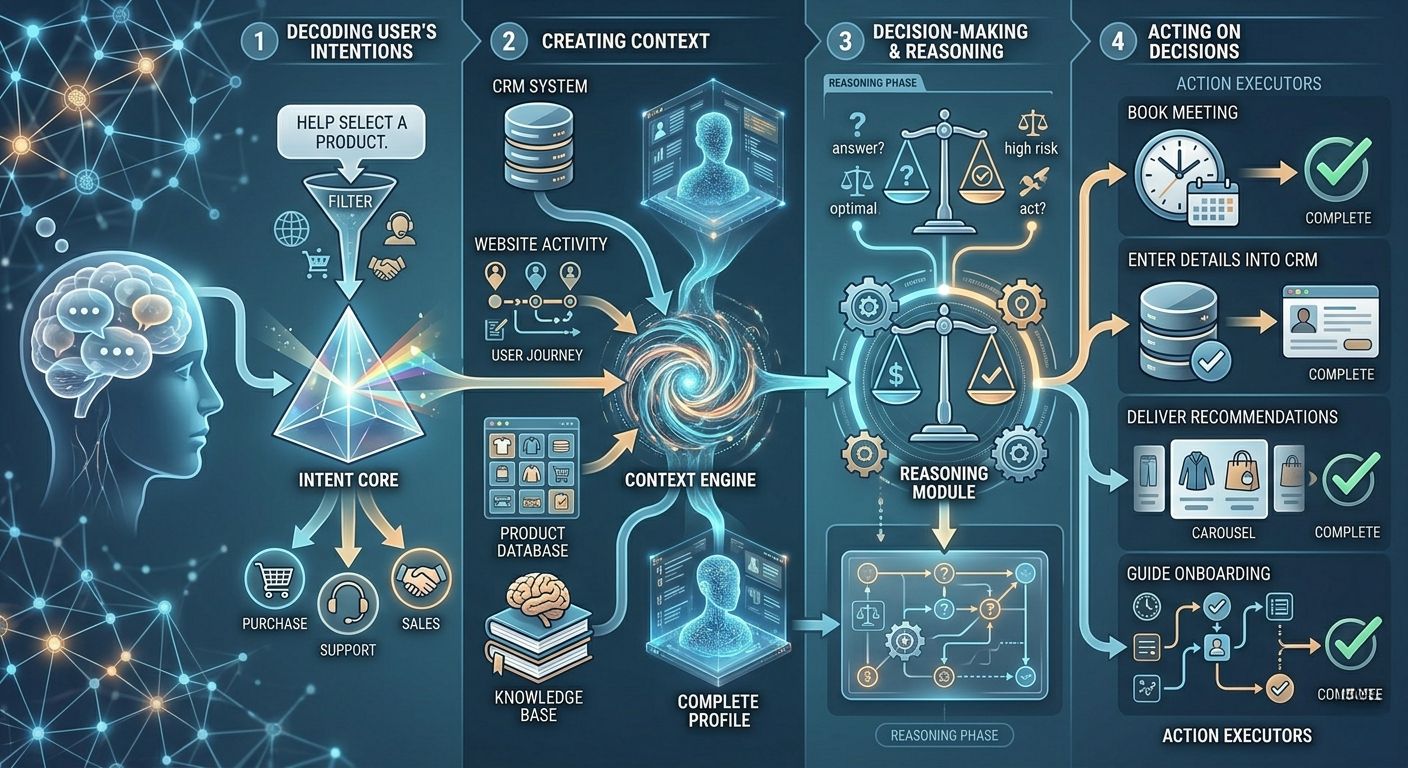
At a high level, a website AI agent goes through several stages to perform its tasks. In particular, it goes through four specific stages.
Step 1 — Decoding User’s Intentions
The system first seeks to understand the user’s intent—beyond keywords, it considers meaning and context.
Consider:
“I am looking for some help selecting a product” -> Purchase intention
“My order, where is it?” -> Support request
“How can I schedule a demo?” -> Sales intention
This enables the system to respond appropriately and stay relevant.
Step 2 — Creating Context
The AI system gathers context by collecting information from several sources, not just a single input.
These sources include a CRM system, website activity history, product databases, and a knowledge base.
By combining these inputs, the AI system forms a comprehensive picture of the user and delivers highly relevant, accurate answers tailored to their needs.
Step 3 — Decision-making and reasoning
This phase marks a key difference between AI-powered bots and traditional chatbots: while traditional bots simply follow set rules, AI bots actively assess situations to select actions.
Once the AI bot has analyzed the situation and evaluated all available options, it makes an optimal decision. Specifically, it determines whether the answer should be provided directly to the user, the issue should be escalated to the sales team, or an automated process should be initiated.
As a result, this decision-making capability enables proactive, goal-oriented behavior.
Step 4 — Acting on Decisions
At last, the agent goes beyond mere decision-making and executes its decisions. This means going beyond simply sharing information; the task is completed to provide an outcome.
Examples include: booking meetings in your calendar, entering user details into your CRM, delivering product recommendations based on user intent and activity, and guiding users through onboarding processes.
Ultimately, this means the AI agent not only initiates an action but also completes it, turning user interaction into something valuable for your business.
Advantages of Using an AI Agent on a Website
In this era of technological advancements, the transition to AI agents on websites is not only beneficial for businesses but also offers a more productive way to leverage these advantages. Let us discuss them in detail.
24/7 Intelligent Engagement
Unlike human teams, AI agents operate tirelessly. They consistently deliver uninterrupted engagement, with no pauses, breaks, or downtime. They respond instantly at any hour, guaranteeing users immediate support regardless of time zone or user volume.
Consequently, businesses enhance global reach and boost customer satisfaction through continuous, real-time interaction.
Improved Conversion Rate
Unlike any other platform, AI agents directly assist users in making their decisions at all times. Through this assistance, friction continues to be minimized as they provide users with the right information at the right time. Quick, personalized responses give users confidence to act, increasing conversion to paying customers.
Decreased Operational Costs
As companies grow, their operational costs tend to rise due to the increased demand for support services. With the introduction of artificial intelligence agents, however, the company began actively reducing the number of support staff members who had to handle mundane tasks. AI takes over tasks such as answering common questions, resolving basic support tickets, and running simple workflows.
Personalization
Beyond efficiency, AI agents elevate engagement by delivering personalized interactions. Rather than a generic approach, each exchange is specifically tailored to the user’s individual needs.
This is achieved by constantly adjusting responses based on factors such as user behavior on the platform, current user intent, and interaction history. By actively leveraging all this information, the AI crafts a uniquely tailored experience, fostering more impactful engagement.
Scalability of Performance
AI boosts engagement, efficiency, and performance scalability. Unlike conventional systems that lag under heavy traffic, AI systems adapt to demand.
These systems automatically scale to support more users, maintaining consistent performance and response quality. Users enjoy reliable service despite traffic.
AI Agent Applications on the Web
AI agents are already transforming business operations and visitor interactions on websites. Companies across industries have adopted AI agents into workflows and begun reaping benefits, making them indispensable to operations.
E-commerce websites
In the context of e-commerce, AI agents help shape the process of browsing for products, making choices, and buying. The user is no longer left alone with their tasks because AI helps them navigate more effectively and make better decisions.
Examples of AI agent actions include: Personalized product recommendations based on user behavior, cart recovery interventions to reduce abandoned purchases, and tailored shopping guidance.
As AI agents support users at every step, more success is achieved; therefore, it is easier to see increased conversion performance and a higher order value per sale.
AI in SaaS Platforms
In SaaS-based platforms, AI solutions automate the user journey from first touchpoint to full adoption. Users do not have to figure out the next steps on their own. The platform gives real-time guidance and support at each critical step.
AI-based solutions in SaaS applications perform activities such as:
- Guiding new users through onboarding
- Explaining product features
- Helping trial users become paying customers.
Service-based businesses
In service-based businesses, the AI agent directly optimizes customer engagement from the initial contact, enabling more efficient management of critical customer engagement activities in real time.
Some of these include:
- Booking appointments through automatic scheduling
- Lead qualification based on intent and readiness
- Responding to customer queries in real-time
Proactive management of these activities enables the AI agent to reduce inefficiencies and avoid redundant correspondence. This ensures the business can overcome any sales resistance.

The Difference between an AI Agent and a Traditional Chatbot
Most companies today are unable to distinguish between an AI agent and a chatbot because they look so similar in how they handle customer engagements. But upon closer inspection, one can easily notice that the distinction is much more profound than initially anticipated.
In contrast to regular chatbots, which follow pre-written scripts and use basic reasoning, AI agents process context, perform intent reasoning, and execute actions.
Challenges Businesses Face without AI Agents
The lack of AI agents leads to many operational and performance problems, affecting consistency and customer retention.
Typical Problems
Bounce rates are high because of the non-existence of instant assistance.
- Customer service that is too slow and unimpressive.
- Missed sales opportunities because of slow and general customer interactions.
- Inconsistency in the customer experience on different channels
Eventually, none of these issues will remain independent but will affect one another, resulting in negative revenue and reputational effects for companies.
The Future of AI Agents for Websites
AI agents are rapidly evolving, and with the relentless pace of technological advancement, their progress toward true independence is imminent.
In the coming years, these digital helpers will evolve into true digital workers able not only to interact with users but also to anticipate and complete tasks independently, transforming websites from merely reactive to proactive and intelligent ecosystems.
New Development Directions
Immediate priorities include anticipating user requests unprompted, enabling agents to collaborate on complex operations, automating all site-related tasks to minimize human intervention, and making decisions swiftly using real-time data.
As a result of these development directions, webpages will shift drastically from mere presentations of information to active, independent operations performed automatically and intelligently.
Conclusion: The Reasons for AI Agents to Become Critical Components
The use of AI agents on websites is no longer a future concept. It has become increasingly important for modern businesses in terms of competitiveness within the digital environment.
In addition, it enhances engagement, boosts conversions, lowers costs, and transforms the website from a static site into an active, continuously valuable business tool.
Firms adopting AI early gain superior performance and gain a measurable competitive advantage over slower innovators.
By using platforms such as Chatn.ai, organizations can deliver intelligent, autonomous, and scalable digital engagement with clients.
This transformation is already occurring. Websites have evolved from static informational pages to driving continuous value as intelligent business assets, making AI integration essential for future growth.