
In today’s rapidly evolving digital landscape, an increasing number of businesses are embracing artificial intelligence. (AI) to their advantage in terms of efficiency, customer service, and productivity. Two major AI technologies, in particular, are chatbots and virtual assistants. It is common to confuse them; nevertheless, they are distinct and offer their own unique benefits.
It is essential for companies that wish to make efficient use of AI to understand the differences between chatbots vs virtual assistants. These two technologies could completely transform customer engagement and process efficiency; however, the real power lies in knowing the proper timing and the optimal way to utilize each of them.
This article highlights the primary distinctions between chatbots and virtual assistants. We will also describe the advantages each can bring to your business, and, last but not least, we will assist you in determining which one is most appropriate for your company’s objectives. Your reading will provide a clearer understanding of these technologies, enabling you to make informed and strategic decisions.
What Are Chatbots?
Definition and Key Features
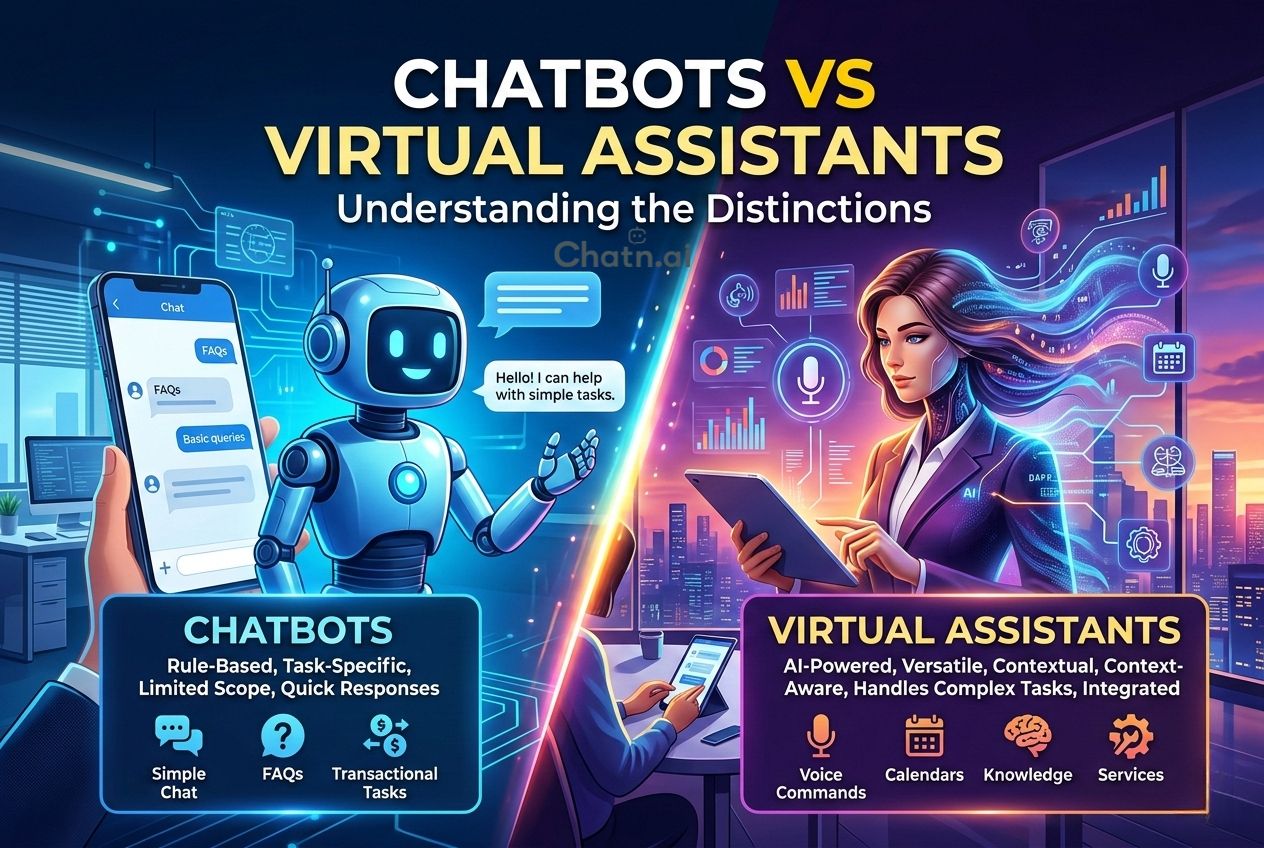
A chatbot is a software application created to simulate conversations with users. These interactions typically occur through text, although some chatbots also utilize voice. Chatbots use two main technologies: simple, rule-based algorithms or advanced AI.
Rule-based chatbots follow predefined scripts and respond based on specific keywords or commands. They are also skilled at repetitive tasks, such as answering frequently asked questions or assisting users with basic tasks.
Conversely, AI-based chatbots utilize machine learning and Natural Language Processing (NLP) to learn and comprehend more complicated queries by users. These bots can learn from interactions, improving over time to respond more effectively and provide a more personalized experience.
Use Cases for Chatbots
Chatbots have become essential tools in business, especially for automation and boosting customer engagement.
- Customer Support: Chatbots provide instant responses to common inquiries, ensuring support is available 24/7. This reduces wait times and enhances customer satisfaction.
- Lead Generation: By gathering key information from potential clients, chatbots can qualify leads and seamlessly pass them to sales teams for follow-up.
- E-commerce: Chatbots enhance the shopping experience by recommending products, tracking orders, and assisting with purchases, making the process smoother for customers.
Pros and Cons of Chatbots
- Advantages: Chatbots can operate 24 Hours, providing users with real-time responses. The availability will ensure high customer satisfaction and reduce waiting time. They also help reduce operational costs by automating routine tasks, allowing staff to focus on more complex issues.
- Disadvantages: Chatbots are only helpful in handling routine tasks, but are limited to preset scripts. As a result, they struggle with more nuanced or complex queries that require human judgment or deeper context.
In some cases, chatbots may not fully address customer needs, especially when the conversation moves beyond basic inquiries. For businesses with more diverse customer interactions, combining chatbots with other solutions can provide a more comprehensive service.
What Are Virtual Assistants?
Definition and Key Features
A virtual assistant (VA) is an advanced AI that helps users manage multiple tasks and interact with the virtual world. Virtual assistants offer a wider range of services compared to chatbots, including meeting scheduling and controlling smart home devices.
Some virtual assistants, including Siri, Google Assistant, and Amazon Alexa, communicate with users through voice recognition technology. Nonetheless, other virtual assistants can also be used through text, making them flexible enough to suit the user’s preference.
Use Cases for Virtual Assistants
Virtual assistants do not merely talk. They can:
- Personal Assistance: Make appointments, send reminders, and check the weather.
- Business Productivity: VAs integrate with applications like Google Calendar, email, and project management tools to help manage workflow applications, which assist in managing workflow.
- Smart Home Control: Virtual assistants can control lights, thermostats, and even play music in response to voice commands.
Pros and Cons of Virtual Assistants
- Advantages: Virtual assistants are very flexible and provide a user-focused experience to their users. They easily integrate into various applications, such as Google Calendar, email, and project management software, making them ideal for simplifying workflows. Having adapted to the needs of its users over time, it can perform a wide range of tasks, such as setting reminders and making intelligent suggestions.
- Disadvantages: However, developing and maintaining a virtual assistant tends to be more expensive than simpler solutions, such as chatbots. Their price also has restrictions, as they usually rely on the services and applications of a third party to function fully. This means that the virtual assistant’s performance can suffer if the integrations fail or change.
Chatbots vs Virtual Assistants: Key Differences
At this point, it is time to discuss the significant differences between chatbots and virtual assistants.
Purpose and Functionality
- Chatbots focus on handling simple, transactional tasks. They are geniuses at answering ordinary questions, making appointments, and receiving orders with speed and efficiency.
- Virtual Assistants: These are more than mere tasks. Virtual assistants are more advanced, organizing tasks, providing personalized recommendations, and utilizing a variety of services and devices to streamline everyday life processes.
Level of AI Integration
- Chatbots learn to follow a set of rules, making them ideal for performing routine tasks. Even AI-powered chatbots are typically focused on narrow tasks and struggle with more complex, dynamic queries.
- Virtual Assistants: Powered by advanced AI, virtual assistants use machine learning and Natural Language Processing (NLP) to understand and adapt to user needs. Over time, they improve their responses and can handle a broader range of tasks.
Interaction Style
- Chatbots: Typically limited to text-based interactions, chatbots focus on solving specific problems as quickly as possible.
- Virtual Assistants: These offer multimodal interactions, which include voice, text, and even proactive notifications, providing a more flexible and interactive experience.
Use Cases Comparison
- Chatbots are most effective in customer service teams, e-commerce sites, and lead qualification, as speedy and effective responses are vital.
- Virtual Assistants are best suited for personal productivity and task management, as well as for more dynamic settings such as smart homes, where coordinating various interconnected tasks is essential.
Which One Is Right for Your Business?
Choosing Between Chatbots and Virtual Assistants
When choosing between a chatbot and a virtual assistant for your business, keep the following factors in mind:
- Business Requirements: A chatbot is a cost-effective variant of automated customer service or a predefined procedure to assist users. A virtual assistant might be more suitable for you if you require the help of a tool that can remind you, help plan your schedule, or even organize projects.
- Difficulty: A chatbot should be enough when you have to do tasks that are highly structured, with repetitive features. A virtual assistant is more applicable in practices that involve decision-making, multistage, and require one-on-one interactions.
- Cost: Chatbots are generally cheaper to create and deploy than virtual assistants, which often require more sophisticated AI functions and integration with various systems.
Cost Considerations
- Chatbots: Tend to be more affordable for businesses just starting with AI. They are quick to implement and maintain, especially when using rule-based models.
- Virtual Assistants: Tend to require a higher investment in terms of both development and ongoing maintenance. However, the broad range of features they offer may justify the cost for businesses with more complex needs.
Real-World Examples: Chatbots vs Virtual Assistants in Action
Chatbot Examples
- E-commerce: Among the best online shops, a chatbot is available to help customers find products, track their availability, and place orders.
- Healthcare: A hospital utilizes a chatbot to address frequently asked questions about appointment availability, treatment types, and insurance-related inquiries.
Virtual Assistant Examples
- Smart Homes: Amazon Alexa is a virtual assistant that allows you to use voice commands to turn lights on and off, set timers, and order items.
- Business: Google Assistant helps business professionals manage their email, meetings, and reminders within a single ecosystem.
The Future of Chatbots and Virtual Assistants: What’s Next?
Evolving Technology
Chatbots and virtual assistants are both moving at a rapid pace. With the advances in AI, especially the Natural Language Processing (NLP), such applications are now able to perform fluent and natural-like dialogues. In the near future, chatbots and virtual assistants will be able to perform more complicated tasks more accurately and efficiently than before.
Merging of Chatbots and Virtual Assistants
In the future, we can develop hybrid models with more comprehensive virtual assistant functions and improved chatbot efficiency. Such a combination would provide the companies with the golden mean of both worlds, automating repetitive procedures and addressing more complex inquiries without any issues.
Conclusion: Chatbots vs Virtual Assistants – Which Should You Choose?
Conclusively, which one to use, chatbots or virtual assistants, depends on your business requirements, budget, and how complicated you need to automate your tasks. Use chatbots for simple, repetitive tasks, and deploy virtual assistants in businesses that require advanced functionality and multi-platform integration.
Knowing the significant differences between the two AI-driven solutions, you will be able to make a wise decision that will help to simplify your business activities, enhance satisfaction among clients, and stimulate productivity.
If you’re ready to implement AI-powered solutions for your business, whether it’s a chatbot for customer service or a virtual assistant for business productivity, Chatn.ai is here to help. Contact us today to learn how we can help you integrate the perfect solution for your needs!