
Businesses automate more processes every year. However, automation alone does not guarantee better operations. In fact, a company can automate a slow process and still end up with a slow process. Similarly, another chatbot will not fix a flawed workflow behind customer requests. Likewise, connecting systems does not automatically improve how teams move work between them.
That is where AI Process Intelligence creates a different opportunity. Instead of asking, “What can we automate?” businesses can first ask, “How does this process actually work?”
By answering that question, organizations can understand how work moves across their operations. AI Process Intelligence combines process data, artificial intelligence, analytics, and automation to uncover workflow patterns.
As a result, businesses can identify bottlenecks, repeated tasks, delays, and process variations. More importantly, teams can use these insights to determine what should change. Ultimately, this approach shifts the focus from isolated automation to smarter, more connected processes that improve how work runs. Start by asking how each process actually works, then use the insights to decide what should change next.
What Is AI Process Intelligence?
AI Process Intelligence uses artificial intelligence to understand, analyze, and improve business processes. Traditional process analysis often relies on interviews, spreadsheets, process maps, and manual reviews. These methods can provide useful insights. However, they may not show how employees and systems work together each day so businesses can miss inefficiencies in their workflows.
AI Process Intelligence takes a broader approach. It analyzes process activity and identifies patterns across workflows. It also helps teams find where work slows down, repeats, or requires unnecessary effort. For example, imagine a customer request moving through five systems. The documented workflow may appear simple, but the actual process may involve repeated data entry, manual approvals, unclear ownership, and multiple follow-ups. Consequently, these issues can remain hidden without clear process-level visibility. By analyzing how work moves, AI Process Intelligence helps organizations uncover these problems and identify opportunities for improvement. Use this insight to improve workflows, address inefficiencies, and drive better outcomes.
AI Process Intelligence vs. Traditional Process Analysis
Traditional process analysis provides a snapshot of a workflow, while AI Process Intelligence offers a dynamic and comprehensive view. Instead of manually reviewing one workflow at a time, teams can analyze large volumes of process activity to identify recurring patterns, unexpected variations, and inefficiencies more quickly. Moreover, AI can help teams understand how processes perform in real-world situations. Therefore, businesses should use these insights to make more informed decisions based on actual workflow behavior rather than assumptions or outdated process maps, strengthening process improvement efforts and results. Act on these insights to improve decisions and workflows.
AI Process Intelligence vs. Process Automation
These concepts work together, but they serve different purposes. While process automation executes tasks, AI Process Intelligence helps organizations understand the processes behind those tasks. This distinction matters because businesses should not automate every inefficient step. Instead, teams should first identify the cause of an inefficiency and determine how it affects the overall workflow. Once teams understand the root cause, they can choose the most effective solution. For example, they might redesign the process, introduce automation, apply AI, or involve human expertise. Ultimately, AI Process Intelligence helps businesses make smarter automation decisions rather than simply automating more tasks.

Why Businesses Struggle to See Their Real Workflows
Modern business processes rarely live in one system. Instead, work moves across applications, teams, databases, communication platforms, and customer-facing channels. Consequently, leaders may struggle to see the complete process.
Work Happens Across Too Many Systems
A single customer request can pass through several systems before completion. For example, a customer might begin a conversation with a chatbot. Then, the chatbot may send information to a CRM, while a support platform handles the next step. Finally, an employee may need to complete the request manually. Although each system may work well independently, the overall process can still create delays and unnecessary effort. Disconnected systems can also force employees to move information between platforms or repeat tasks. As a result, businesses may struggle to understand where workflow problems occur. Use AI Process Intelligence to help organizations connect these activities and examine how work moves across systems. By doing so, teams can uncover bottlenecks, reduce unnecessary steps, and create more efficient workflows.
Manual Work Creates Invisible Bottlenecks
Small manual tasks can create significant delays. For example, employees may copy information between systems, check request statuses, wait for approvals, or search for information before completing a task. Although each action may seem minor, these tasks can quickly consume valuable time. Moreover, employees repeat them across hundreds or thousands of interactions, increasing the overall workload.
As a result, teams may spend more time managing processes than serving customers or completing higher-value work. Therefore, businesses should identify where manual effort accumulates, determine which tasks create the most friction, and act on those areas first.
AI Process Intelligence helps teams uncover these hidden bottlenecks. Analyze workflow activity to reveal repetitive tasks, unnecessary delays, and opportunities to improve or automate the process, so teams can focus their efforts where they matter most.
Teams Often Optimize Tasks Instead of Processes
Businesses often focus on improving individual tasks, such as automating an email, introducing a chatbot, or simplifying a form. Although these changes can improve specific activities, they may not solve problems in the larger workflow.
In many cases, improving one task shifts the bottleneck to another stage. As a result, teams may see limited gains even after investing in new technology. Instead, businesses should examine the entire process from beginning to end. Analyze each stage to identify delays, unnecessary handoffs, repeated work, and gaps between tasks. Then focus on the stages that create the biggest bottlenecks.
Ultimately, this broader perspective helps organizations solve process-level problems rather than improve individual activities. Apply this perspective now to address the workflow as a whole.
The Business Benefits of AI Process Intelligence
AI Process Intelligence can improve more than operational efficiency. It can help businesses make better decisions about how work should happen.
Greater Process Visibility
First, AI Process Intelligence gives leaders a clearer view of how workflows actually operate. Teams can see where tasks slow down, repeat, or require unnecessary handoffs. Moreover, this visibility helps leaders identify process problems more quickly. Therefore, they can act on workflow data to prioritize improvements rather than relying on assumptions. Ultimately, better process visibility helps businesses make smarter decisions, improve workflows, and strengthen performance. Leaders should use this visibility to drive those improvements.
Faster Workflow Optimization
Moreover, teams can spend less time guessing where inefficiencies exist. Instead, they can use real process data to pinpoint problem areas and focus their improvement efforts. As a result, teams can prioritize the workflows that need the most attention. This data-driven approach also helps them make faster decisions and address inefficiencies with greater confidence. Ultimately, AI Process Intelligence helps businesses optimize workflows more efficiently and focus resources where they can have the greatest impact.
Reduced Operational Friction
By removing unnecessary steps, businesses can make workflows easier for employees and customers. Simpler processes can reduce delays, confusion, and repetitive work. Streamlined workflows help employees complete tasks with fewer interruptions. Customers can also move through processes with less friction and fewer unnecessary interactions. As a result, businesses can improve operational efficiency while creating smoother experiences. To do this, businesses should remove unnecessary steps and simplify processes wherever possible. Reducing process friction helps organizations build workflows that work better for everyone.
AI Process Intelligence and Intelligent Automation
AI Process Intelligence and intelligent automation work best together. Process intelligence helps organizations understand the workflow. Automation helps them execute improvements.
Together, they create a continuous cycle:
Observe → Understand → Improve → Automate → Measure → Optimize
From Workflow Visibility to Action
Although process insights can reveal important problems, they create real value only when teams act on them. Once teams identify a bottleneck, they should move quickly with a practical strategy to address its root cause. For example, redesign the workflow, remove unnecessary steps, or introduce AI and automation. However, do not automate every problem discovered. Instead, evaluate the process and choose the solution that best fits its needs. Ultimately, choose the approach that best fits the workflow, business goals, and needed human involvement.
Connecting AI Insights With Automated Workflows
Modern AI systems can support far more than information retrieval. They can help businesses route requests, collect information, trigger actions, update systems, and escalate complex situations. AI can connect these actions across different stages of a workflow. Teams can turn process insights into practical improvements rather than leaving valuable information unused. In turn, this connection bridges process intelligence and operational execution. Ultimately, businesses can use AI-powered workflows to respond faster, reduce manual effort, and create more connected processes—so teams should act on these capabilities now.
Keeping Humans in the Loop
Businesses should identify where human intelligence adds the most value and assign repetitive tasks to AI. This allows teams to focus on work that requires judgment, creativity, and experience, while personnel review exceptions, manage complex cases, and make context-driven decisions.
Companies should clearly distinguish between automated and manual tasks. This clarity ensures teams understand when AI operates independently and when human intervention is needed. As a result, organizations can improve efficiency without sacrificing accountability or oversight. Effective automation enhances, rather than replaces, human skills. By combining AI with human judgment, companies can create more powerful and adaptable workflows.
Common AI Process Intelligence Mistakes to Avoid
AI Process Intelligence can create significant value. However, businesses can still approach it incorrectly.
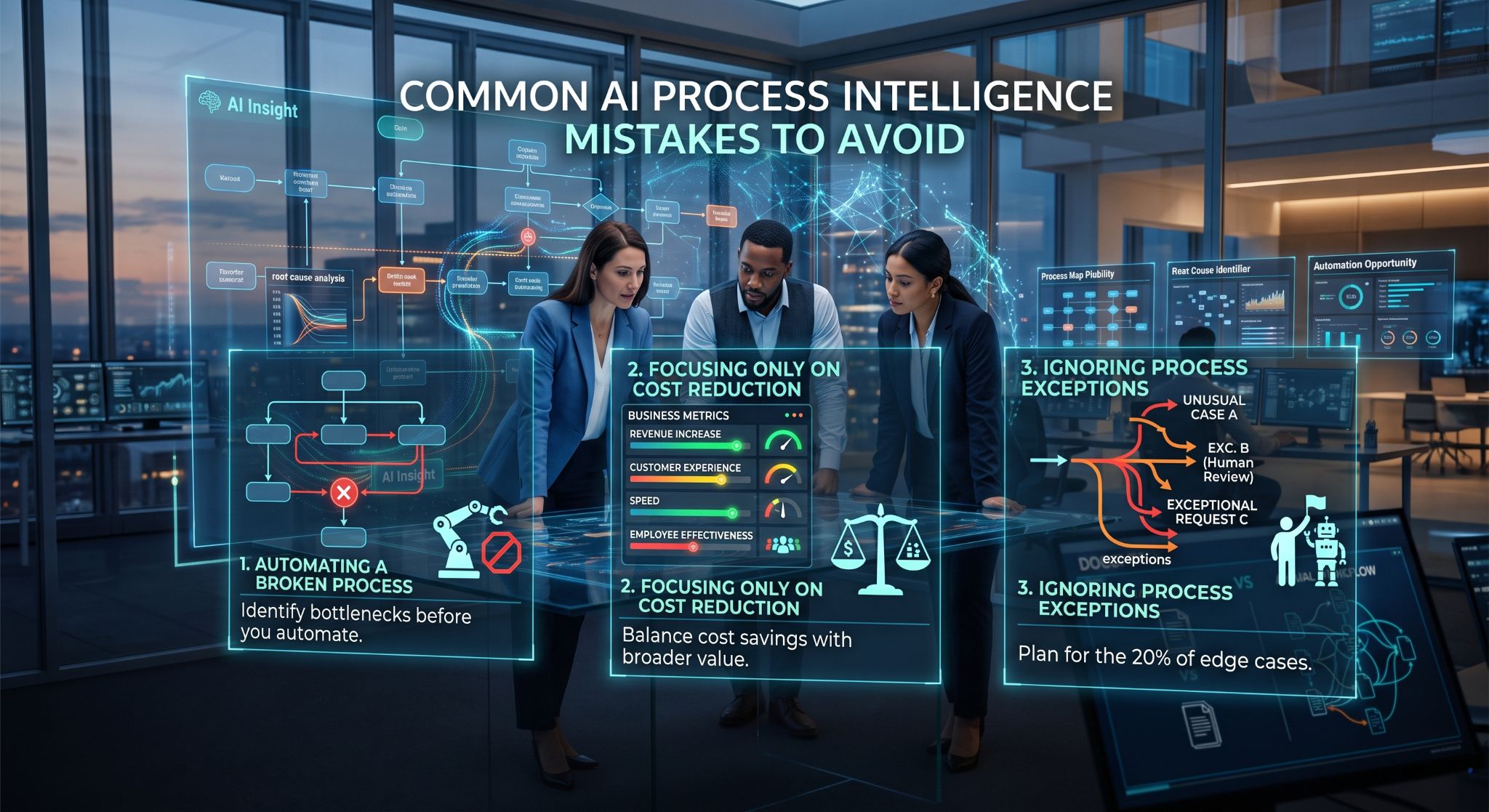
Automating a Broken Process
Automation isn’t a magic solution to an inadequate workflow. Rather, teams have to learn how the process functions and where issues lie. After that, they can eliminate unnecessary steps, iron out the kinks, and streamline the workflow. They should automate the appropriate tasks only after that. This is the way to set up efficient workflows, not just automate inefficient workflows.
Focusing Only on Cost Reduction
While reducing costs is important, businesses should also assess automation’s impact on quality, speed, and both customer and employee experiences. Consider whether automation improves accuracy, reduces delays, and supports employee effectiveness. Evaluating these factors together enables businesses to develop automation strategies that provide lasting value, not just immediate savings.
Ignoring Process Exceptions
Real workflows rarely follow one perfect path. Instead, teams often encounter exceptions, unusual cases, and unexpected requests. Therefore, AI strategies should account for these situations rather than relying solely on standard workflows. Moreover, businesses should define clear rules for handling exceptions and determine when employees need to step in. By planning for these scenarios, organizations can build more reliable automation and maintain better control over complex processes.
The Future of AI Process Intelligence
AI Process Intelligence is moving process optimization toward a more proactive model. Businesses can increasingly use AI to identify patterns and anticipate potential problems.
From Reactive Analysis to Predictive Processes
Traditional analysis often detects problems only after they occur. AI enables organizations to identify early warning signs and patterns that indicate potential issues, allowing teams to address threats before they affect operations. By adopting AI, enterprises can shift from reactive analysis to proactive and resilient decision-making.
From Recommendations to Autonomous Actions
AI systems can now increasingly go beyond opportunity identification and support appropriate actions. For instance, if there’s a common time-consuming workflow problem, an AI system could automatically trigger a specific action. This enables teams to solve common issues quickly and saves time on mundane tasks. But when things call for more context or judgment, employees can still review actions. This is the right balance that will enable businesses to automate repetitive decisions and have humans in the loop when needed.
From Individual Automation to Connected Operations
It’s not just about more automated tasks. Rather, organizations need to develop more connected processes. AI, workflows, business systems, and human expertise dovetail to streamline operations and enhance decision-making for companies. Furthermore, this integrated system enables teams to share information, minimize process gaps, and adapt to evolving needs faster. By pairing the right technologies with the right people, organizations can create more intelligent, efficient and adaptable operations.
Conclusion: Make Every Business Process Smarter
Automation should not be adopted solely because it is possible. Businesses need solutions that genuinely improve effectiveness. AI Process Intelligence delivers value by analyzing workflows to identify bottlenecks, repetitive tasks, and process patterns, which supports better operational decisions. Teams can use these insights to implement intelligent automation and accelerate processes.
A step-by-step approach is most effective:
- Understand the process.
- Identify the friction.
- Improve the workflow.
- Automate intelligently.
- Measure the outcome.
It is essential to involve people when human judgment and expertise are needed. AI should help employees work smarter, not harder. By combining AI with human skills, organizations can build stronger operations. AI Process Intelligence helps organizations move from isolated tasks to integrated, smarter workflows. Intelligent interactions, combined with effective processes, can improve customer experiences, optimize operations, and drive long-term efficiency.