


Introduction: Customer Communication Needs to Be Smarter
As businesses expand, customer communication becomes more complex. Increased customer volume leads to more inquiries, while expectations for support across multiple channels continue to rise. Manual communication can quickly overwhelm customer-facing teams, who may spend significant time on repetitive questions rather than addressing unique customer needs. AI-based customer communication offers a valuable solution. By leveraging artificial intelligence, businesses can identify customer intent, deliver relevant responses, and automate routine interactions.
What Is AI Customer Communication?
AI Customer Communication refers to the application of artificial intelligence to help companies communicate better with their clients. It can utilize a combination of conversational AI, natural language processing, automation, knowledge management, and customer information. All of this helps companies to understand requests and provide relevant answers. Nevertheless, AI customer communication is not limited to automated responses. Today’s technology allows understanding intents, retrieving information, guiding clients, performing actions, handling escalations, and identifying conversation patterns. That is why the scope of AI customer communication is wider than just chatbot automation.
AI Customer Communication vs. Traditional Customer Communication
AI Customer Communication vs. Chatbots
While a chatbot may be part of an AI customer communication strategy, these terms are not interchangeable. For instance, a simple chatbot might respond to specific queries or take predetermined steps during a dialogue. At the same time, AI customer communication enables intent recognition, personalization, knowledge retrieval, process automation, and escalation of complex dialogues to human agents. Furthermore, AI-driven customer communication enables the connection of customer interactions to company processes. Therefore, customers will receive relevant information and have opportunities to complete certain actions. This difference is crucial. Businesses need to build an AI-powered dialogue strategy not only to make a chatbot talk but also to understand their customers better, provide relevant assistance, and bring all conversations to valuable conclusions. Overall, successful customer communications via AI will help customers progress further and enable employees to concentrate on human-driven dialogues.

Why Customer Communication Is Becoming an AI Problem
The clients’ expectations have changed greatly. Nowadays, customers expect prompt, relevant responses whenever they contact businesses. However, clients want their needs recognized rather than receiving a generic response from businesses. Thus, it becomes necessary for enterprises to establish a communication experience that will be both timely and useful. In addition, the volume of client communication is rising continuously. Companies have to answer queries about products, services, accounts, orders, onboarding, and support across different communication channels. As a result, it may become difficult for employees to deal with all communications manually. Repeated queries may consume precious time and cause delays in response. Luckily, applying AI to client communication will solve many problems for the business.
Customers Expect Immediate Answers
It is important to understand that slow communication can generate dissatisfaction right away. In general, many customers expect quick answers from businesses without delay. Sometimes, the customer may choose not to purchase or go to another provider because they have to wait too long for an answer. Hence, fast communication can give companies a significant competitive edge. Fortunately, AI can answer many customer questions immediately. In addition, AI technology can help customers outside regular business hours. In other words, customers will be able to receive help even if the company’s representatives are not available at that moment. At the same time, employees will be able to focus on complicated requests.
Communication Happens Across Multiple Channels
A conversation with a customer does not usually take place in a single channel. On the contrary, conversations with customers usually start on websites, proceed through messaging, email, etc. Specifically, a customer might start a conversation on a website and continue it via messaging. But disconnected systems prevent businesses from retaining useful conversational context when switching between channels. This means that a customer has to repeat all their previous statements, while a business representative has to search for previous messages. Luckily, AI technologies allow companies to achieve consistent communication across different customer channels. Moreover, AI helps businesses maintain relevant conversational context and enable connected interactions. Thus, instead of viewing each conversation separately, businesses can create a connected customer communication experience.
Repetitive Questions Consume Employee Time
Often, employees spend a lot of time repeating the same customer questions. Therefore, repetitive communication might be unproductive and eat into the time employees have to complete other tasks. For instance, clients may inquire about prices, products, accounts, availability, or basic technical issues. Although these questions are relatively simple, they may take a long time to answer manually. However, automation can easily handle repetitive client communications. Moreover, AI may help answer questions rapidly and consistently while reducing unnecessary communication queues. Therefore, employees will have enough time to handle more complex queries and build relationships with clients. In addition, employees can make decisions that require human intervention.
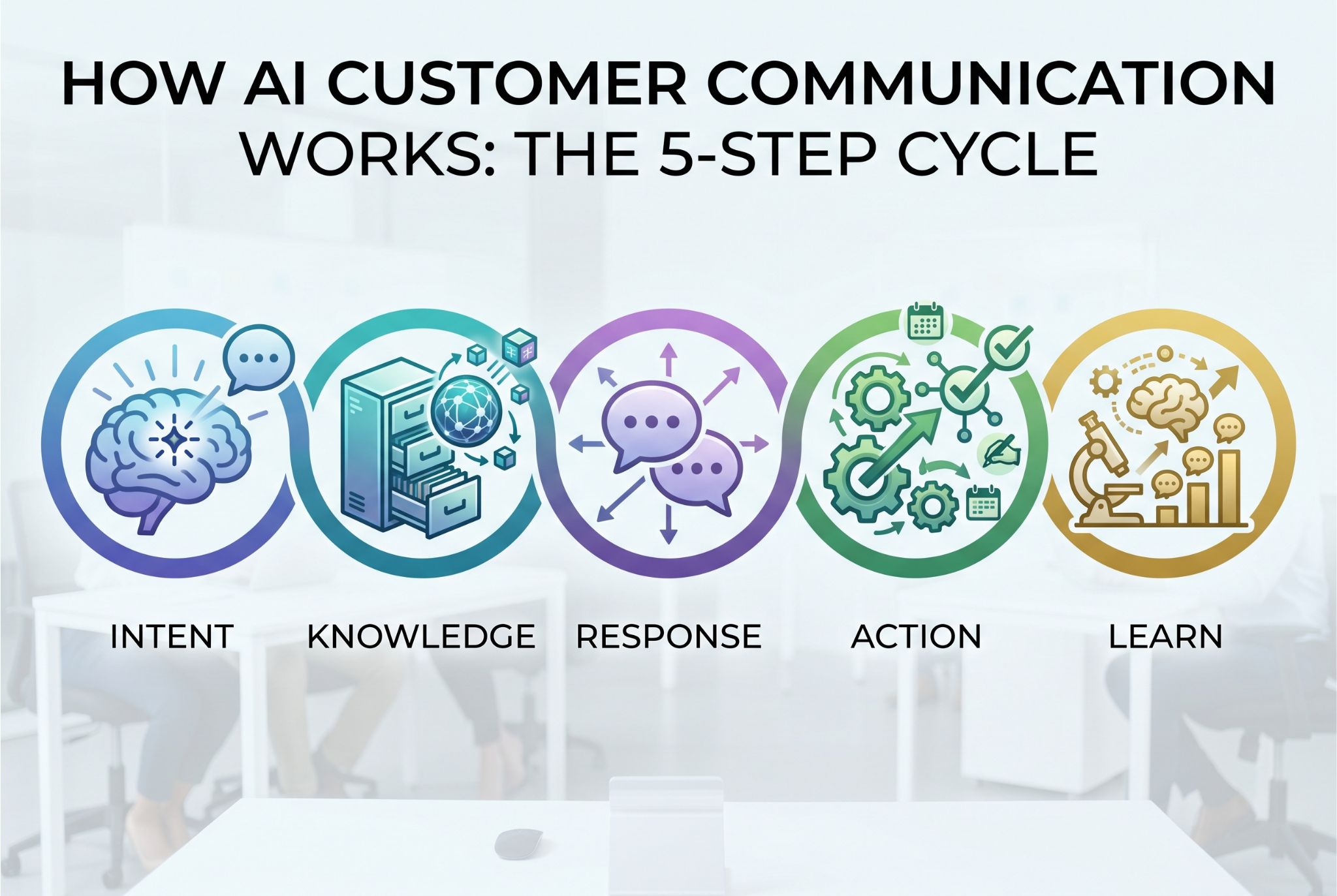
How AI Customer Communication Works
Effective AI customer communication follows a simple but powerful process:
Understand → Retrieve → Respond → Act → Learn
Each stage contributes to a better customer interaction.
1. Understand Customer Intent
First, AI needs to understand what the customer wants to achieve. Natural language technology helps AI interpret everyday language and identify the meaning behind each request. Natural language technology can help businesses understand customer intent. This technology enables AI to read the meaning of customers’ language rather than the specific keywords. This means customers do not have to worry about asking questions differently to make the AI work. For instance, when a customer asks, “Can somebody assist me to update my subscription?”, the AI will understand that the customer intends to change their subscription. In summary, the system can focus on the underlying intent rather than just specific keywords used.
2. Retrieve Relevant Information
Then, AI requires access to reliable and relevant information. Otherwise, even if the response is well written, it will not meet the customer’s needs. Thus, firms need to link AI to reliable, approved sources of information. They can include product information, firm policies, FAQ pages, services, and other relevant knowledge. Moreover, firms must update this information and ensure it is properly structured. This allows the AI to retrieve the right information for customer queries, enabling it to provide relevant and accurate answers. Reliable firm knowledge is very important for building firm-customer trust and communication.
3. Generate a Relevant Response
After AI has comprehended the customer’s query and retrieved the correct data, it is ready to generate a relevant response. However, it should do more than produce a technically correct answer. On the contrary, AI should tailor every response to a customer’s specific question, context, and intention. Also, personalization may increase the relevance of customer communication. For instance, AI will be able to provide information relevant to the customer’s needs by using the conversation context. Thus, customers will have to waste less time looking for an answer or explaining themselves. Besides, AI will be able to avoid generic responses and direct customers to the most relevant information or next steps. In turn, it will increase the relevance of customer interactions.
4. Take the Next Action
This is where AI-powered customer communication gets even more effective. Rather than simply responding to a query, AI can help customers complete their next actions to assist customers in making their requests, supplying necessary information, routing their queries, scheduling activities, or initiating business processes. Besides, with connected workflows, AI will go further than merely communicating to deliver tangible customer results. Thus, customers will be able to perform routine actions without unnecessary delays or further support calls. Meanwhile, employees will have the opportunity to reduce manual labor and focus on more complex matters. In essence, AI will not only communicate but also make a pathway to action.
5. Learn From Communication Patterns
Customers’ communications contain important data. Additionally, each communication can provide insight into what customers want, where they face challenges, and the questions they ask most frequently. Businesses can identify patterns by analyzing recurring questions, challenges, communication gaps, and other issues. As a result, teams can better understand customer needs and identify areas for improvement. These insights can also guide updates to products, documentation, workflows, and other parts of the customer experience. Finally, companies can convert customer conversations into knowledge to improve their service delivery.
AI Customer Communication Needs More Than Automation
Automation alone does not guarantee better communication. Poorly designed AI can frustrate customers just as quickly as slow human support. Therefore, businesses need a thoughtful strategy.
Give AI Access to Reliable Business Knowledge
Access to reliable information is necessary for successful communication. Thus, it is necessary to establish a connection between AI and trustworthy business knowledge and to monitor it regularly. Besides, updating outdated information will help ensure that AI provides relevant and consistent answers.
Create Clear Human Escalation Rules
At the same time, customers should know the conditions for getting assistance from an employee. For instance, certain situations may be defined by businesses where human intervention is needed. In this way, guidelines will help avoid conversation loops and enable customers to contact an appropriate employee.
Protect Customer Data
Customer communication includes sensitive information that needs protection. Thus, it is necessary to ensure the security of customer data during each interaction with AI. Before developing AI communication, companies need to create an effective data protection policy, access control, and governance. In addition, all security measures should be regularly reviewed and controlled.
How Chatn Helps Businesses Improve Customer Communication
From Conversations to Actions
Keep Humans Where They Add the Most Value

The Future of AI Customer Communication
Customer communication is moving beyond simple question-and-answer exchanges. Businesses now prioritize connected experiences that help customers achieve their goals. In the future, businesses will create smarter, more connected customer journeys. They will move from reactive communication to proactive engagement, focusing on helping customers complete specific tasks rather than only answering questions. What is more, businesses will have an opportunity to integrate their customer communications into various channels. This way, customers will be able to communicate with them and have a consistent experience as they move from one channel to another. In addition, businesses can use AI to understand customers’ intentions and use connected workflows to guide the conversation towards the desired action. At last, the future of AI in customer communication should not involve eliminating humans. It should combine AI with human efficiency and expertise.
Frequently Asked Questions About AI Customer Communication
What is AI customer communication?
AI customer communication uses artificial intelligence to help businesses understand, manage, personalize, and automate customer interactions.
How does AI improve customer communication?
AI can reduce response times, automate repetitive requests, personalize interactions, provide consistent information, and route complex conversations to employees.
What are examples of AI customer communication?
Examples include AI-powered support, automated customer inquiries, lead engagement, onboarding assistance, product education, and intelligent conversation routing.
Can AI personalize customer communication?
Yes. AI can use conversation context and relevant customer information to provide more personalized and useful interactions.
What is the difference between AI customer communication and chatbots?
Chatbots are one application of AI communication. AI customer communication can also include personalization, workflow automation, knowledge retrieval, analytics, and human escalation.
Is AI customer communication suitable for small businesses?
Yes. Small businesses can begin with focused use cases, such as answering common questions or automating repetitive customer requests.
How can businesses measure AI communication performance?
Businesses can track response time, resolution rate, customer satisfaction, conversation completion, escalation rate, employee time saved, and customer engagement.
Conclusion: Make Every Customer Conversation More Valuable
But businesses require more than just regular customer interaction. They require valuable interactions at every point of the customer’s journey. By leveraging AI Customer Communication, businesses can uncover customer intent, deliver quicker responses, personalize their interactions, automate repetitive tasks, and align conversations with actionable steps. But effective AI communication goes beyond just automation. Businesses need reliable information, intelligent workflows, clear escalation policies, a secure data management system, and continuous optimization. Additionally, businesses should prioritize the customer experience in their interactions. This not only enhances communication but also maintains a personal touch in business. Simultaneously, AI can free up time for employees to concentrate on more complex tasks, foster customer relationships, and make decisions that demand human judgment. In conclusion, businesses can use these conversations to enhance customer experiences and meet business objectives. Chatn helps businesses make this transition with efficient, AI-powered customer communication.