

Businesses now rely on more digital tools than ever, yet increased technology does not always result in higher productivity. Employees often switch between applications, search for information, and repeat routine tasks, which can consume significant time. An AI Business Assistant offers a solution. Rather than adding another isolated tool, firms can use AI to help staff access information and manage workflows more efficiently. With the right AI business assistant, employees can quickly find answers, complete tasks, and improve processes. This allows teams to spend less time searching and more time on productive work. AI also reduces inefficiencies and improves team collaboration. Organizations can focus on automating specific tasks where AI delivers the most value, rather than automating everything.
Ultimately, the goal is simple: AI should make work easier, more integrated, and more efficient for businesses.
What Is an AI Business Assistant?
An AI Business Assistant uses artificial intelligence to assist companies, their employees, and clients with specific tasks. Unlike conventional software applications, an AI Business Assistant allows users to interact with technology using natural language. Specifically, users are free to make requests, ask for information, or assistance with following the correct process.
After that, the assistant analyzes each request and either provides information or guides the user through the appropriate workflow. Thanks to that, users will be able to receive all the necessary support much more quickly, without needing to navigate several different systems and interfaces.
Depending on the particular solution, an AI Business Assistant may assist businesses with the following tasks:
- Answering standard business-related questions
- Providing access to internal information
- Helping with employee self-service
- Automation of routine tasks
- Guidance through business workflows
- Connecting users with needed resources
- Assisting with customer interaction
- Making information accessible
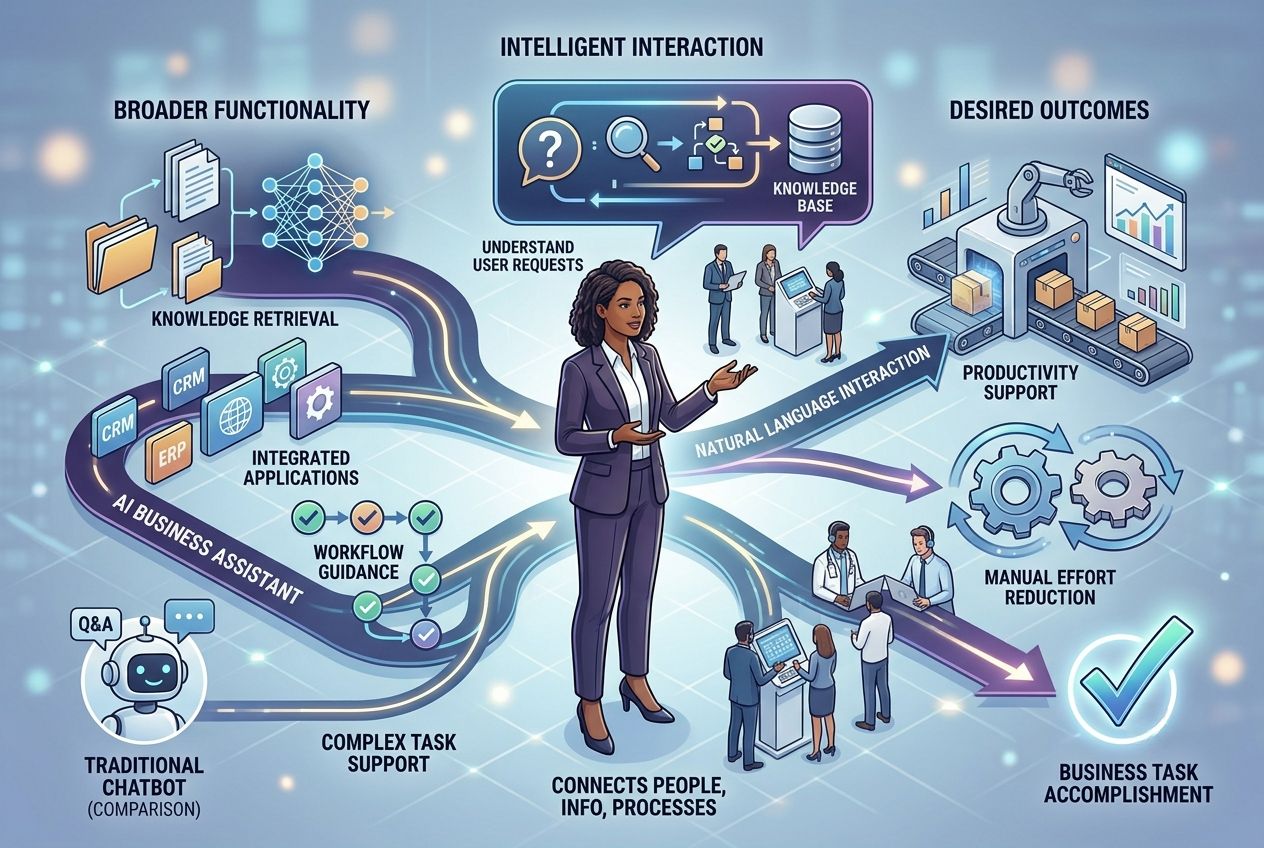
In addition, businesses may use all of the listed capabilities to optimize interactions and reduce any manual efforts. As a result, an AI Business Assistant creates the link between people, information, and business processes.
How an AI Business Assistant Works
The process begins when a user submits a request, such as asking about a company policy or a specific business process. The AI system analyzes the request to identify the user’s intent, then retrieves relevant information or guides the user to the appropriate next step.
Advanced AI Business Assistants integrate with business applications, knowledge bases, and workflow tools to deliver more tailored support based on user needs. Although interacting with an AI Business Assistant appears straightforward, it relies on technologies such as natural language processing, generative AI, knowledge retrieval, machine learning, and workflow automation. These technologies enable the assistant to understand user requests and respond effectively, allowing users to interact with business systems quickly and naturally.
AI Business Assistant vs. Traditional Chatbot
An AI Business Assistant and a traditional chatbot may appear similar. However, they often serve different purposes and support different business needs. A traditional chatbot typically focuses on answering questions or guiding users through predefined conversations. In contrast, an AI Business Assistant takes a broader approach to user support.
For example, an AI Business Assistant can help users access information, understand business processes, and navigate relevant workflows. Additionally, it can support employees in completing routine tasks and finding the resources they need. In simple terms, a chatbot primarily focuses on conversation. Meanwhile, an AI Business Assistant combines conversation with assistance, information access, and productivity support. However, the distinction is not always absolute. In fact, an AI Business Assistant can include chatbot capabilities while offering broader functionality.
Ultimately, the key difference lies in the desired outcome. While a chatbot may focus on answering a question, an AI Business Assistant can help users take the next step and accomplish meaningful business tasks more efficiently.
Why Businesses Need an AI Business Assistant
In contemporary times, businesses face various productivity issues. Nowadays, employees have to work with emails, documentation, various applications, meetings, customer inquiries, and internal business processes each day. As a result, an easy task might take some time to complete due to its complicated nature. For instance, searching for a specific piece of data may require employees to use multiple applications. Similarly, completing an inquiry might force employees to switch among multiple apps. Over time, all these little moments add up and become an obstacle to workplace productivity. Luckily, an AI Business Assistant will help companies address such issues, providing a better way to find answers and information. Instead of forcing employees to memorize where exactly their colleagues store documents, businesses will be able to offer another way of finding them. In addition, businesses can use AI to automate repetitive business processes, freeing employees to focus on their main tasks. In this way, businesses will be able to automate routine tasks and enable employees to focus on more important work.
Employees Lose Time Browsing for Data
Information about the company can be available in various locations. Therefore, employees may have to browse internal websites, emails, shared drives, knowledge bases, and other business apps to get the required data. Nevertheless, such fragmented data may cause delays in work. In cases where employees cannot find the necessary information in time, they may waste time browsing rather than focusing on performing essential tasks.
In this regard, an AI Business Assistant can offer a more interactive way to get the necessary knowledge. Rather than switching between platforms to search for data, employees can type their queries in natural language. Additionally, quicker access to the company’s knowledge can help make better-informed decisions and fulfill duties more easily. Thus, productivity can be increased in a more accessible environment.
Routine Work Activities Lead to Low Productivity
Employees often perform some routine tasks as part of their jobs. Employees may respond to frequently asked questions, search for documents, check the information, or process requests. While such tasks might not be very time-consuming individually, when performed regularly, they will start to eat away at employees’ productive time. However, AI automation can help to minimize these effects. With the help of an AI business assistant, companies will be able to automate routine communications and eliminate repetitive tasks for employees. Therefore, employees will have more time to spend on tasks that deliver greater value than routine chores.
7 Ways an AI Business Assistant Can Improve Business Operations
An AI Business Assistant can support businesses in several practical ways. However, the greatest value comes from applying AI to real operational problems. Here are seven areas where businesses can explore meaningful opportunities.
1. Automate Repetitive Business Tasks
Routine tasks can easily become obstacles to productive teamwork. Employees may frequently respond to identical queries, manage similar requests, and deal with various routine administrative tasks. Consequently, companies may consider automating their routine operations using Artificial Intelligence. In such a case, an AI Business Assistant will be helpful for routine interactions, providing necessary data and assisting the user by directing them to appropriate sources. Thus, workers will have more time for doing things that require human involvement. Furthermore, companies will become more efficient without wasting effort. But to automate operations, companies should first select the appropriate tasks to automate. This way, they will use artificial intelligence effectively.
2. Provide Employees with Faster Access to Information
Employees require information to make good decisions and do their jobs properly. Unfortunately, companies usually have the necessary knowledge distributed across different systems, making it hard for employees to access it. However, the use of an intelligent business assistant can become the best solution to the problem. It enables people to ask relevant questions in natural language instead of looking for information in different sources. In such a way, companies will be able to increase access to information while saving employees’ precious time. Also, increased access to information may reduce information-based friction.
3. Boost Workplace Efficiency
Workplace efficiency goes beyond speed. Rather, the business should seek to eliminate unnecessary barriers to make things easier for employees. In particular, an AI efficiency tool can help employees spend less time searching for necessary data, switching between platforms, and performing repetitive tasks. Thanks to this, employees will be able to perform their jobs without any disruptions and unnecessary effort. Moreover, even minor optimizations will bring significant benefits if they are implemented on a large scale. Thus, businesses should consider how AI can make their day-to-day operations more efficient. Finally, organizations can use AI efficiently to optimize the workplace and help employees accomplish more with existing resources.
4. Simplify Business Workflows
Business processes typically involve several stages, systems, and teams in their execution. In such a situation, it becomes difficult for employees to know what to do and what information is necessary to take the next step. The AI Business Assistant will facilitate such navigation through the process for users. For instance, an employee asks how to accomplish a task. The AI will offer useful tips and point to the proper workflow.
Furthermore, using appropriate integrations will increase the simplicity and convenience of AI-driven workflows. Instead of learning how to interact with each system separately, companies will be able to provide easier points of interaction that offer relevant information and assistance to users. Thus, the AI Business Assistant will simplify business workflows and eliminate unnecessary steps.
5. Support Better Customer Experiences
Another thing that an AI Business Assistant can do is support customer-facing teams. Customer service representatives need quick access to company policies, product information, customer information, and other internal resources. However, it is sometimes difficult for employees to navigate multiple systems to find the necessary information. Thankfully, an AI Business Assistant can assist teams to get the relevant information much faster. In turn, the employees will be able to respond to customer inquiries efficiently and provide a consistent level of support. Furthermore, an organization can leverage AI to make its customer experiences even better. In addition to using a customer-facing chatbot, the organization can also provide intelligent assistance to its employees. Therefore, this approach is based on making sure that employees have access to all the information they need to serve customers better. Thus, response friction will decrease while customer interactions are smoothed.
6. Minimize Operational Friction
There are a variety of possible sources of digital friction in the modern workplace. Employees can face unnecessary clicks, duplicate questions, isolated software solutions, and complicated processes. All this can be frustrating for employees, can interrupt the workflow, and slow down operations. Hence, organizations should seek opportunities to eliminate some of these obstacles from their daily work routines.
Fortunately, an AI-powered business assistant can help with this process. Employees will be able to find the necessary data and learn about the next step using natural language. Thus, the ultimate objective here is quite simple – to simplify the process of finding necessary information, following the process, and taking the right step. In such a way, organizations will be able to create more efficient workflows.
7. Efficient Scaling of Business Assistance
As businesses grow, their need for internal and external support services increases. Relying solely on additional manual tasks is not a sustainable solution. AI-driven automation enables companies to manage requests more efficiently. An AI Business Assistant can facilitate interactions, deliver relevant data, and guide users to the right resources.
AI does not need to replace human expertise to add value. Businesses can assign routine tasks to AI, allowing employees to focus on more complex work that requires their expertise. This approach increases support capacity and efficiency while preserving the human expertise that drives business value.

How Chatn Helps Businesses Build Smarter AI-Powered Experiences
A company needs more than technology for its own sake. Instead, it requires intelligent AI solutions that address customer, employee, and business needs. At Chatn, we help businesses implement smart conversational solutions to achieve these goals. AI-driven interactions, combined with real-world applications, make it easier for users to find information, receive assistance, and connect with digital services.
Intelligent support can manage repetitive tasks, address data gaps, and resolve process challenges. For example, organizations can use AI to answer employee questions, enhance knowledge access, and streamline business processes. Each organization has unique workflows and requirements. Therefore, businesses should implement AI strategically, focusing on measurable outcomes. An AI Business Assistant can connect people, information, support, and workflows. When applied thoughtfully, conversational AI reduces unnecessary effort and helps employees and customers achieve their goals more efficiently.
Conclusion: Building a Smarter Business With AI
It is not that you need more technology in your business. Rather, you should find more effective ways to link people, information, and processes. An AI Business Assistant can be a tool that helps businesses get closer to that objective. Enhanced information access, automation of appropriate tasks, and streamlined workflows can minimize everyday friction in the business and improve employee efficiency. But achieving success in AI adoption is not just about picking a strong platform. Businesses need to identify real-world applications, safeguard sensitive data, ensure human oversight, and monitor outcomes.
First and foremost, organizations should leverage AI to address real-world business challenges. With a strategic approach to its integration, an AI Business Assistant can become more than just a conversational tool. The other approach is to create a usable link between staff and vital information. Also, AI can aid in developing more integrated and productive experiences throughout the business. The future of business AI isn’t about more technology. Instead, it is about smart solutions to simplify the work, make it more connected, and more productive.
Frequently Asked Questions About AI Business Assistants
What is an AI Business Assistant?
An AI Business Assistant is an AI-powered system that helps businesses and employees access information, answer questions, support workflows, and automate suitable tasks.
How does an AI Business Assistant work?
An AI Business Assistant interprets natural language requests and provides relevant information or assistance. Depending on its capabilities, it may also connect with business systems and workflows.
What can an AI Business Assistant do?
An AI Business Assistant can answer questions, retrieve information, support employee self-service, automate repetitive interactions, and help users navigate business processes.
Is an AI Business Assistant the same as a chatbot?
Not necessarily. A chatbot typically focuses on conversational interactions. An AI Business Assistant can have broader capabilities that support information access, productivity, and business workflows.
Can small businesses use an AI Business Assistant?
Yes. Small businesses can explore AI assistants for suitable use cases, such as answering common questions, supporting customers, or reducing repetitive administrative work.
How can businesses measure the value of an AI Business Assistant?
Businesses can measure time savings, employee adoption, task completion, resolution rates, workflow efficiency, and customer experience. The right metrics depend on the use case.