
While employees use various technologies, more tools do not always boost productivity. Employees often switch between platforms, knowledge bases, documents, and business software, spending more time searching for information than using it. This friction is often avoidable, as employees usually know what they need but face barriers to accessing information or completing tasks.
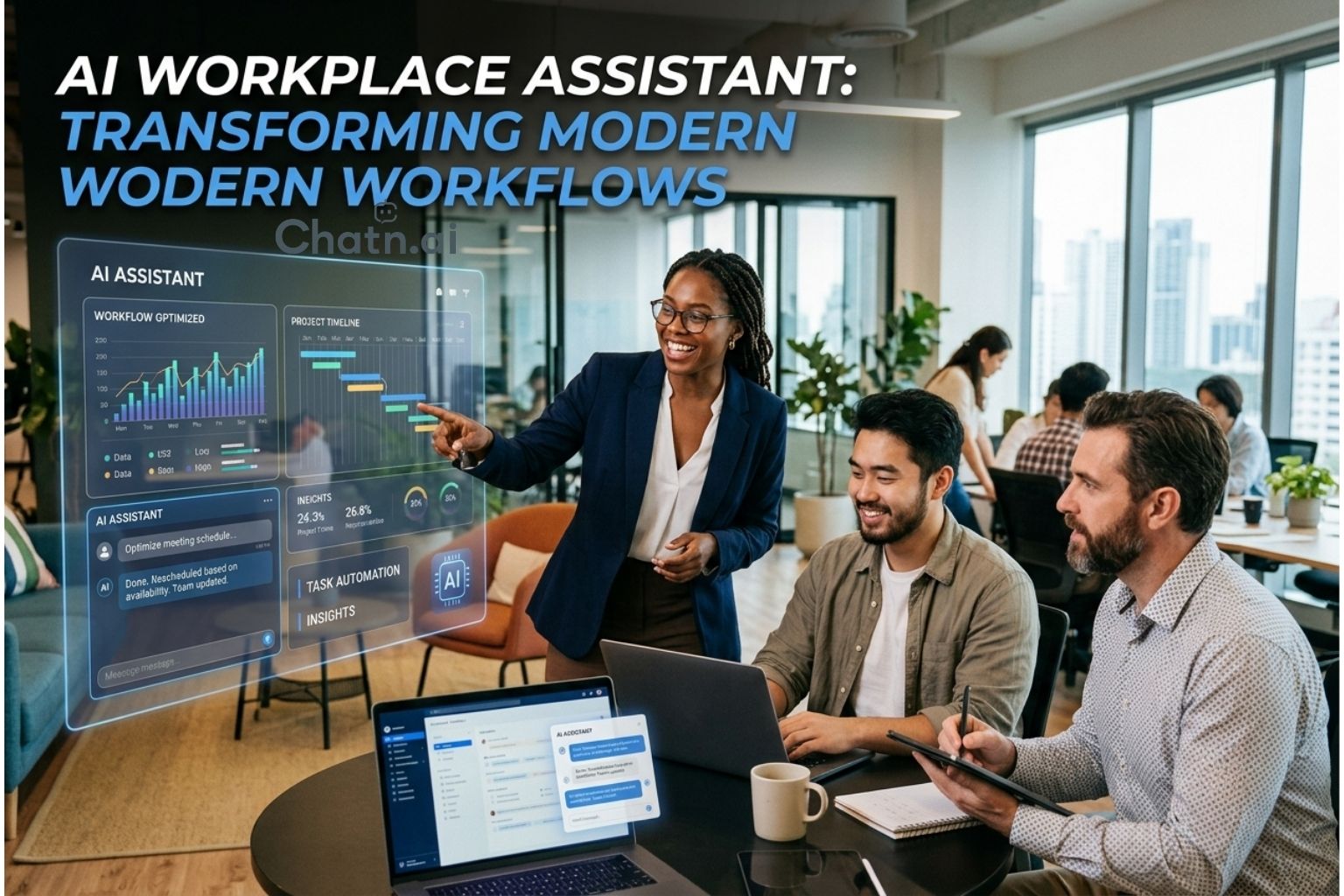
An AI Workplace Assistant offers a stronger value by reducing friction and improving how employees work. Instead of requiring employees to navigate multiple systems, an AI assistant streamlines access to workplace information and processes by answering questions, managing workflows, and handling routine tasks, helping employees work more efficiently and increasing productivity. AI assistants offer more than automation. The best solutions connect people, information, and workflows, helping companies increase productivity and enabling employees to focus on core responsibilities.
What Is an AI Workplace Assistant?
An AI Workplace Assistant is a technology that uses artificial intelligence to understand requests, offer relevant advice, and support a variety of work-related tasks, helping employees work more efficiently. Unlike standard office software, an AI assistant lets employees use natural language to make requests. This makes it easier to ask questions, seek advice, and receive help on any topic. For example, employees can ask where to find a company policy, how to complete an internal process, or what steps to take before starting a task. Instead of searching multiple systems for information, employees can simply make a request and receive assistance in a conversational manner. In summary, an AI Workplace Assistant serves as an intelligent layer between employees and their daily systems, connecting them to the information and resources needed to perform their jobs. It is not meant to substitute for all work-related tools or processes, but rather to complement them.
Why Traditional Workplace Tools Are No Longer Enough
Most organizations already rely on multiple technologies to operate effectively. For example, companies often use separate platforms for communication, HR, customer management, projects, documents, and knowledge. While each system may function well on its own, employees must frequently switch between them throughout the day. This creates a hidden productivity challenge. Employees spend valuable time searching for information, recalling complex processes, and determining where to find reliable answers.
As a result, fragmented technology can lead to unnecessary workplace conflicts. For example, an employee may require access to data already available elsewhere in the organization. It could, however, take a few documents to search or for another employee to assist you in finding that information. These small delays add up over time, hindering productivity, disrupting workflows, and making tasks unnecessarily complex.
This is where Workplace AI can make a difference. Rather than adding to these challenges, Workplace AI can address them. Instead of introducing another complex tool, an AI Workplace Assistant provides a simpler way for employees to access information and processes and to move between systems. This can help to minimize conflict in the workplace and enhance employee satisfaction. Finally, an AI Workplace Assistant fosters a more connected digital workplace. Staff can spend less time navigating systems and more time focusing on their core tasks.
How an AI Workplace Assistant Changes the Employee Experience
The value of an AI Workplace Assistant comes from simplifying how employees get work done. Rather than forcing people to learn every system in detail, an AI assistant can help them interact with workplace resources more naturally.
From Searching for Information to Asking for Answers
Employees spend valuable time looking for internal information. They can look through Knowledge Bases, open documents, or search through shared folders. Yet, despite their efforts to search from various sources, they may still be unable to locate the correct information. This can waste staff members’ time, leaving them to work through complex information systems rather than on meaningful work.
This can be done with an AI Workplace Assistant. Employees can ask questions in their own words, rather than having to look through various sources. The AI can then interpret their needs and present them with relevant data from the organization’s resources. Furthermore, staff can get information in a more natural, conversational manner. This means that they can get answers more quickly, save time in needless searches, and do work more efficiently. In short, an AI Workplace Assistant simplifies accessing information, making it more efficient and user-friendly in the workplace.
From Manual Navigation to Guided Workflows
Workplace procedures often involve multiple steps, requiring staff to identify needs, locate documents, submit requests, or follow protocols. This can make even simple tasks confusing and time-consuming.
An AI Workplace Assistant streamlines these procedures by providing timely, relevant guidance, eliminating the need for employees to search for information themselves. For example, when an employee asks what to do next or needs help understanding a process, the AI assistant provides the necessary information and directs them to the appropriate next step. What’s more, this method reduces confusion and helps employees navigate processes with greater confidence. Ultimately, an AI Workplace Assistant creates a more intuitive and efficient workplace.
From Repetitive Tasks to Intelligent Assistance
Many employees handle repeated requests throughout the day. Although these tasks are not complex, they can be time-consuming and distracting. AI can support these routine tasks by helping employees access information, complete repetitive work, and receive immediate guidance. This allows staff to focus more on higher-value activities.
An AI Workplace Assistant increases efficiency without removing people from essential workplace processes. It provides basic support and reduces unnecessary friction. For instance, AI tools help employees locate data, understand policies, and complete common tasks more quickly and easily. This frees staff to spend more time on creative and critical thinking, judgment, and joint effort. Organizations can, in turn, design a more productive workplace and do so by keeping people at the heart of the work.
7 Ways an AI Workplace Assistant Can Improve Modern Work
An AI Workplace Assistant can influence more than individual productivity. It can also improve how organizations manage information and workflows.
Here are seven important benefits:
1. Access to Workplace Information – Faster.
Knowledge is useful if employees can access and utilize it promptly. But, in many cases, organizational knowledge can be spread over isolated platforms, documents, and databases. This can cause your employees to become frustrated when they need information. Luckily, an AI Workplace Assistant can provide a more direct way to access relevant knowledge. Employees can ask questions in natural language and find helpful information more efficiently, rather than having to search through multiple systems. Furthermore, an AI assistant can guide workers to find available resources without having to navigate complex systems. Employees can thus save time on searching and devote more time to applying the information they find. In the end, increased access to information can boost productivity and enhance how organizations use their knowledge.
2. Minimized administrative tasks and repetitive work.
Many administrative tasks can silently take up hours of employees’ time. While these activities might appear insignificant on their own, they may add up to significant productivity losses at a later date. Luckily, AI-powered workplace tools can help automate mundane tasks and eliminate manual processes. For instance, an employee could use an AI assistant to locate information, complete procedures, or launch a typical workplace request. Moreover, AI can also assist workers in performing repetitive tasks without the need for constant help from co-workers or support systems. Therefore, staff can carry out daily tasks more quickly, focusing on more value-added jobs. Thus, organizations can avoid workplace friction and increase productivity without redesigning all the business processes. Rather, they can offer intelligent assistance where it is most beneficial.
3. More Consistent Employee Support
There are a variety of answers given by employees, depending on who they ask. This can lead to confusion, particularly when teams use different processes or regularly make changes to their procedures. Luckily, an AI employee assistant can give a more regular first line of defense. If the assistant can be linked to well-maintained, accurate data, employees will have access to more consistent guidance. Furthermore, workers can pose natural-language questions and get relevant information without continually having to reach out to other workers. As a result, teams can minimize needless interruptions and establish a more uniform employee experience. But, human assistance remains essential. Employees can seek assistance from other team members when professional judgment, expert information, or personal attention is needed for the matter at hand. In the end, an AI Workplace Assistant can be used alongside, not in place of, human support. Together, this enables businesses to provide quicker support and maintain human resources at the heart of the complex work.
4. Improved Cross-Team Collaboration
Information silos can easily hinder collaboration. If knowledge is isolated across teams, workers can find it difficult to obtain information from outside their own team. For instance, an employee might know the process used for their own department but be unable to locate the information of interest from another department. Consequently, they could end up taking longer to find answers or reach out to others throughout the organization.
An AI Workplace Assistant can assist in making the work environment more accessible with information. An AI assistant can facilitate the process of knowledge sharing and help employees find relevant information more easily. Also, employees can get advice without completely relying on personal relationships and informal communication. This means that teams can minimize information gaps and work together more efficiently. In the end, increased access to shared knowledge can minimize intra-departmental conflict and equip staff with the clarity and confidence to collaborate more effectively.
5. Faster Workflow Completion
When employees cannot easily access information, workflows often slow down. For instance, they might stop to find a piece of information, to find out what they need to do next, or ask a colleague for help and support. This can then extend even mundane tasks past their expected duration. Fortunately, an intelligent workplace assistant can help minimize these distractions by communicating relevant information and guidance to employees when needed.
Employees can leverage an AI Workplace Assistant to manage everyday processes more efficiently, rather than pausing to look for answers. Furthermore, the assistant can show them where to go to learn what to do next and also locate relevant resources. This means that staff can navigate their daily tasks with increased ease and efficiency, minimizing wait times and boosting productivity. In the end, quicker completion of workflows can increase the productivity of businesses to avoid unnecessary conflicts at work.
6. Better Employee Self-Service
Sometimes employees do not need to seek assistance from another individual to answer a simple question in the workplace. They do need an accessible, easy-to-use source of information they can find on their own, however. An AI Workplace Assistant can facilitate employee self-service by making common information, guidance, and workplace resources readily available. Employees no longer have to wait for a co-worker or a support staff member to be available to answer their questions or provide help; they can ask questions and receive assistance when they need it.
Moreover, this means that employees can have control over the ordinary requirements at work. This means they can find answers to simple questions and work through with fewer interruptions. Meanwhile, self-service can cut down on unnecessary requests from employees to colleagues and support services. Thus, those groups can invest more time in more complex problems that require subject matter expertise or human decision-making. In conclusion, AI-powered employee self-service can empower employees, boost efficiency, and foster a more responsive work experience.
7. More Scalable Workplace Operations
As businesses grow, the complexity of the workplace can also increase—more employees, more questions, more processes, and greater volumes of organizational information. But traditional support models might not be able to grow at the same rate. As employees’ needs continue to grow, support teams can easily get a lot of repetitive questions and routine requests.
Thankfully, there’s an AI Workplace Assistant that can help organizations support their expanding teams with scalable digital support. Information can be provided to employees, guidance given, and processes facilitated without having to ask someone to perform the actions directly. Additionally, AI can assist in processing frequently used workplace requests more efficiently. This means that support teams can spend more time and resources on more complex issues that need human judgment. As a result, companies can increase access to support at work and minimize the need for extra labor to provide it. In conclusion, an AI Workplace Assistant can aid businesses in developing more scalable operations that support workers effectively as the operation grows.

Key Features to Look for in an AI Workplace Assistant
Organizations should evaluate AI workplace solutions carefully. The right platform should address real workplace needs rather than simply adding another AI feature.
Natural Language Understanding
The employees ought to be able to engage in a natural conversation with an AI Workplace Assistant. Rather than memorizing intricate commands or searching for the right keywords, the employees pose the question.
In addition to that, natural language understanding assists in better interpretation of the request made by the employees and provides appropriate answers. Due to this, the employees do not need to make much effort while accessing the information and performing their daily routine tasks. Finally, it makes the overall process much easier for the employees to use. Ultimately, natural communication makes it easy for employees to interact with the workplace AI.
Knowledge and Information Access
For an AI Workplace Assistant to be effective, it requires access to reliable, accurate, and timely information. Failure to have this will pose challenges in guiding and providing the most relevant response to an employee’s queries. For this reason, companies need to have well-organized information and reliable sources of knowledge. It is also essential for them to ensure frequent review and updating of information in the workplace. With effective knowledge management, employees will be able to find the required information without confusion. Consequently, the AI assistant will be able to provide employees with relevant information without wasting their time doing too many searches. In essence, good knowledge management will increase the effectiveness of an AI Workplace Assistant.
Workflow Assistance
Answering employee questions is helpful, but an AI Workplace Assistant is most effective when it supports employees directly within their workflows. For example, the assistant can guide employees on next steps, clarify relevant processes, and direct them to necessary resources. This enables employees to complete routine tasks more efficiently and confidently. More importantly, workflow assistance allows AI to provide value beyond communication by supporting the practical implementation of information. Ultimately, companies should enable employees to progress from asking questions to achieving tangible results.
Common Errors Companies Need to Avoid
Despite their potency, AI tools for the workplace can miss the mark if companies lack a strategy and proper planning. Therefore, companies should consider possible issues before implementing AI technology.
First, one of the common errors consists of seeing AI as just a chatbot. It can result in additional disconnection and waste of opportunities. On the contrary, businesses should consider how AI can help employees connect and share useful information.
Second, it is important not to automate a process without first knowing its ins and outs. Companies need to define the problem, study the existing process, and understand where the embedding of AI can add value.
Moreover, the role of employees’ adoption cannot be underestimated. Employees who lack confidence in the new tool or do not comprehend its usefulness will probably ignore it. Thus, businesses ought to inform them about the purpose and concrete benefits of AI. Still, security and privacy issues, as well as ethical AI implementation, need to be considered. Finally, companies should focus on measuring results instead of activities. The large amount of interaction does not mean that companies benefit from it. Companies should understand if it helps.
How to Choose the Right AI Workplace Assistant
Before selecting a workplace AI solution, businesses should ask several important questions.
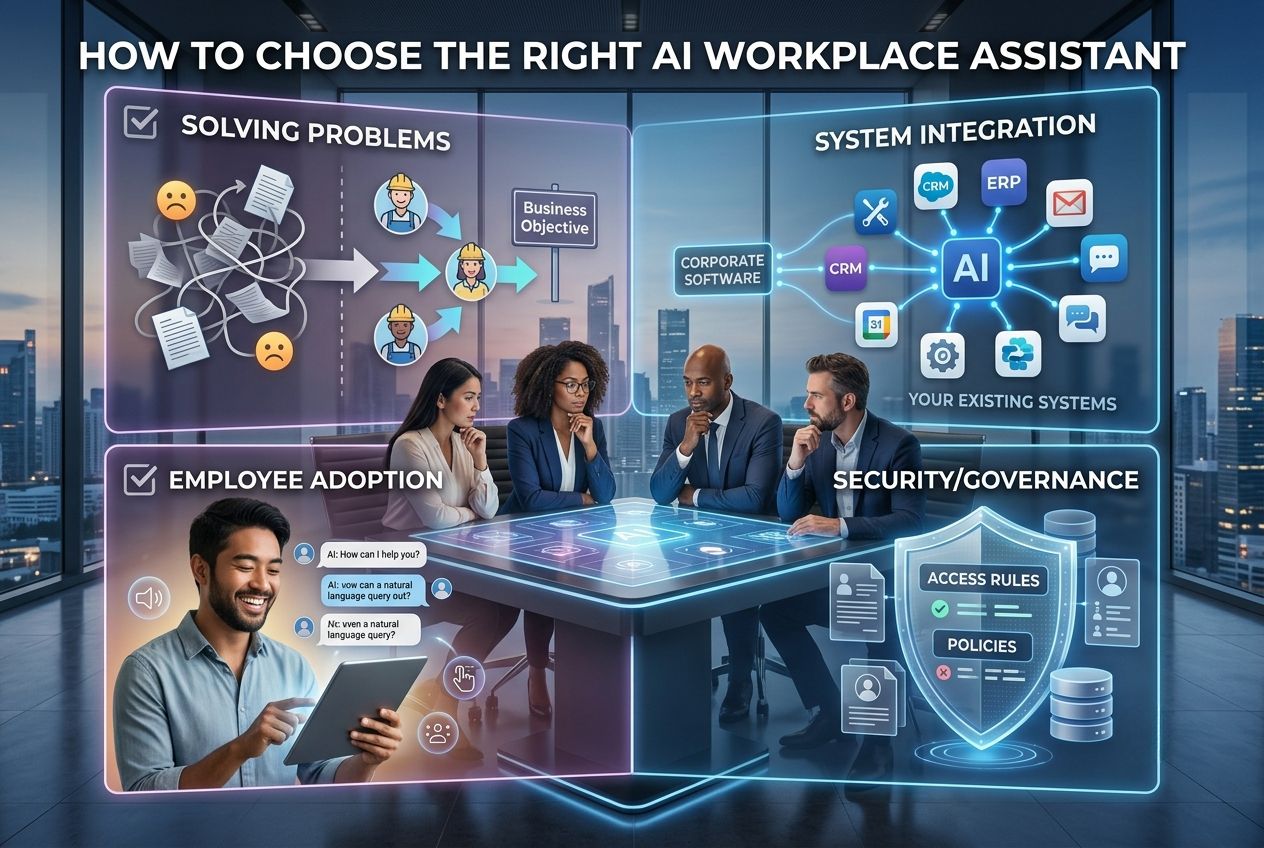
Is It Solving an Existing Problem at Workplaces?
The foremost thing the best AI Workplace Assistant should do is solve an existing, relevant problem in the workplace. Instead of introducing artificial intelligence just for the sake of it, companies need to pinpoint areas that create the most friction within the workforce. For instance, businesses can look for repetitive actions, information gaps, delays in workflow processes, and questions from employees. After that, they can identify which problems can be solved using the AI assistant. Besides, businesses must find a way to link the solution to their business objectives. Consequently, they will know if the assistant helps them become more productive and do away with unnecessary work.
Can It Work With Existing Systems?
The issue of integration is crucial because it helps determine the usefulness of the AI Workplace Assistant. Business organizations currently rely on multiple platforms, software programs, and information systems to support their daily operations.
Organizations should therefore assess whether the AI assistant can be easily integrated into the current technological infrastructure. This involves assessing the compatibility of the AI solution with relevant programs and software.
In addition, proper integration enables employees to interact with fewer systems. Employees will be able to get information and assistance from one system without having to shift from one platform to another. In essence, organizations should select an AI Workplace Assistant that integrates well with their current technology systems.
Is Employee Adoption Possible With It?
The employee adoption of the technology is highly dependent on its ease of use and convenience. Thus, an AI Workplace Assistant should facilitate everyday tasks rather than complicate them. Employees need to be able to engage in communication with the assistant without any extra technical training. For instance, employees should be comfortable posing questions and seeking assistance in natural language.
Furthermore, a convenient user experience will encourage employees to use artificial intelligence more often. Consequently, organizations will be able to promote employee adoption and help employees get more out of this technology. Overall, companies should choose an AI Workplace Assistant that integrates well with their day-to-day workflows. When employees find it easy to communicate with AI, they can focus on productive work rather than spending too much time learning new technology.
Is It Supporting Security and Governance?
An effective AI tool needs to keep the organization’s sensitive data secure while also assisting employees effectively. Thus, organizations need to consider the solution’s security, privacy, permissions, and governance before implementation. In addition, it is essential to identify how an AI Workplace Assistant will provide access to internal information while securely protecting sensitive data. Access control may help ensure that employees are provided with only the information they need. At the same time, organizations need to develop governance policies to ensure the responsible use of AI solutions. Overall, the company needs to select an AI solution that provides both intelligent assistance and good security and governance.
Conclusion: Creating the Intelligent Workplace Environment
The introduction of the AI Workplace Assistant is one example of the transformation in employees’ interactions with workplace technologies. Rather than struggling to navigate numerous systems independently, employees can get intelligent assistance to access information, understand processes, and perform their tasks faster and more easily.
However, the proper implementation of AI in the workplace involves more than just automating routine activities. The true potential of AI in the workplace lies in the ability to create more connections among people, information, and workflows. When used smartly, AI can help eliminate unnecessary repetitive friction, promote self-service among employees, and streamline workplace processes. At the same time, it allows employees to spend more time performing tasks that involve the use of human reasoning, imagination, and collaboration.