
Introduction
Customer service is changing fast. People now want help right away and do not want to wait or repeat themselves. Businesses face higher demand for good customer service at a fair cost. Support teams are getting more requests, but hiring more agents is expensive and often not possible. As customer expectations rise, old support methods often fall short. To keep up, companies need new ways to grow their customer support. Autonomous customer support offers a potential solution. Unlike basic automation, it uses artificial intelligence to understand customer intent, make decisions, take action, and resolve most issues without human involvement. This approach increases speed and efficiency while ensuring consistent customer experiences. Autonomous customer support doesn’t imply replacing humans with AI. On the contrary, it allows agents to work with complicated cases that require empathy and critical thinking. The technology handles repetitive, routine requests quickly and precisely.
What Is Autonomous Customer Support?
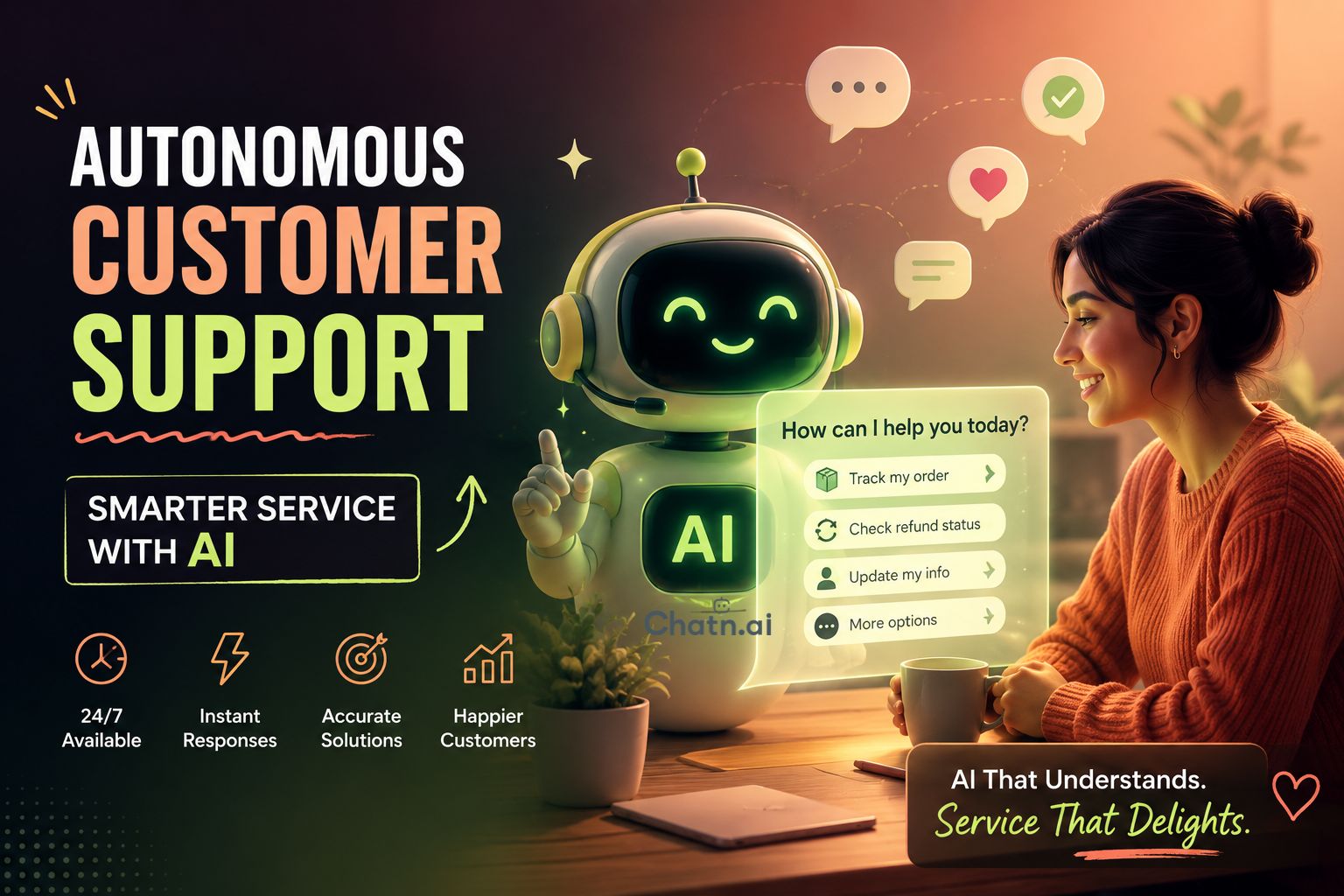
Autonomous customer support uses AI to resolve customer inquiries without human involvement. It understands conversations, extracts relevant information, manages business processes, and determines the best action for each customer instead of relying on scripted replies. This enables companies to deliver faster, more accurate, and personalized support. Unlike conventional chatbots that rely on scripted responses and handle only simple queries, autonomous customer support engages in conversations and responds to complex requests. It leverages conversational AI, machine learning, workflow automation, and enterprise integration to resolve issues from start to finish. For example, it can confirm identities, reset passwords, process refunds, update account information, and generate support tickets automatically. Key features include natural language recognition, maintaining conversation context, accessing business systems, automating workflows, learning from past interactions, and escalating issues only when needed. In summary, autonomous customer support positions AI as an intelligent service partner that enhances efficiency, customer satisfaction, and business outcomes.
Why Traditional Customer Support Is Reaching Its Limits
Today’s customer service expectations differ from those of a decade ago. But many organizations still rely on outdated support processes that don’t meet the needs of today’s digital-first buyers. While these remain standard service methods, they face growing customer expectations for greater speed, individuality, and uniformity. On the other hand, businesses have to cope with rising inquiries across all their communication channels, deliver high-quality service, and manage operational costs. This can lead to longer response times, increased workloads for support staff, and frustrated customers. Moreover, as digital channels become more integrated, it is more challenging to scale traditional customer support effectively. As a result, many companies can struggle to meet customer expectations and provide a smooth, seamless experience. There are several problems showing why conventional customer support is coming to an end.
Growing Customer Expectations
Today’s buyers expect immediate assistance, no matter when or how they contact you. They use live chat, messaging apps, email, and social media, and expect responses to be quick, accurate, and consistent. Customers also expect businesses to remember past interactions and personalize each communication. They do not want to repeat information when switching channels or support representatives. As digital experiences become more integrated, expectations continue to rise. To meet these demands, businesses must provide consistent, connected, and personalized support at every touchpoint. Manual processes often fall short, so many companies are adopting AI-powered solutions to deliver faster, more effective, and customer-focused support.
Increasing Conversation Volume
Businesses now receive inquiries through many communication channels simultaneously. For instance, a support team can handle website chats, mobile app messages, social media messages, emails, and voice communications daily. The number of incoming conversations has been steadily increasing as customers move to more digital channels. Additionally, the number of conversations can grow at a rate much greater than the number of people in the support team. This leads agents to deal with increased workloads, longer support queues, and greater pressure to maintain high service standards. Meanwhile, customers continue to demand fast and reliable service irrespective of volume. Manual processes, however, make it challenging for support teams to stay on top of things. This, therefore, results in high operational costs, slow response times, and decreased customer satisfaction for businesses. As such, there is a growing trend toward intelligent automation solutions that can scale customer support efficiently, without compromising on the quality of service.
Rising Operational Costs
When expanding a customer support team, companies must continually invest. They need to hire new people, provide ongoing training and service management, and address personnel losses. As businesses grow, support costs continue to increase. These costs increase even more during peak seasons, new product launches, or periods of rapid business growth. However, many organizations struggle to scale their support operations without a significant increase in their budgets. Furthermore, repetitive customer inquiries burden agents’ time each day. For instance, some of the most common queries concern order status, password resets, billing details, and appointment bookings. While these requests do not involve much human judgment, they take up a significant amount of agents’ time and can lead to lower productivity. Fortunately, autonomous customer support can handle these mundane tasks. This means companies save on operational expenses and enable human agents to dedicate their time and effort to more complex matters that require expertise, empathy, and decision-making.

How Autonomous Customer Support Works
Autonomous customer support integrates multiple artificial intelligence technologies into a single decision-making engine. These technologies can work in concert to provide businesses with a more targeted and efficient customer experience at scale. It’s not just a chatbot but a system that constantly reads consumer conversations, understands intent, pulls relevant info, executes business actions, and decides on the next optimal step. Thus, it alleviates the need for constant human intervention for many customer requests. Moreover, the system is integrated with knowledge bases, CRM platforms, and other business applications, providing access to real-time information and automating tasks. In the meantime, it learns from past interactions, enhances its performance over time, and adjusts to changing customer needs. As a result, businesses can optimize support processes, improve response times, and provide consistent, timely support on various communication platforms.
Understanding Customer Intent
The first step in any customer interaction is to understand what the customer needs. Advanced conversational AI does this by using natural language processing (NLP) and machine learning to analyze each message. It uses sentence structure, conversational context, previous interactions, customer history, and keywords to better understand each request. Moreover, this more advanced analysis helps the system determine if the customer wishes to follow the order, update their accounts, resolve a billing problem, or seek technical assistance. The AI doesn’t follow a script; it responds based on the customer’s intent and what they are talking about. As the interaction unfolds, the system continually improves its understanding and maintains context throughout the conversation. As a result, it provides more precise answers, reduces repetition, and creates a more fluid and individualized customer support experience.
Retrieving Accurate Information
Once the AI has detected the intent, it will automatically pull the information it needs from business systems it’s connected to. It does not rely on a single platform; it collects real-time data from various platforms and provides accurate, context-aware, and personalized responses.
The AI can be enabled to access:
- Knowledge bases. Frequently asked questions?
- Internal documentation
- CRM platforms
- Customer account records
- Product databases
- Order management systems
Moreover, when these data sources are combined into a single system, automated customer support reduces information silos and improves the precision of responses to customer inquiries. This means customers can get answers that are relevant and specific to their needs, rather than generic and out-of-date ones. On the other hand, the AI responds immediately, minimizing delays and helping businesses deliver swift, consistent customer service across all interactions.
Executing Customer Requests
The most notable difference between autonomous customer support and traditional bots is the ability to take action. In contrast to traditional chatbots, autonomous AI can take action on the customer’s behalf when possible and provide instructions when necessary. The AI does not just tell you how to solve a problem, but actually takes the required action. This makes it easier and quicker for customers to get a resolution.
For instance, AI can take charge of tasks such as:
- Reset passwords
- Update customer profiles
- Schedule appointments
- Process returns
- Create support tickets
- Check order status
- Modify subscriptions
Key Capabilities That Make Customer Support Autonomous
There are advanced AI capabilities that can be combined to make customer support autonomous. Each capability, when used separately, helps in making the process efficient and effective. But when used in combination, they form an intelligent system that can comprehend customer needs, analyze them, and act on them with minimal human intervention. By leveraging these capabilities, businesses can deliver more accurate, personalized customer experiences. This results in more efficient and proactive support processes.
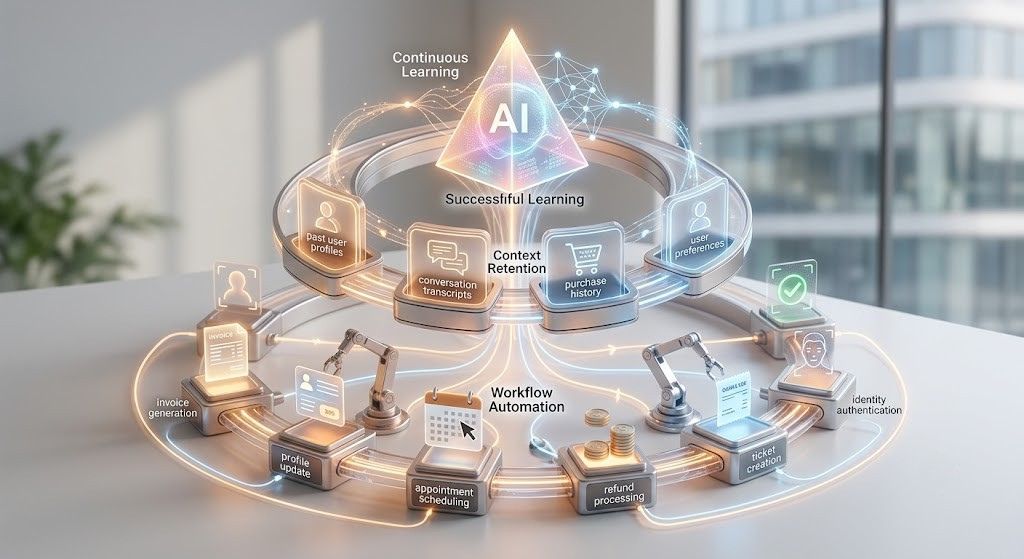
Continuous Learning
Unlike rule-based automation, autonomous AI continually improves over time. In other words, it is not static but learns from each customer encounter and thus becomes better. Moreover, through each dialogue, the system is gaining an understanding of new questions customers ask, how to solve them successfully, and how to become better at future tasks. Also, this feature of continuous learning allows companies to adapt quickly to changes in customer behavior, trends, and product requirements.
Context Retention
Customer satisfaction relies greatly on consistency. Thus, self-sufficient AI always retains context during every customer interaction. Also, it retains previous customer interactions, customer preferences, buying behavior, and requests. Hence, customers receive highly personalized service without having to provide the same information repeatedly. Moreover, such context awareness helps AI respond more naturally, resulting in more consistent conversations. Finally, context retention decreases frustration and increases customer satisfaction and trust.
Workflow Automation
The process of providing customer support does not only mean providing answers. Thus, autonomous AI goes beyond communication and links to enterprise software for workflow automation.
Moreover, it is integrated into the company’s systems and performs its operations instantly without any human intervention. It means that it is able to:
- Make an invoice
- Update the customer’s profile.
- Arrange an appointment
- Provide a refund
- Open a ticket
- Authenticate a customer’s identity.
Consequently, the company does not need to delegate unnecessary tasks to other employees and reduces the time required for customer service processes. There is no need to redirect the customer to other departments or third-party applications, as the AI handles all required steps during the conversation.
Business Benefits of Autonomous Customer Support
Implementing autonomous customer support creates measurable improvements across customer experience, operational efficiency, and business performance.
Faster Issue Resolution
Customers value quick service, so autonomous AI prioritizes fast and effective responses to every request. By instantly accessing data and acting automatically, the system resolves many issues within minutes instead of hours. As a result, customers do not experience unnecessary delays. Faster problem resolution directly improves customer satisfaction and reduces support queues.
Reduced Operational Costs
Recruitment, training, and managing support agents require substantial investments. As a result, companies consistently allocate their resources to these areas. As a result, an AI that works independently will reduce the number of repetitive tasks that agents must perform manually. In this way, firms will optimize the number of employees while maintaining high-quality customer service. As a result, reduced operational costs will provide additional opportunities for companies to invest in innovation, product development, and customer experience improvements.
Enhanced Customer Satisfaction
It has always been observed that customers enjoy receiving accurate responses promptly. Hence, an autonomous customer service will provide faster, more dependable service to all customers. Moreover, an autonomous system provides services all day long, thus enabling customers to get their queries addressed whenever they require it. In addition, personalized conversations help ensure customers are understood, rather than treated like any other ticket in the queue. This will enable building a more emotional connection between customers and their companies. This will enhance overall service quality and, consequently, customer satisfaction.
Industries That Benefit Most from Autonomous Customer Support
Although every organization can improve customer service through AI, certain industries experience particularly significant benefits.
Retail and eCommerce
Online consumers expect prompt support. Thus, automated customer service is crucial in ensuring prompt and efficient shopping processes.
Indeed, this allows customers to perform important functions, including:
- Monitor their deliveries
- Make returns of products.
- Check product availability
- Get personalized recommendations
- Solve payment problems
In addition, these features ensure that the company can promptly meet consumers’ needs throughout the shopping process. Ultimately, this improves the customer experience, satisfaction, and retention.
SaaS Companies
Software companies receive an endless stream of technical queries each day. Thus, it is vital for them to have an autonomous system to respond to repeated inquiries that come through in large volumes.
Specifically, autonomous AI helps the customers:
- Solve typical problems
- Deal with subscription issues.
- Help reset the password.
- Provide onboarding services
- Answer any questions regarding the products.
Additionally, the automation ensures the users get instant responses. Hence, the onboarding process is easier for users. On the other hand, the support team will have more time to work on complicated technical problems.
Healthcare
The health care industry processes sensitive requests that need both efficiency and accuracy. Thus, health care institutions implement autonomous customer support to ensure efficient patient interactions and provide quality services.
Namely, an autonomous system will be able to:
- Schedule appointments
- Respond to patient queries.
- Issue reminders
- Provide policy information
- Help patients use relevant sources.
Additionally, all of this will allow patients to receive the necessary assistance in time, without any extra wait. In other words, health care institutions can improve the availability of information for their patients. Moreover, specialists will be able to concentrate solely on providing medical treatment to the patients.

Autonomous Customer Support vs Traditional AI Chatbots
Even though both of these solutions might seem similar at first, their potential is quite different. That is why it is crucial to understand how they work in practice to distinguish their differences.
Traditional AI Chatbots | Autonomous Customer Support |
Responds to set of questions | Understands customer’s intentions |
Uses scripted dialogues | Intelligent conversation adaptation |
Gives information | Business processes execution |
Low context awareness | Context maintenance |
Frequent human intervention required | Handles many requests autonomously |
Minimal personalization | Provides personalized experiences |
Static decisions | Continuous learning and improvement |
Besides, there is a notable difference between these two approaches to automating customer service operations. Traditional AI chatbots tend to respond only to preset questions. On the other hand, autonomous customer support not only understands intentions but executes actions and solves problems. Thus, this differentiation plays an important role for modern companies. They no longer need artificial intelligence to answer certain questions. What they require is an intelligent system that will execute actions and provide good experiences.
Best Practices for Implementing Autonomous Customer Support
Successful implementation requires thoughtful planning rather than simply deploying new technology.
Establish Clear Objectives for the Business
Organizations should identify specific customer service pain points to address with AI. By defining core challenges before implementation, companies ensure the technology is applied purposefully.
Businesses should focus on clear, measurable objectives such as:
- Decreased response time
- Increased customer satisfaction
- Lower costs
- Better first contact resolution
These objectives guide the alignment of technology with business outcomes, making implementation decisions more coherent and efficient. Clear objectives drive the transformation of customer support and demonstrate the immediate value of autonomous systems.
Build a Reliable Knowledge Base
Artificial intelligence operates efficiently when it has access to accurate, structured data. Companies should therefore establish a reliable knowledge base to support autonomous customer service. It is essential to keep all documentation current, organized, and searchable so both AI systems and human agents can quickly access the information they need. A well-maintained knowledge base improves answer accuracy and consistency, resulting in a better customer experience, reduced confusion, and faster issue resolution. In summary, a robust knowledge base is essential for efficient autonomous customer support.
Integrate Core Business Systems
AI can offer its greatest advantage when integrated directly into the current business platform. That is why companies should integrate their core systems to leverage their automation capability. Namely, integrating CRM, ticketing, inventory, and internal applications helps AI access real-time information and execute workflow actions effectively. Thus, the system no longer needs to issue any instructions but performs all processes entirely. Moreover, this type of integration allows companies to minimize manual work, avoid siloed data, and ensure higher accuracy. That is how companies benefit from fast resolutions and seamless workflows for customers in different support channels.
The Future of Autonomous Customer Support
With advancements in technology, customer service will continue to develop. Hence, businesses have to prepare for a future in which support will become more proactive, intelligent, and automated.
First, AI will be able to predict the customer’s needs and resolve their issues even before they happen. In other words, instead of waiting for customers to report issues, autonomous AI will detect trends, predict customer needs, and propose solutions on its own. Thus, companies will shift from reactive to proactive support services.
Second, voice AI technologies will continue to develop. Customers will be able to speak to AI-powered assistants across different environments, such as voice assistants, messaging services, websites, and mobile apps, without losing conversation context. Thus, customer support will become seamless and natural across channels.
Third, hyper-personalization will become commonplace. AI will be able to adapt all customer interactions to each customer based on their behavior, preferences, and previous conversations.
Finally, autonomous AI assistants will start working together within the company. This means that the customer support department, sales, marketing, and operations will be connected via an intelligent system.
Conclusion
Customer expectations will only keep increasing; hence, businesses need to continually transform to meet them. It is no longer competitive to provide fast, precise, and personalized assistance; rather, it is an obligation that influences customer loyalty and growth. The next level of transformation is autonomous customer support. Autonomous AI combines conversational intelligence, workflow automation, enterprise integration, and continuous learning, and, as such, provides an intelligent system that independently handles most customer concerns and even assists human agents when human intervention is required. This way, companies offer faster, smarter, and consistent service experiences. Instead of taking jobs away from human agents, autonomous AI helps eliminate repetitive tasks, speeds up problem-solving, and offers more valuable customer engagement. With solutions such as Chatn.ai, businesses can transform. Moreover, they are well-positioned to provide intelligent, customer-centered support.