

Introduction
Today’s customers don’t just want a quick response; they want one that’s high quality. They want companies to know their preferences, remember what they liked or disliked before, and deliver customized experiences every time. With digital expectations higher than ever, businesses need to reimagine customer engagement across all touchpoints. Sadly, many organizations have not yet adopted a unified communication strategy, so conversations tend to be repetitive, impersonal, and frustrating. Customers may have to repeat themselves or wait a long time for a response that clarifies the issue. Over time, these bad experiences make it harder to build trust and loyalty. Luckily, companies no longer have to rely on old methods of engagement. AI has revolutionized the way businesses communicate with customers, allowing them to engage people proactively, individually, and continuously in relationship-building ways rather than react to each query. This shift has introduced a new paradigm called AI Engagement. AI Engagement is not just about customer support; it’s about elevating the entire customer experience. It allows enterprises to engage in meaningful chats before, during, and after any interaction. From product exploration to customer support and loyalty, AI can deliver meaningful engagement at the right time in a natural way. As a result, businesses enhance customer satisfaction and create additional opportunities for long-term growth. Learn about AI Engagement, the challenges of traditional engagement strategies, and how intelligent conversational AI can help build better customer relationships at scale. Discover how Chatn.ai can help organizations provide outstanding experiences and maintain customer loyalty from the initial interaction through long-term retention.
What Is AI Engagement?
AI Engagement refers to the use of AI to create intelligent, personalized, and continuous interactions between businesses and customers. Rather than treating each conversation as an isolated event, it integrates customer information, conversation history, preferences, and behavior to deliver personalized experiences. Unlike conventional communication tools, AI Engagement does more than respond to basic inquiries. It is aware of customers’ needs, flexible, and usable across a variety of channels, making each interaction more meaningful and consistent.
Suppose, for instance, somebody visits your web page for the first time. They look at a couple of products but don’t buy them. A couple of days later, they returned using the messaging app. Instead of beginning a new conversation, the AI-powered engagement platform identifies what they’ve already done and keeps the conversation going. It can suggest products, solve the customer’s problem, and guide them to the next step. This continuity helps provide a seamless customer experience. It also lets customers know the business cares about their time and values them.
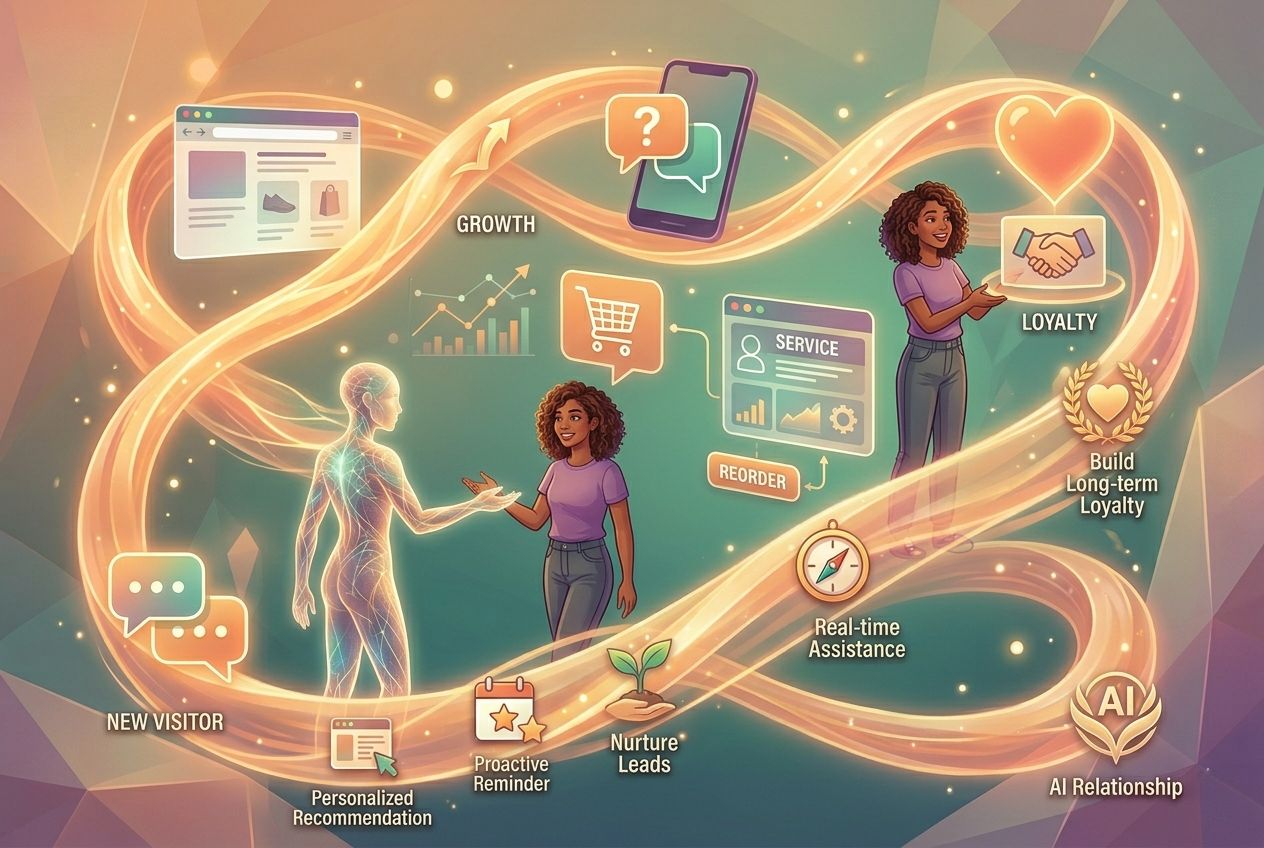
AI Engagement is also available for customer communication across the customer life cycle. It helps businesses not only by fixing problems, but also by helping them:
- Greet new visitors with individualized discussions.
- Make product or service recommendations based on customer interests.
- Send proactive reminders and follow-ups.
- Nurture leads through intelligent conversations.
- Provide real-time assistance through various channels.
- Offer customized suggestions for reordering.
- Build long-term customer loyalty through continuous engagement.
As AI continues to mature, engagement isn’t just about a transaction, but a relationship. As a result, businesses build stronger emotional bonds and improve operational efficiency. In short, AI Engagement empowers businesses to connect with customers in a personal, timely, and helpful way. It blends automation and intelligence to create experiences that traditional communication methods cannot match, leaving a stronger final impression.
Why Traditional Customer Engagement Falls Short
In the last ten years, customer expectations have undergone a massive transformation. But many engagement practices have not kept pace with these changes. Instead, companies are still using antiquated communication techniques that prioritize efficiency over relationships. While these methods have provided satisfactory results in the past, they cannot meet today’s customers’ needs. Consequently, companies face challenges in establishing trust, retaining customers longer, and fostering brand loyalty. Organizations must reevaluate their approach to customer engagement at every touchpoint in the customer journey to remain competitive.
Generic Communication No Longer Works
Generic communication no longer works in a world filled with senseless noise. To stand out, communication must be specific and intentional. Customers today receive many marketing emails, notifications, and promotional messages daily. As a result, people often tune out messages that are not relevant to them. Traditionally, engagement strategies rely almost exclusively on a “one size fits all” approach to communication. They tell the same story to all customers, regardless of their likes/dislikes, purchase history, or position in the customer buying process. This can be quick and easy, but it doesn’t generate much long-term value. Unlike generic communication, AI can analyze customer behavior in real time and customize the conversation. It provides focused interactions that are relevant, timely, and valuable, making them more attention-grabbing. This means that businesses can enhance engagement, build customer relationships, and improve overall customer satisfaction.
Customers Expect Businesses to Remember Them
Investing in your customer base is essential to keeping your business relatable. Customers want to be remembered. In today’s world, consumers spend a day online, seamlessly using various sites, mobile apps, social media, and messaging apps. As a result, they expect businesses to remember them across interactions and continue conversations smoothly throughout the customer journey. But conventional systems tend to operate separately. A team may have valuable customer information that another department cannot access. As a result, the customer must repeat the same question(s) or re-explain their concerns at each step of the customer journey, disrupting the experience. These are disjointed interactions that cause needless frustration. Most importantly, they create the impression of disorganization, lack of response, and inattention to customer needs throughout the customer journey. Rather, AI Engagement addresses this challenge by preserving conversational context throughout a series of touchpoints. It integrates data from past interactions and keeps conversations going. AI can recall previous exchanges and maintain a natural progression without needing to restart each one. This results in customers spending less time repeating themselves, and businesses providing faster, more consistent, and highly personalized services along the customer journey.
Slow Responses Reduce Customer Engagement
Speed is an important factor in customer satisfaction. In reality, consumers demand responses, whether it’s a line of credit or any other method of communication. Time directly impacts customers’ perception of a brand. Sadly, many businesses still rely on manual processes and have limited support hours. In times of high demand, response times can be much longer, and customer satisfaction is rapidly lost. As a result, some customers give up waiting for help, and others give up on making a purchase. A delay is an opportunity that is lost, and a chance to build trust and strengthen customer relationships is lost. Unlike that, AI-powered engagement changes all that. AI chatbots and conversational intelligence provide immediate answers, 24 hours a day. Additionally, even with human agents, AI saves time by prepping context and pulling up relevant customer data. This minimizes delays, optimizes the process, and facilitates seamless transitions. Customers get quicker, more precise support without compromising service quality or customer-specific solutions.
Engagement Often Ends Too Soon
Businesses focus heavily on acquiring new clients, but they often devote far less time and energy to maintaining relationships after the initial contact. As a result, they often miss the chance to cultivate long-term loyalty. For example, a customer can buy something and never hear from the company again. In other instances, customers receive emails with generic offers that do not take into account their interests, likes, or past interactions. Therefore, these interactions are out-of-place and out-of-context. This strategy overlooks important ways to build customer loyalty and encourage repeat visits. Over time, it decreases brand-customer relationships.
AI Engagement, however, takes communication beyond the sale. It processes custom follow-up messages, relevant product suggestions, timely product updates, customer satisfaction surveys, and proactive reminders based on customers’ actual behavior. Therefore, no interaction is wasted, and no relationship is weakened but strengthened over time.
Modern Customers Expect Continuous Engagement
Customers’ journeys are rarely linear. Individuals gather product information, compare options, ask questions, delay decisions, and return later via other routes. Consequently, engagement is more complicated and less predictable than ever before. So, companies need engagement strategies that work in real time and adapt to evolving customer behavior. But many efforts still fail to track these journeys. Traditional communication methods are not always effective in meeting changing customer expectations. In most situations, they treat relationships as one-time transactions. As a result, customers face disjointed communication that lacks continuity and personalization.
AI Engagement, on the other hand, changes this experience entirely. It promotes holistic conversations that evolve with each customer. Instead of responding to one-off requests, businesses now provide customized experiences throughout the customer journey. In the end, businesses that embrace AI Engagement are more likely to cultivate strong relationships, boost customer satisfaction, and build long-term loyalty. In the next section, you’ll discover how AI can make every customer interaction a chance to enrich engagement and support sustainable business growth.
How Does Chatn.ai Drive AI Engagement?
Delivering meaningful customer engagement requires more than quick responses. Businesses must understand customer needs and tailor interactions to match intent, ensuring consistency across all touchpoints. Achieving this requires an intelligent, adaptable platform. Chatn.ai’s advanced conversational AI enables businesses to meet these goals. Unlike traditional chat platforms that focus on single interactions, Chatn.ai supports ongoing engagement throughout the customer lifecycle. The platform allows businesses to connect with customers before, during, and after each interaction, strengthening relationships. Chatn.ai also delivers personalized, context-aware conversations, helping businesses build loyalty, improve satisfaction, and foster lasting connections at every touchpoint.
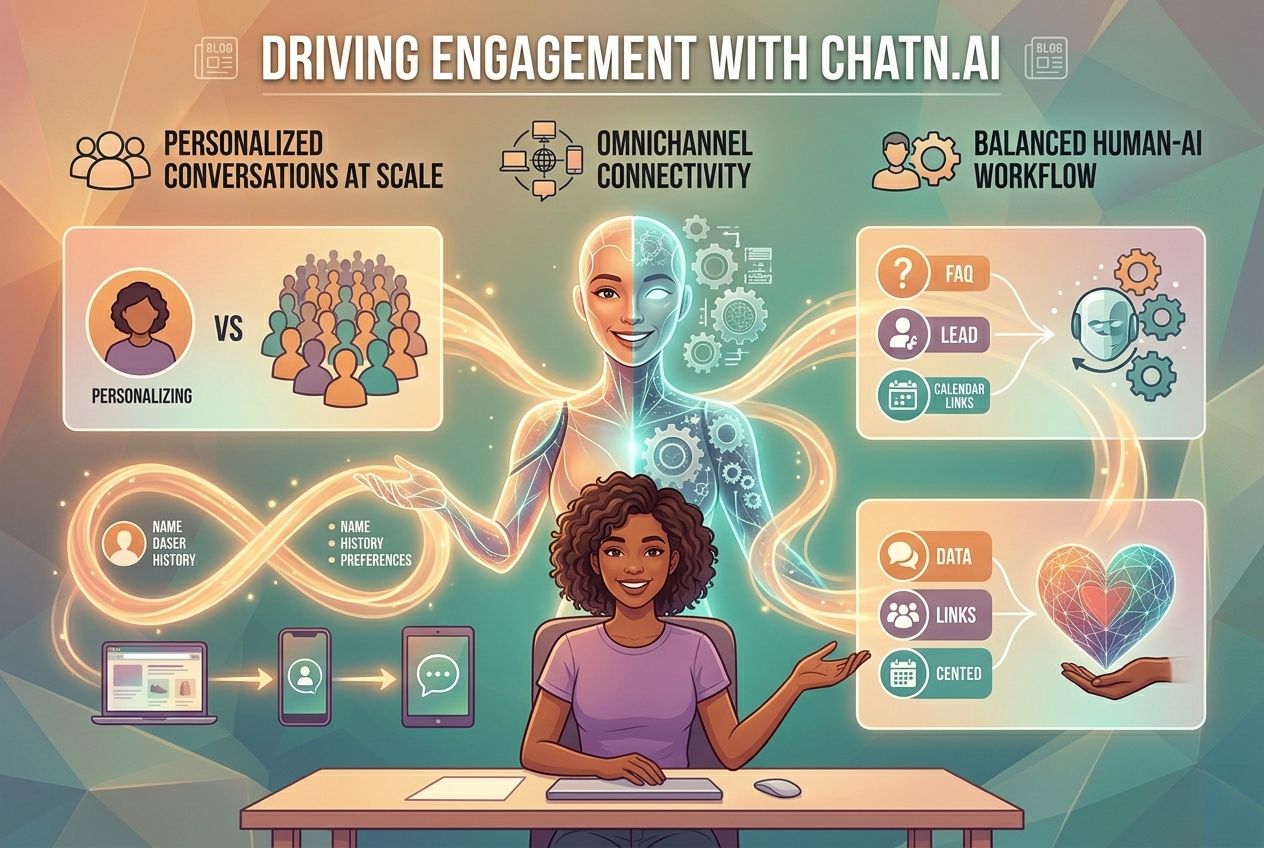
Create Personalized Conversations at Scale
All customers expect relevant, personalized communication. But as businesses scale and reach more customers, catering to each personally becomes challenging. To address this challenge, Chatn.ai leverages AI to analyze customer intent, needs, actions, and past interactions. Consequently, the platform provides more natural, relevant, and engaging conversations. Unlike traditional AI-powered systems, Chatn.ai is customizable, adapting each interaction to the specific context and dynamics of every customer. Additionally, it analyzes past interactions to develop more timely and relevant solutions. As a result, businesses can do more to make customers feel valued, deepen customer relationships, and greatly enhance customer satisfaction and engagement.
Stay Connected through Various Channels
Today’s customers use multiple communication channels, such as websites, applications, social media, and messaging platforms, throughout the day. To keep up with increased customer expectations, businesses have to ensure consistent, uninterrupted communication across all channels. To fulfill this requirement, Chatn.ai offers an omnichannel solution that helps businesses stay connected through continuous conversations, regardless of the channel customers choose. Conversations are stored across channels and with customer context on the Chatn.ai platform, so customers do not have to repeat the same information at each point. This helps businesses reduce frustration and respond efficiently.
Automate Engagement Without Losing the Human Element
Automation should make communication more efficient and personal. Use AI to handle mundane tasks so humans can focus on the interactions that require their attention. To do so, Chatn.ai automatically handles routine tasks such as answering frequently asked questions, qualifying leads, scheduling appointments, and sending personalized follow-ups. Meanwhile, when human intervention is needed in an interaction, the platform seamlessly directs the customer to the appropriate representative. This is possible because Chatn.ai provides the full context from the conversation, so agents do not have to ask customers for the details again. That way, companies not only make their processes more efficient but also preserve the human touch.
The Future of AI Engagement
As artificial intelligence becomes smarter, easier to use, and more widespread, engagement will change. Rising customer expectations will force companies to change their approaches. Adopting the technology will give such companies an advantage over competitors. The way forward includes several trends likely to change how companies engage clients in the near future, including prediction, personalized experiences, and AI agents. Companies should be ready for these changes.
Predictive Customer Engagement
Unlike responding to a customer’s request for help, AI predicts customer needs in advance by analyzing past behavior, current data, and interactions. This helps businesses reach customers at the right time through effective communication methods. In practice, AI detects potential problems before they occur, suggests products based on customer preferences, and provides personalized services based on behavior. It can also detect buying patterns and customer engagement trends, allowing businesses to act proactively rather than reactively. Thus, businesses can solve problems faster and improve customer experience. Overall, predictive customer engagement helps build strong relationships between businesses and customers.
Hyper-Personalized Conversations
The use of personalization won’t be limited to just addressing customers by name. On the contrary, in the future, AI systems will go further in analyzing customer preferences, buying behavior, web activity, engagement levels, and interaction history to deliver a truly personalized conversation. By combining all these pieces of information, AI will be able to provide a completely personalized experience for every single customer. Moreover, the system will continue learning from all interactions, thereby improving its conversation and offering better recommendations in the future. Not only will they be able to send mass messages, but they will also personalize content for each customer based on their behavior and preferences. As a result, all conversations will become more relevant, useful, and sincere. Eventually, hyper-personalized conversations will enable the development of loyal customer relationships.
Voice and Multimodal Experiences
Consumers will expect companies to integrate voice, text, images, and video across touchpoints as technology advances. Conversational AI solutions will ensure seamless transitions between communication types while keeping customer context consistent. AI will detect inputs and provide a more efficient, personalized experience for each consumer. Customers will communicate in innovative ways, depending on their preferred channel. Companies that incorporate voice and multimodal experiences will benefit from stronger engagement and more seamless customer interactions.
Conclusion
Customer expectations are changing, and organizations need to adapt. Today, customers expect every conversation to be personal, contextualized, and relevant. They also no longer care only about the products and services a company provides. Instead, they value their experience when talking to a brand’s representatives. AI Engagement can help businesses cope with growing customer expectations. Through conversational intelligence, personalization, automation, and customer insights, organizations can build stronger relationships across all stages of the customer journey. In this way, they can better enhance customer satisfaction, loyalty, retention, and business growth. But for these to become possible, it is important not only to embrace AI technologies. To make them work efficiently, one should find a platform that enables engaging conversations across different touchpoints. This is where Chatn.ai stands apart. With Chatn.ai, organizations can engage customers in intelligent, personalized conversations without sacrificing efficiency or a human approach. Chatn.ai can help optimize conversations, improve customer relationships, and provide a seamless experience across all channels. No matter the goal, Chatn.ai helps organizations deliver better customer experiences.