

What is AI Memory in Artificial Intelligence?
AI Memory is defined as the storage, access, and use of data from past interactions. Thus, with AI Memory, it becomes possible to retain context and consistency during conversations, decision-making, and general task performance. Instead of treating each request or instruction as entirely new input, AI Memory relies on the context established by previous conversations. Moreover, with AI Memory, it is easier for an AI system to provide accurate answers to user questions. With time, AI Memory will improve the quality of help delivered.
Simple Definition of AI Memory
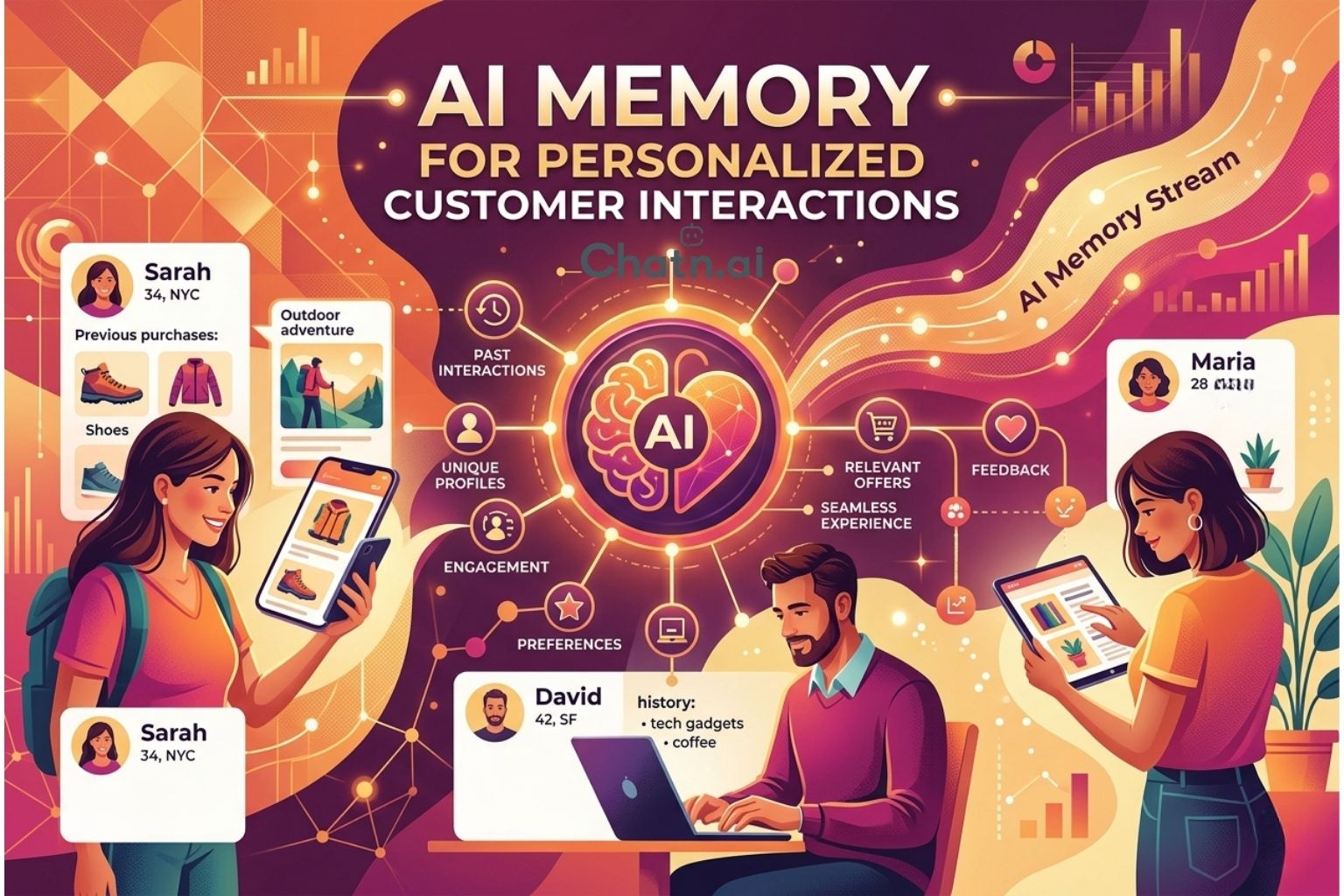
AI Memory refers to an AI system’s ability to retain user context, preferences, and past interactions for future use. This supports relevant, personalized, and consistent experiences. AI Memory enables systems to better understand users and respond more accurately. It reduces repetition, allows users to focus on their goals, and creates a seamless, human-like experience that increases engagement.
AI Memory can store and utilize information such as:
- User preferences
- Conversation history
- Behavioral patterns
- Task continuity
- Frequently requested information
These capabilities allow AI systems to deliver smarter interactions and adapt more effectively to each user’s needs.
How AI Memory Differs from Traditional Chatbots
In general, chatbots lack context and history because they are isolated entities focused only on the ongoing interaction. As a result, they cannot retain long-term context or prior interactions, such as the user’s name or previous requests. AI Memory addresses this by allowing systems to use information from prior interactions. Without AI Memory, each conversation starts anew, forcing users to repeat their names, preferences, formatting, etc. As a result, the system cannot provide personalized answers or a connected interaction. Thanks to AI Memory, systems can continue conversations naturally and draw on prior interactions. Personalization comes from behavior and preference history, along with a consistent interaction format across sessions. AI Memory helps systems achieve greater contextual awareness and more connected interactions, delivering a more satisfying experience overall and a stronger payoff for users.
Why AI Memory Is Becoming Essential in Modern AI Systems
AI systems are now expected to behave more like assistants than tools. This shift makes memory a core requirement.
Minimizing Repetition and Resistance
It is common for users to dislike being asked to repeat themselves during each interaction, as it can cause unnecessary resistance and hinder progress. Thankfully, the use of AI Memory solves the problem by enabling the system to retain relevant information from previous interactions, thereby reducing repetition. As a consequence, interactions will be more natural and easygoing since users do not need to reiterate what they require each time they start talking. Furthermore, businesses do not have to struggle to establish effective communication channels when the AI system already contains all the necessary information. His technology will help simplify communication, leaving room only for significant interactions.
Enabling Personalization
Personalization is no longer optional for many businesses; customers demand experiences that match their needs and preferences. Therefore, organizations must engage customers with interactions that feel personalized. Thanks to AI Memory, systems can recall relevant user details over time. AI Memory can do things such as:
- Recall preferences
- Adjust tone and responses to the situation.
- Adjust suggestions based on earlier interactions.
- Provide timely, relevant help.
In turn, these capabilities help create experiences that seem personalized. Moreover, users receive replies aligned with their preferences and prior interactions. In other words, AI Memory enables help that feels like more than completing a task.
Enabling Long-Term User Relationships
AI Memory enables companies to build lasting user relationships by retaining conversation context and continuing interactions over time. This ensures users receive consistent, personalized service with each use.
This capability is especially valuable in:
- Customer service
- Sales management
- Tools for businesses
In these scenarios, support teams recall past issues, sales assistants remember user preferences, and business tools track workflows. This allows users to avoid repeating information and focus on their objectives. AI Memory also enables experiences that adapt to changing user expectations. Users engage with intelligent systems that learn and improve over time, rather than isolated sessions.

Types of AI Memory Systems
AI Memory is not one uniform structure. It has multiple forms that work together.
Episodic Memory
Episodic memory stores specific events, experiences, and interactions. It enables AI to recall previous communications and apply that knowledge as needed, ensuring continuity and stronger contextual support.
In practice, episodic memory can include information like:
- “The user asked for support with billing a week ago.”
- “The user had issues with logging in yesterday.”
When users contact the system again, data from previous interactions can be retrieved and referenced in the current conversation. This prevents customers from repeating or retelling their interaction history each time they seek help.
Semantic Memory
Semantic memory refers to the knowledge base that contains generic information about the user rather than specific experiences or transactions. In other words, semantic memory helps AI remember essential facts and qualities that do not change over time. As a result, AI can create a more personalized experience across multiple conversations.
Examples of information that can be stored in semantic memory include:
- Preferences
- Responsibilities
- Business context
- Communications styles
- Repeatedly mentioned topics
Since the scope of information in semantic memory is broader, AI can become better acquainted with the user’s nature and needs. Thus, AI’s ability to personalize responses and recommendations increases significantly. Also, semantic memory enables an AI system to create a more personalized experience without repeatedly asking the user for the same data.
Procedural Memory
Procedural memory allows the storage of behavioral patterns that enable the AI to understand how typical users behave. Unlike episodic memory, which emphasizes particular events and facts, procedural memory concerns actions and routines that people perform frequently. Therefore, AI systems will be able to adjust their behavior to fit in and make communication more effective by adopting new practices that align with user needs.
Namely, the procedural memory enables the system to learn:
- The way users act when interacting with the system
- The workflow that is preferred by users
- The actions that users often take
- The procedures that users follow
Thus, the AI system will facilitate communication and eliminate redundant actions. As a result, users will find it easier to interact with the system and perform necessary procedures, and the AI will be able to anticipate users’ requirements and provide help accordingly.
AI Memory in Chatn.ai: Practical Applications
AI Memory becomes powerful when applied to real-world systems. For Chatn.ai, it enhances multiple business functions without changing core workflows.
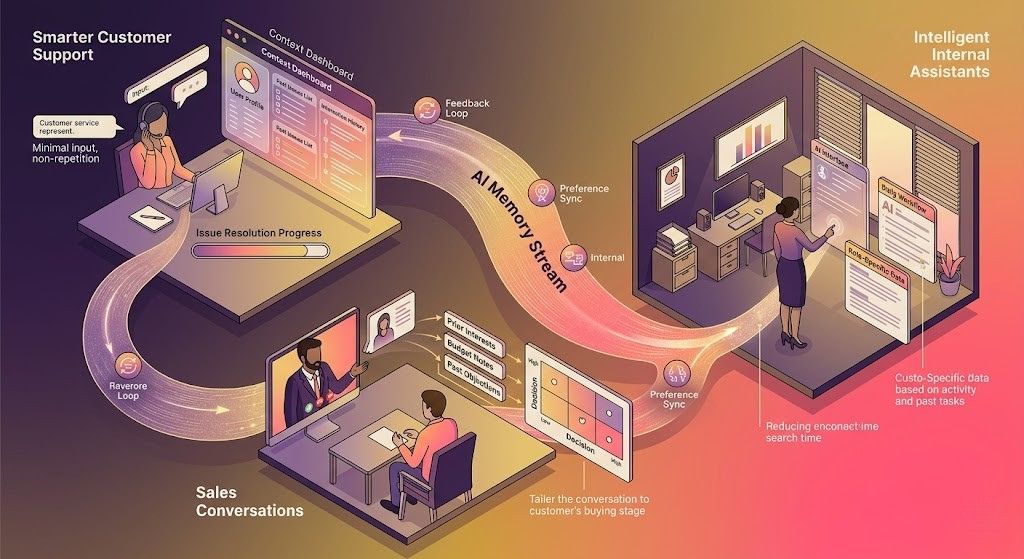
Smarter Customer Support
AI Memory helps customer support software retain information about past issues, conversations, and solutions. This context helps support personnel and enables AI assistants to respond more effectively. The main benefits of this approach include: Users do not need to repeat information, which helps create a smoother support experience.
- As a result, issues are resolved faster with the available context.
- Much higher levels of overall satisfaction
- As a result, support becomes continuous rather than transactional.
With prior context, support assistants can identify recurring issues and provide more proactive assistance, thereby improving the customer support experience.
Sales Conversations with Context Awareness
AI Memory enhances sales conversations by storing and applying context from previous sessions. This helps salespeople or AI agents engage in more informed discussions with users. With this feature, AI can retain key information such as:
The product interests shown in the past:
- Signs that a budget is being discussed
- Objections mentioned previously by the user
By leveraging this context, the system can identify the customer’s decision-making stage. This allows it to provide relevant guidance, avoid unnecessary details, and streamline the buying experience.
Intelligent Internal Assistants
AI Memory enhances internal software by retaining context from employee interactions. It helps systems identify employees’ needs, roles, and activities.
Employees benefit from AI Memory in several ways:
- Get customized responses tailored to their roles and actions.
- Access the context needed to perform tasks effectively.
- Reduce redundant actions in workflows.
With contextual data, employees spend less time on repetitive searches and focus on higher-priority tasks. This also improves team collaboration and streamlines workflows.
Benefits of AI Memory for Businesses
AI Memory delivers measurable business impact. It is not just a technical upgrade. It is a performance driver.
Enhanced Customer Satisfaction
With AI Memory, the user experience improves because AI systems remember users and their preferences. Users will not spend extra minutes providing the same information each time they interact; instead, the AI system will provide relevant help and improve their overall experience. Also, because AI remembers users’ preferences, it will offer help based on previous user behavior and needs. This will help resolve customer issues more quickly and deliver services that better match users’ needs. As a result, user satisfaction will rise as each interaction becomes more streamlined and useful for the customer. Additionally, users are more satisfied when they have a pleasant experience, and they will use your services repeatedly in the future.
Reduced Operational Costs
By reducing redundant interactions and streamlining support processes, AI Memory can help organizations save money on their operations. Previous conversations, preferences, and resolutions are stored, so users don’t have to enter the same information repeatedly. This reduces the time support staff must spend answering repetitive questions and frees up time to focus on more complex issues that require human expertise. Additionally, AI-driven systems can handle inquiries more efficiently by leveraging contextual knowledge to provide prompt, accurate answers. As a result, organizations can reduce support burden, optimize resources, and boost overall operational efficiency. Furthermore, fewer interactions reduce service costs and still provide a good customer service experience. Overall, AI Memory enables businesses to manage their operations more effectively and efficiently, reducing the need for manual intervention and minimizing human error.
Enhanced Conversion Rates
Personalization will help users make confident decisions because AI memory can track their interests and past conversations. As a result, the information provided by the AI system will better meet users’ needs and expectations. In addition, AI will enable organizations to communicate with customers at the right time and in the right way through AI memory. Recommendations for goods or services will be based on customers’ behaviors and interests rather than being generalized. Therefore, users are more likely to follow the decision-making process because they trust the relevance of the information they receive from the AI system. Personalized interactions also reduce purchasing obstacles and uncertainty.
Challenges in Implementing AI Memory Systems
Despite its benefits, AI Memory introduces complexity.
Data Privacy and Security Concerns
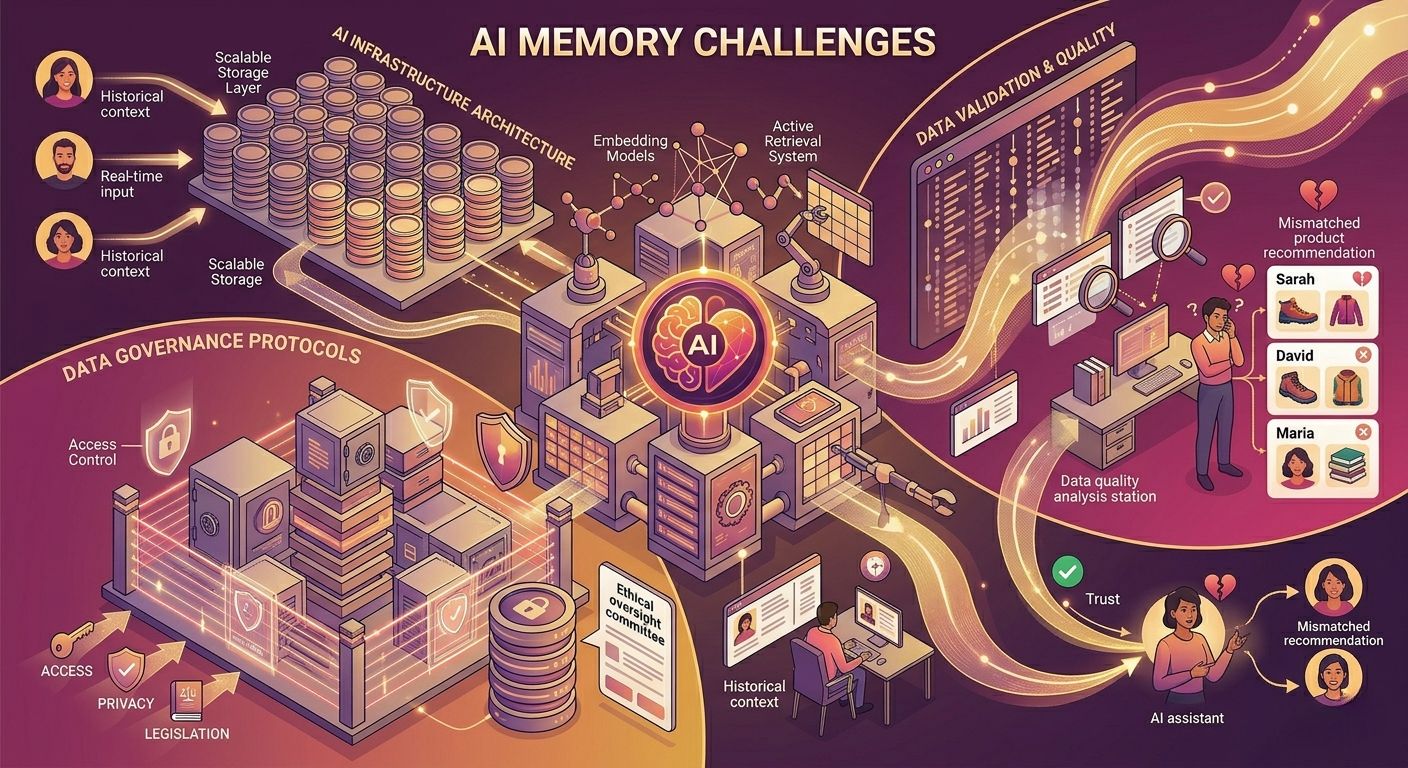
Data Breaches and Privacy concerns are a significant worry. Data Breaches and Privacy concerns are a great concern. While AI Memory offers numerous advantages, it also presents several data privacy and security concerns. Organizations can benefit from AI systems that retain user context, preferences, and interactions, but they need robust data governance protocols to safeguard sensitive data.
Businesses need to focus on the following to build trust and responsible use of AI Memory:
- Secure data storage
- Strong access controls
- Adherence to relevant legislation
In addition, companies should have policies in place to ensure that customer information is collected, stored, and utilized properly. In doing so, they can minimize security dangers and enhance consumer confidence. Moreover, adherence to privacy laws enables companies to avoid legal issues and demonstrate their commitment to responsible AI use. In conclusion, AI Memory and strong security measures can be integrated to provide personalized experiences while safeguarding user privacy and fostering ongoing trust.
Memory Accuracy Risks
AI Memory can greatly enhance personalization and efficiency, but memory errors can also pose substantial problems. Outdated, incomplete, or incorrect data can lead to inaccurate responses from an AI system.
Poor quality data can result in:
- Misaligned anticipations of what they want.
- Inadequate or inappropriate suggestions
- Higher user distrust and confidence
Moreover, an AI with faulty memory can lead to frustration and adversely affect user experience. Thus, businesses need to validate, update, and manage stored information periodically to ensure it remains accurate and relevant. Similarly, measures should be established to enable users to access, correct, or update significant information as required. In conclusion, it is crucial that AI systems continue to provide value and maintain trust and trustworthy experiences over time, and accurate AI Memory plays a vital role in these endeavors.
System Complexity
AI Memory is a powerful device, but it also needs to be extremely well-architected and designed for the system. Unlike traditional AI systems that “consume” information in a single encounter, AI Memory must record, store, retrieve, and leverage context over time across many interactions.
Organizations use the following technologies to aid these functions:
- Retrieval systems
- Embedding models
- Scalable storage layers
In addition, such parts must interact effortlessly to ensure that AI can obtain relevant information swiftly and precisely. This has led to businesses needing to thoughtfully plan and manage their AI infrastructure for optimal performance, reliability, and scalability. Additionally, the more information that is stored, the more necessary it is for systems to process larger amounts of data without slowing down or becoming inaccurate. In conclusion, AI Memory offers tremendous potential for value creation, but it demands careful planning, robust architecture, and continuous optimization to be implemented and maintained effectively.
The Future of AI Memory in AI Systems
AI Memory is still evolving. However, its future direction is clear.
Fully Persistent AI Assistants
With the evolution of AI Memory, AI systems will increasingly remember and use user context over time spans of months, even years. Future AI assistants will not only have more knowledge of user preferences, behaviors, goals, and interactions over time, but they will also remember information during a session. This will make AI more able to provide highly contextualized and uniform experiences. Moreover, users won’t have to enter the same data repeatedly when interacting with a system. Rather, AI assistants will advance the conversation and evolve in accordance with both needs and preferences. This progress will thus lead the way to fully persistent AI assistants – not just tools, but long-term digital companions. In the end, these lifelong digital helpers will be able to offer continuous assistance, provide increasingly relevant advice, and generate more meaningful interactions throughout the user journey.
Predictive Memory Systems
AI Memory is not only about capturing past interactions, but also about anticipating what users want to do next. As AI evolves, more systems will analyze user behavior and preferences and predict their needs before they ask for help. Thus, the next generation of AI will become more proactive than reactive. Rather than waiting for a user to ask for assistance, an intelligent system will identify users’ needs and offer recommendations, relevant information, and advice. In addition, predictive memory abilities will help AI offer much more personalized experiences during each interaction. For instance, the system may suggest next steps, show relevant sources, and provide important information related to users’ previous actions and goals. This proactive method helps users complete tasks faster and more efficiently.
Deep Enterprise Integration
AI Memory promises to be integrated into enterprise systems in a profound way, with the aim of delivering both a seamless data flow and a wealth of valuable information. In this way, AI will no longer function in isolation but will actively integrate with the organization’s core systems and platforms to provide a comprehensive intelligence service.
This integration will feature the integration of systems like:
- Customer Relationship Management (CRM)
- HR platforms
- Analytics tools
Moreover, AI Memory can combine information from various sources and create more comprehensive, context-aware insights by connecting these systems. This means that companies can break down data silos and enhance cross-departmental decision-making. Employees will have access to the same accurate information across different platforms. In the end, this degree of integration will enable organizations to run more efficiently, foster better collaboration, and create a seamless AI Memory-based intelligence ecosystem.
Conclusion: The Significance of AI Memory for the Next Age of AI
AI Memory does more than mark another step forward in technology; it changes how AI is developed and works. Traditional AI cannot remember and respond based on past experience, but AI Memory gives systems this ability, enabling more natural and meaningful communication. Because of that, companies can provide customers with a much better experience at all touchpoints, while engaging more with clients and building stronger connections through increased consistency in responses and experiences.
Chatn.ai customers have a powerful tool in AI Memory, which gives them a significant advantage by increasing personalization, making communication more relevant, and eliminating inconsistencies throughout the customer journey. Finally, AI Memory shapes the next age of AI by giving it new capabilities and enabling more natural communication through memory and experience.