

Introduction
Today, customer expectations have evolved dramatically from just a few years ago. Users now expect prompt responses, tailored recommendations, and seamless support. They want brands to solve problems without repeated questions and to provide support whenever needed. However, many businesses still rely on the old customer-experience approach, which is no longer sufficient. Most customers still spend a lot of time navigating complex websites, communicating with support agents, or searching long lists for answers. As a result, customer satisfaction drops, customer engagement declines, and managing changing requirements becomes harder. Even more concerning, this can lead to the loss of valuable leads.
For this reason, companies seek new solutions that deliver exceptional experiences without significant investments in infrastructure and human resources. At the same time, businesses cannot compromise between efficiency and personalized support. In response to these challenges, the concept of AI Concierge emerges. Unlike other support mechanisms, it offers users more than simple answers. An AI Concierge accompanies customers throughout the entire buying process, helping them complete tasks quickly and confidently.
What Is an AI Concierge?
An AI Concierge is an intelligent virtual assistant that assists, guides, and supports customers throughout their interactions with a business. It goes beyond answering questions by actively enabling the customer journey. Unlike traditional chatbots, which only respond to queries, an AI Concierge is proactive. It anticipates customer needs and offers timely advice and support, helping customers achieve their goals more efficiently. This approach enables businesses to deliver seamless and intuitive customer experiences.
A luxury hotel concierge provides a useful analogy for understanding this concept. A concierge offers suggestions, provides answers, arranges requests, and assists guests to have a smooth trip. Likewise, an artificial intelligence Concierge operates at scale and digitally. Unlike a human concierge, however, it can help thousands of customers at once and is available around the clock. More than that, AI concierges offer capabilities beyond traditional customer service. They track customer interactions, identify preferences, provide personalized recommendations, handle repetitive tasks, and maintain conversation histories. They also integrate with business systems to deliver timely and relevant information. quicker, more customized, and more useful support. Meanwhile, businesses enhance customer satisfaction and engagement, and build stronger relationships at every stage of the customer journey.
The Evolution From Receptionist to Digital Concierge
Customer service technology has advanced significantly. As customer expectations have risen, businesses have adopted new tools to improve communication and service delivery. Initially, call centers and receptionists managed customer inquiries, providing personalized support but requiring significant resources and limited availability. Later, businesses introduced websites and live chat systems, allowing customers to contact support more efficiently. Companies then adopted chatbots to address frequently asked questions, improving efficiency and reducing support team workload. However, early chatbots often lacked context, personalization, and conversational flexibility, resulting in customer interactions that felt impersonal and unresponsive to individual needs.
Advancements in AI have transformed customer experience. Modern conversational AI systems understand intent, recognize context, analyze customer behavior, and generate more natural responses. These systems also learn from interactions and continuously improve. With these advancements, AI Concierge platforms have ushered in a more intelligent and customer-focused approach. Instead of just answering questions, they proactively engage with customers, offer tailored suggestions, and support customers throughout the process. They also maintain context throughout conversations, creating more meaningful and seamless experiences. So, customer service technology has long since gone beyond automation alone. In today’s digital era, companies are transitioning from manual guidance to intelligent, proactive customer interactions and increasingly personalized customer experiences thanks to AI Concierge solutions.
Core Responsibilities of an AI Concierge
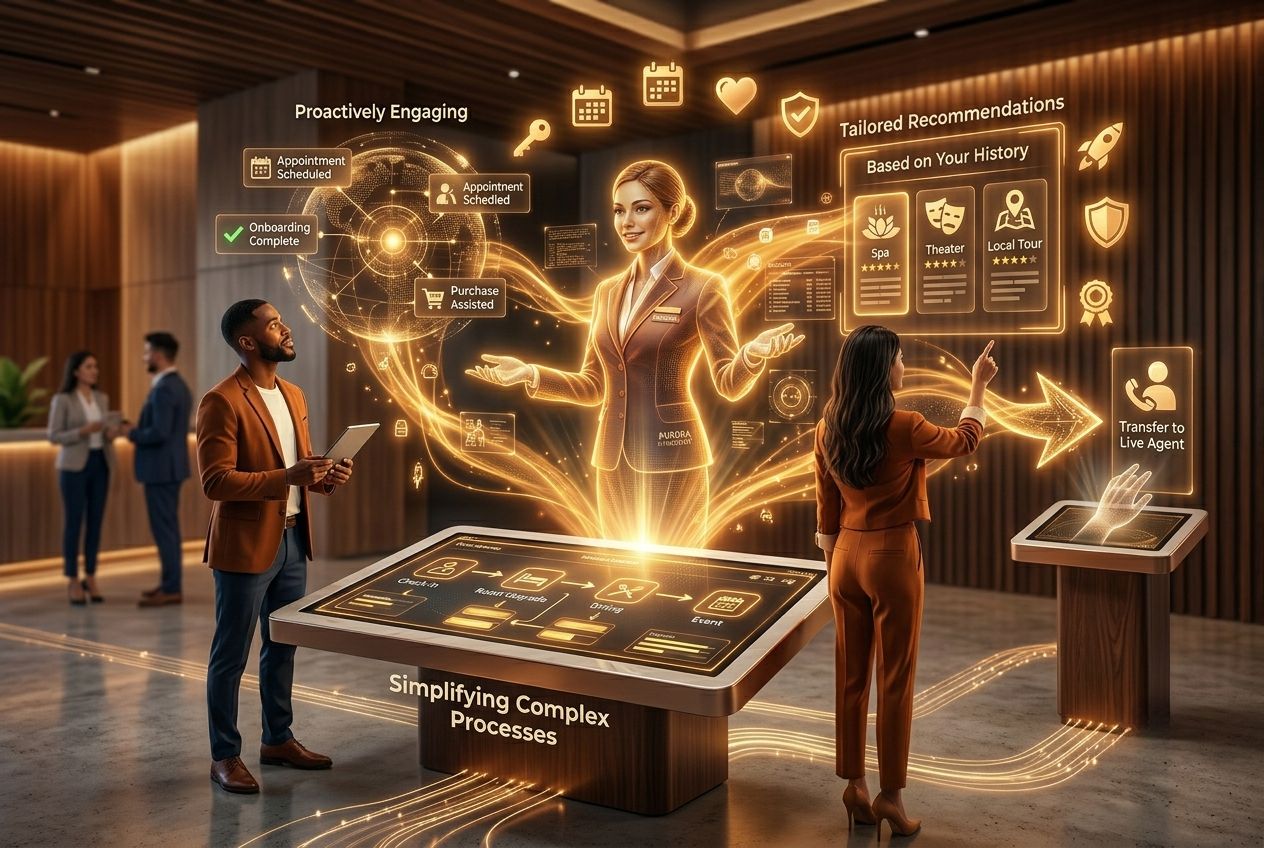
An AI Concierge is a customer support tool designed to help users achieve their goals while reducing support workload. First, it delivers prompt and accurate responses to customer inquiries, enabling users to access information quickly and focus on their priorities. Second, it guides users through products, services, and digital experiences by directing them to appropriate solutions, recommending relevant resources, and simplifying complex processes. Third, it provides tailored recommendations based on customer choices, actions, and history. By understanding individual needs, the AI Concierge offers personalized support such as scheduling appointments, assisting with purchases, onboarding, and automating repetitive tasks. It can anticipate and address issues proactively, and when necessary, transfer customers to a live representative while preserving context. Ultimately, the AI Concierge enhances customer experience by providing intelligence, personalization, automation, and efficiency.
Why Traditional Customer Experiences Are Falling Behind
Customer expectations are evolving. As technology and digital experiences advance, customers increasingly expect rapid, seamless, and personalized interactions from businesses. Many organizations struggle to meet these changing demands. Customers seek convenience and immediate support, but outdated processes and disconnected systems create obstacles. Across websites, mobile apps, social media, and messaging channels, customers expect a consistent experience. However, few businesses deliver seamless journeys, often requiring users to switch channels, re-enter information, or search for answers. As a result, customer frustration rises, engagement drops, and satisfaction declines. These friction points can also increase the risk of customers turning to competitors. To address this, companies should rethink their customer approach and adopt solutions that enable more connected, personalized, and efficient experiences. This will help them meet current expectations and build stronger customer relationships.
Customers Expect Immediate Answers
Today’s consumers expect speed and convenience in every aspect of their lives. They access entertainment, make purchases, and find information instantly. Customers do not want to wait for assistance; they expect businesses to address their questions and concerns in real time. When organizations do not meet these expectations, customer satisfaction declines. Delayed responses cause frustration, reduce engagement, and may drive customers to seek alternatives. Even short waits can negatively impact the customer experience. Businesses must provide timely and consistent support at every touchpoint. An AI Concierge can help solve this problem by providing instant support at any time of the day. An AI Concierge addresses this challenge by delivering instant support around the clock. It provides prompt and accurate information, guidance, and assistance. This enables businesses to improve customer satisfaction, increase engagement, and streamline interactions.
Generic Experiences Reduce Engagement
Customers expect businesses to understand their specific needs and preferences. Generic experiences often fail to meet customer expectations. They may cause customers to feel anonymous rather than valued, which can reduce engagement and retention. When businesses use a standard approach to communication, suggestions may be less relevant and effective. As a result, customers may overlook opportunities, lose interest, or seek more personalized experiences elsewhere. In contrast, AI-driven customer engagement enables companies to tailor interactions to individual preferences and behaviors. By analyzing customer data and understanding user intent, AI delivers more targeted and timely support, recommendations, and experiences. This approach helps customers feel understood, valued, and supported throughout their journey. Tailored interactions also strengthen customer relationships, engagement, and long-term loyalty.
Fragmented Journeys Create Friction
Most customer journeys span multiple channels and touchpoints. For example, a customer may begin research on a website, follow up by email, and then contact customer service for assistance. However, these interactions are often disconnected. Businesses may lose important context as customers move between channels, leaving customers to repeat information and restate their needs multiple times. This leads to frustration and wasted time. Disjointed journeys make the experience difficult and inefficient, while recurring friction can lower customer satisfaction and engagement over time.
Customers expect businesses to remember them and recall previous interactions, regardless of the channel used. Without this continuity, businesses risk providing experiences that feel disjointed and impersonal. An AI Concierge maintains context across channels and interactions. By tracking customer progress throughout the journey, businesses can offer seamless transitions, personalized support, and a streamlined experience from start to finish.
Limited Availability Hurts Satisfaction
Traditional support teams often have limited hours and resources. While they aim to assist customers, they are not always available when needed. Customers now engage with businesses at all hours, including evenings, weekends, and holidays. As a result, they expect support to be available whenever they have questions or issues. When customers cannot access timely support, frustration increases. This can lead to lost sales, delayed decisions, or customers choosing competitors. Immediate assistance is essential to maintain service quality and satisfaction. As customer expectations rise, companies must provide consistent support while controlling costs. Relying solely on traditional support structures makes it difficult to meet growing demand. AI Concierge technology helps organizations address these challenges by providing intelligent assistance at any time and location. The system responds instantly and accurately to customer inquiries, account issues, and procedural guidance. This enables companies to be more responsive, improve customer satisfaction, and deliver better experiences. Customers receive assistance whenever they need it.

Conclusion
Customer expectations are evolving with the times, and traditional support methods can no longer keep up. Today’s customers call for quick responses, customized interactions, and hassle-free experiences throughout all channels. This means companies need to innovate and do more than just provide great service; they need to deliver it efficiently. This is where an AI Concierge really comes into its own. It doesn’t just respond to questions—it actively guides customers through the process, offers tailored suggestions, keeps context in mind throughout the conversation, and provides assistance when needed. This enables companies to build more meaningful, connected, and customer-centric experiences. Furthermore, AI Concierge technology can address numerous problems with traditional customer experiences, such as delayed responses, disjointed journeys, generic interactions, and limited availability. When these pain points are addressed, businesses can enhance customer satisfaction, build customer loyalty, and maximize long-term engagement. With the continued evolution of AI technology, AI Concierge solutions will become a key part of the future of customer experience. By adopting this technology now, companies will be better equipped to meet their customers’ increasing expectations and outperform competitors. Businesses can create intelligent, personalized, and scalable customer experiences with platforms such as Chatn.ai and make a meaningful impact. In conclusion, an AI Concierge is more than just a support function: it’s a strategic asset that can help organizations foster better relationships, optimize customer journeys, and drive sustainable growth in a digital age.