

Adopting clinical AI tools offers numerous advantages for healthcare organizations. These benefits extend to providers, staff, and patients alike.
Better Diagnostic Accuracy
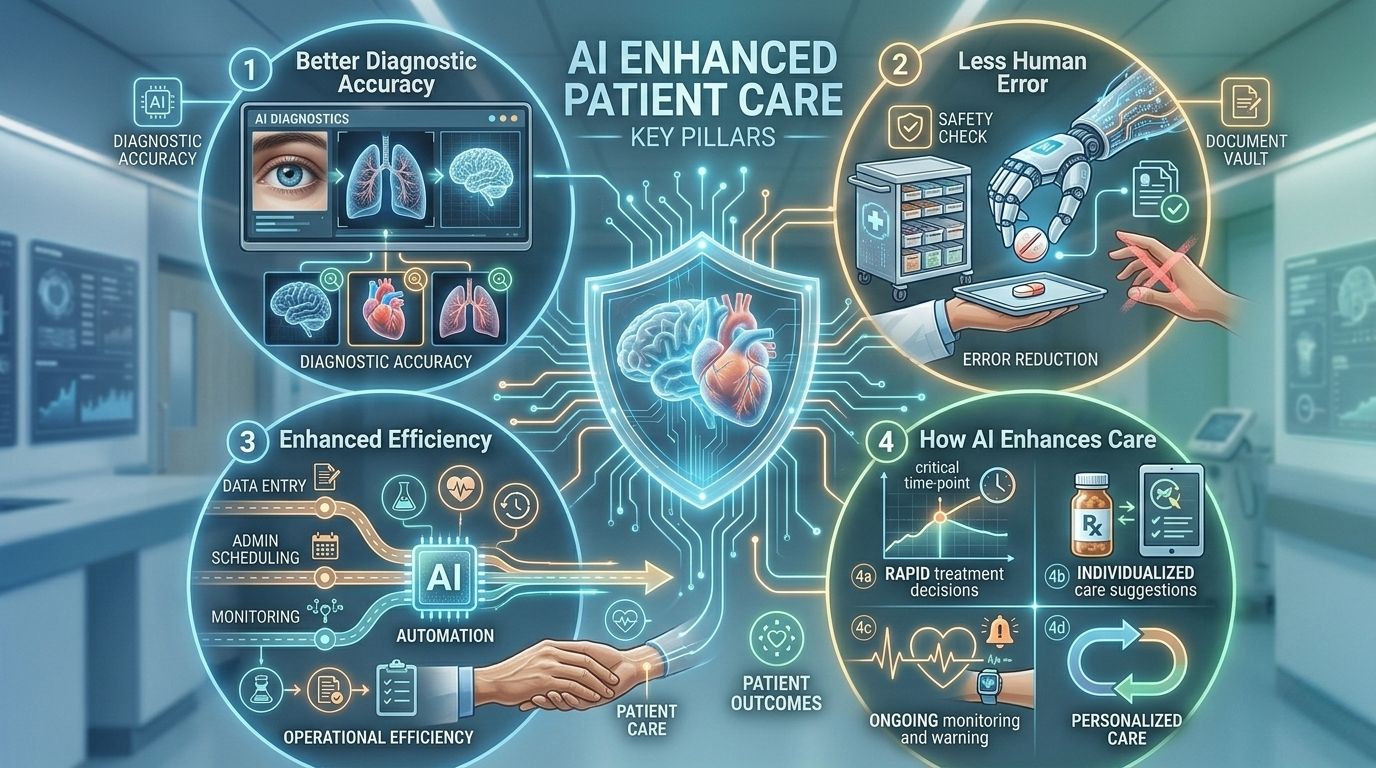
The AI algorithms used are very proactive in recognizing patterns and trends that might go unnoticed by humans. For instance, an AI-assisted diagnostic system can quickly and accurately detect minute changes on medical images. AI clinical tools help medical practitioners prevent misdiagnoses and screen patients for serious conditions early. Early detection not only improves treatment effectiveness but also increases patients’ survival chances. Additionally, AI helps practitioners make better decisions by providing actionable information, thereby improving overall confidence in the accuracy of the diagnosis.
Less Human Error
Manual charting, medication errors, and supervision errors are among the many human errors that have serious consequences in healthcare facilities. Fortunately, healthcare teams can mitigate human errors by using clinical AI tools, which automate tasks such as documentation, medication management, and initial data analysis. Secondly, clinical artificial intelligence tools can send real-time notifications, enabling healthcare teams to respond to potential errors promptly. By monitoring data and identifying anomalies, artificial intelligence tools can not only mitigate human errors but also assist healthcare teams in making informed clinical decisions, thereby reducing errors and enabling them to focus on high-value care.
Enhanced Efficiency
Clinical AI technologies have the potential to increase efficiency by automating routine, mundane tasks. Using clinical AI tools allows healthcare workers to focus more on patient engagement and informed decision-making. For example, AI technologies can easily execute routine tasks such as data input, patient monitoring, and examination with ease and precision. Additionally, AI technologies can increase efficiency by organizing patient data, detecting key trends, and prioritizing tasks according to urgency. Clinical AI tools enable healthcare workers to focus on delivering quality care, responding to emergencies, and making informed decisions. Over time, healthcare workers can increase efficiency, which can translate to improved patient satisfaction and healthcare outcomes.
How AI Enhances Patient Care
Rapid treatment decisions: The ability to analyze complex datasets in real time enables AI to help healthcare teams make more informed, quicker treatment decisions. As a result, patients will receive timely interventions that can enhance outcomes.
Individualized care suggestions: In addition, AI algorithms can analyze each patient’s profile and create the optimal treatment plan. Such personalization provides care that meets individuals’ needs, making it more effective and satisfying.
Ongoing monitoring and warning: In addition, AI continuously monitors real-time health indicators and issues alerts when problems arise. Automated monitoring and real-time alerts improve patient safety and enable healthcare teams to respond instantly to critical changes.
Challenges and Considerations in Implementing Clinical AI Tools
Despite the promise of AI, adopting clinical AI tools is not without challenges. Organizations must navigate technical, operational, and ethical considerations.
Data Privacy and Compliance
Healthcare organizations have access to sensitive patient information and, therefore, must take all necessary steps to comply with HIPAA and other regulations. Thus, clinical AI tools should actively ensure information security by storing information in secure locations, transmitting it in coded form, and managing access levels. Through such protections, organizations minimize risk and retain patient trust.
Integration with Existing Systems
To deliver real value, healthcare organizations must integrate AI tools seamlessly with electronic health records (EHRs) and other hospital software. Without proper integration, teams may struggle to adopt the technology effectively. As a result, organizations can limit performance gains and miss the full benefits of clinical AI tools.
Employee Education and AI Intelligence
Healthcare organizations need to train their teams to ensure they get the most out of clinical AI tools. The lack of appropriate education can lead staff to distrust AI systems and their use. Thus, organizations should comprehensively teach teams how to make sense of AI recommendations, analyze algorithmic outputs, and use the insights in clinical decision-making with confidence.
Overcoming Implementation Barriers
To start with, healthcare organizations must introduce pilot programs where they can test AI in controlled environments to quantify the effect of AI in the real world. Second, they must collaborate with reliable suppliers of healthcare AI to provide reliability and compliance. Moreover, teams are required to constantly monitor system performance and actively streamline workflows in response to needs. With such proactive measures, organizations can maximize the potential of clinical AI tools and reduce operational and clinical risks to a minimum.
Case Studies: Clinical AI Tools in Action
AI has transformative potential when seen in real-world applications. To mention but one example, in hospital imaging departments, AI-driven imaging has proactively reduced the rate of incorrectly diagnosed cancer by one-fifth in pilot studies. Likewise, hospitals that applied AI risk scoring reduced 30-day readmissions by 15% after adopting predictive analytics for readmissions. Also, the ICU patient monitoring system enabled the delivery of critical alerts in real time, thereby improving response speed and patient survival rates. Combined with the above instances, it is clear that clinical AI tools are not hypothetical; they indeed improve patient outcomes and operational efficiency in healthcare settings.
Lessons Learned from Real-World AI Implementation
Case studies show that healthcare organizations seeking clinical AI systems can apply the following lessons:
- First, organizations can initiate pilot projects to assess the impact before full implementation.
- Two, the incorporation of new technology into existing systems can ensure the smooth operation of those systems.
- Three, the constant monitoring and training of staff can ensure proper utilization of the new technology for the betterment of healthcare services.
Clinical AI Tools’ Future
AI in healthcare is still developing quickly, and new developments point to even more significant shifts in the future. For example, AI-driven surgery planning enables algorithms to assist surgeons in anticipating potential complications and optimizing techniques, thereby improving accuracy and outcomes. In a similar vein, robotic assistance uses AI-guided systems to improve precision in intricate processes while lowering human error. Furthermore, telemedicine and AI triage integrate virtual care platforms with AI to help healthcare providers prioritize patients more efficiently and increase access to remote services. All things considered, the future of healthcare is becoming more data-driven, predictive, and individualized, with clinical AI tools at its core.
Emerging Opportunities with Clinical AI Tools
As the use of clinical AI tools continues to improve, new opportunities are arising for healthcare organizations. For instance, AI-enabled surgery planning enables healthcare organizations to predict potential challenges associated with the surgery. Healthcare organizations can leverage this emerging opportunity to improve surgical outcomes. Furthermore, robotic surgery enables healthcare organizations to improve the accuracy of complex surgeries while reducing the chances of human error. Also, AI triage and telemedicine are an emerging opportunity for healthcare organizations. Healthcare organizations can leverage this emerging opportunity to improve surgical outcomes.

A Guide on Choosing the Appropriate Clinical AI Tool for Your Organization
Choosing the right AI tool for your organization can be challenging, and it is imperative that organizations prioritize the tool’s needs, reliability, and integration capabilities. An organization can begin by analyzing workflows and identifying pain points that the AI tool can address. Secondly, the organization can evaluate vendors based on the tool’s needs, reliability, and scalability, ensuring it aligns with the organization’s needs. Finally, the organization can prioritize tools that deliver the best ROI and continually improve patient outcomes.
Key Questions to Ask Before Adoption
Healthcare organizations should ask specific questions before adopting a clinical AI tool, as detailed in the following section. First, it is important to ensure that the clinical AI tool is HIPAA-compliant to keep patients’ data secure. Secondly, healthcare organizations must ensure that the clinical AI tool integrates easily with existing EHRs without disrupting workflow efficiency. Third, it is important to determine the parameters for measuring the impact of clinical AI tools on the efficiency of the healthcare organization.
Essential Evaluation Criteria for the Adoption of Clinical AI in Healthcare Organizations
Before adopting a clinical AI system, healthcare organizations need to evaluate certain critical parameters. Firstly, the healthcare organization must ensure the AI system is HIPAA-compliant to maintain data confidentiality. Secondly, the healthcare organization must ensure the smooth integration of the AI system with existing EHRs to maintain workflow efficiency. Thirdly, the healthcare organization must identify the success parameters of the AI system, including efficiency, patient outcomes, and staff productivity.
Conclusion: Embracing Clinical AI Tools for Better Healthcare
Currently, clinical AI tools play an integral role in changing the face of modern healthcare. They offer improved accuracy, workflow, and patient outcomes, while minimizing human error. Therefore, there is no doubt that healthcare organizations that invest in clinical AI tools have an edge in the market. Additionally, healthcare providers can offer faster, more personalized, and safer patient care by embracing AI. Therefore, the right time to start exploring clinical AI tools is now, as it is essential for success and efficiency.