
You've probably heard the buzz about AI agents transforming businesses. But here's the thing: not all AI agents are created equal, and choosing the wrong one is like hiring a sales expert to handle your HR department. It just doesn't work.
The confusion is real. You're bombarded with terms like "chatbots," "conversational AI," and "intelligent agents," but what does your business actually need? Let's cut through the noise and figure out which type of AI assistant will genuinely move the needle for your company.
Understanding the Types of AI Agents: Beyond the Technical Jargon
Before we dive into specific business applications, let's get one thing straight: the types of ai agents you'll encounter range from simple rule-followers to sophisticated learning systems. Some AI agents operate on basic "if-this-then-that" logic, while others adapt and improve based on every interaction they have.
Think of it like hiring employees. You wouldn't expect someone on their first day to perform like a 10-year veteran, right? AI agents work similarly: some are entry-level specialists, while others are seasoned professionals who continuously learn and evolve.
The technical world categorizes these as simple reflex agents, model-based agents, goal-based agents, and learning agents. But let's translate that into what actually matters for your business.

The Five AI Assistants Your Business Actually Encounters
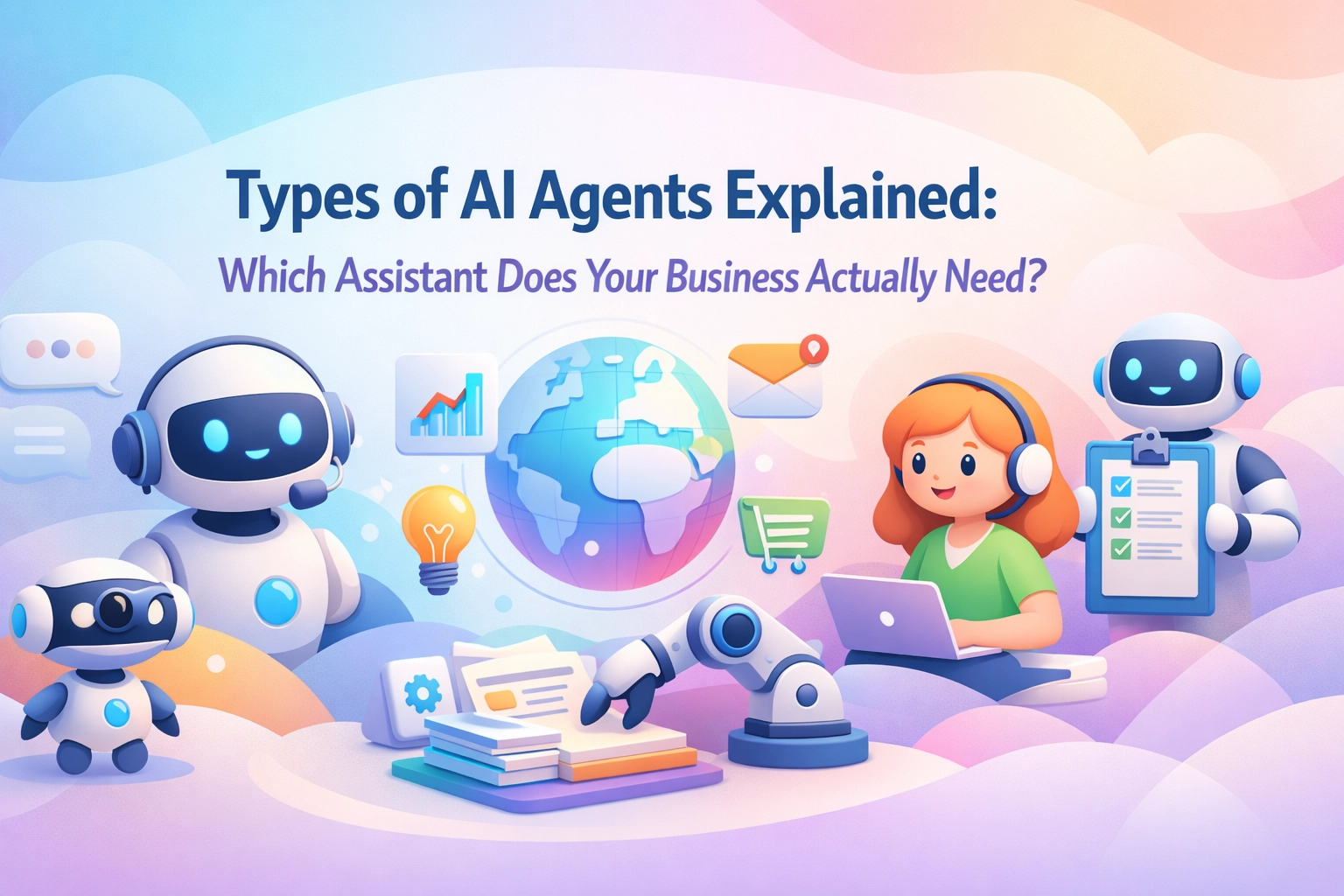
Here's where the rubber meets the road. Most businesses need one (or more) of these five specialized AI agents:
1. Customer Support Agents: Your 24/7 Problem Solvers
Your support AI agent is the frontline warrior handling customer inquiries, troubleshooting issues, and providing instant answers. These agents excel at realistic ai chat that doesn't feel robotic or frustrating: they understand context, remember previous conversations, and escalate complex issues to humans when needed.
What makes them work: A well-designed support agent combines goal-based decision-making (solving the customer's problem) with learning capabilities (improving responses based on successful resolutions). The chatbot ui matters tremendously here: customers need intuitive interfaces whether they're texting, calling, or chatting on your website.
Real-world impact: Companies using support AI agents report handling 60-80% of routine inquiries without human intervention, freeing your team to tackle complex issues that actually need the human touch.
2. Sales Agents: Your Always-On Revenue Generators
Sales AI agents don't just answer questions: they qualify leads, schedule meetings, and guide prospects through your sales funnel. These agents need to be persuasive, personalized, and perceptive about when to push and when to nurture.
The best sales agents leverage utility-based decision-making, weighing multiple factors (lead quality, conversation history, timing) to determine the optimal next step. They're not following rigid chatbot scripts: they're adapting their approach based on how each prospect responds.
Why multi-channel matters: Your prospects aren't all on the same platform. Some prefer texting, others want to jump on a quick call, and some will chat on your website. A sales agent that works across web chat, voice calls, phone, and SMS meets customers where they are, dramatically increasing conversion rates.

3. HR Agents: Your Internal Support System
Employee questions don't stop at 5 PM, and your HR team shouldn't have to work around the clock. HR AI agents handle benefits inquiries, policy questions, PTO requests, and basic troubleshooting for internal systems: all while maintaining compliance and confidentiality.
These agents function as model-based systems, maintaining context about each employee, company policies, and previous interactions. They know that "Sarah from accounting" has different benefits than "Mike from sales," and they respond accordingly.
The integration advantage: Unlike DIY chatbots you'd have to build and maintain, ready-to-use HR agents plug into your existing workflows, syncing with your HRIS, payroll systems, and communication platforms without requiring a development team.
4. Training Agents: Your Scalable Knowledge Experts
Training AI agents deliver consistent, personalized learning experiences for employee onboarding, product training, and skill development. They adapt to each learner's pace, answer questions in real-time, and track progress without requiring trainers to repeat the same material endlessly.
These learning agents continuously improve their teaching methods based on what works. If multiple employees struggle with the same concept, the agent adjusts its explanation or provides additional resources automatically.
Cross-department value: Whether you're training new sales reps on your product line, teaching customer service protocols, or onboarding new developers, a training agent scales your expertise without scaling your headcount.

5. Onboarding Agents: Your New Hire Success Partners
First impressions matter, and chaotic onboarding creates lasting damage. Onboarding AI agents guide new employees through paperwork, company culture, system access, and those first crucial weeks when questions pile up faster than answers.
These goal-based agents have one clear objective: get new hires productive as quickly and smoothly as possible. They proactively reach out with relevant information at the right time, answer questions instantly, and ensure nothing falls through the cracks.
Why "Just Building a Bot" Isn't the Answer
Here's what most businesses get wrong: they think they need to design and build AI agents from scratch. That's like saying you need to build your own CRM software instead of using Salesforce.
The reality? You need ready-to-use assistants that integrate into your existing workflows, handle interactions intelligently, and gather the information your business actually needs: without requiring months of development or a dedicated AI team.
This is where ai chatbot design becomes critical. The difference between a frustrating bot and a helpful assistant often comes down to:
- Multi-channel availability: Can your customers reach it via web chat, voice, phone calls, AND texting?
- Context awareness: Does it remember previous conversations and user preferences?
- Human handoff: Does it know when to escalate to a real person?
- Integration depth: Does it actually connect to your business systems, or just float in isolation?

Choosing Your AI Agent: The Decision Framework
So which AI assistant does YOUR business actually need? Ask yourself these questions:
For Customer Support Agents:
- Are you drowning in repetitive customer questions?
- Do customers complain about slow response times?
- Is your support team spending time on issues that could be automated?
For Sales Agents:
- Are qualified leads slipping through because nobody followed up quickly enough?
- Do prospects get stuck in your funnel without guidance?
- Is your sales team wasting time on unqualified leads?
For HR Agents:
- Does your HR team answer the same policy questions repeatedly?
- Are employee requests getting lost or delayed?
- Do new hires struggle to find basic information?
For Training Agents:
- Is training consistency a problem across locations or shifts?
- Are your trainers overwhelmed by repetitive questions?
- Do you need to scale training without hiring more trainers?
For Onboarding Agents:
- Does new hire onboarding feel chaotic or incomplete?
- Do new employees frequently ask where to find information?
- Is your onboarding process different depending on who's doing it?
Most businesses discover they need more than one type of AI agent: and that's perfectly normal. The key is starting with your biggest pain point and expanding from there.
The Multi-Channel Advantage You Can't Ignore
Here's a game-changer: your AI agents need to work everywhere your people are. Not just web chat. Not just phone calls. Everywhere.
Modern AI assistants handle interactions across web chat, voice conversations, traditional phone calls, and SMS texting seamlessly. A customer might start a conversation via text, continue it through your website chat, and finish with a voice call: and the agent maintains context throughout.
This isn't just convenient: it's essential for realistic ai chat experiences that feel natural and helpful rather than robotic and frustrating. When customers can switch channels without repeating themselves, satisfaction skyrockets.

Ready to Deploy, Not Build
The businesses winning with AI agents aren't spending months on custom development: they're deploying ready-to-use assistants that work immediately. These solutions come pre-trained on best practices, integrate with common business systems, and start delivering value in days, not quarters.
Think of it like this: you don't custom-build your email platform, your accounting software, or your project management tools. Why would you custom-build your AI agents?
The smart approach? Choose specialized assistants designed for your specific use case (support, sales, HR, training, or onboarding), deploy them across your preferred channels, and let them start handling interactions while gathering valuable data about what your customers and employees actually need.
Your Next Move
Understanding the types of ai agents is just the first step. The real question is: what's costing your business right now? Slow customer support? Inconsistent training? Leaky sales funnels? Chaotic onboarding?
Start there. Choose the AI assistant that addresses your biggest pain point, deploy it across the channels your people actually use, and watch it transform that specific workflow. Then expand to other areas as you see the impact.
The future of business isn't about replacing humans with AI: it's about augmenting your team with specialized assistants that handle the repetitive, the routine, and the round-the-clock, so your people can focus on what actually requires human creativity, empathy, and strategic thinking.
Which assistant does your business actually need? Now you know how to decide.