
No corner of the internet is free from the influence of AI chatbots. These chatbots respond to consumer inquiries, qualify leads, and provide 24/7 support to employees. But despite their omnipresence, it’s surprising that many people continue to ask the same question: How do AI chatbots work?
This confusion is understandable because vendors often use technical language that many users find difficult to understand. Technical vendor language blurs the line between real intelligence and basic automation. As a result, doubt hinders adoption, leading to bad tech decisions.
And that’s where this guidebook will come into play.
Within this article, you are going to discover in the simplest detail how AI-powered chatbots function step by step. As you progress through it all, I will ensure you not only see the technology that powers conversational AI but also gain an understanding of its significance, and finally realize what makes a chatbot intelligent and what does not.
What Is an AI Chatbot (And What It Is Not)
An AI chatbot is an intelligent computer program that actively listens to user input and responds accordingly. Unlike other chatbots, which follow predefined scripts and lack intelligence, tech support chatbots react intelligently to user interactions. Because they can interpret input based on their intelligence, these chatbots offer users an excellent, natural conversation experience.
The Difference Between AI Chatbots and Rule-Based Bots
Rule-based chatbots follow pre-set flows. For example, if the user types in a specific phrase, the chatbot produces a matching response. While such systems can handle simple tasks, they break easily when conversations get off-script.
In contrast, AI chatbots work a little differently. The system may match keywords, they genuinely analyze languages. Therefore, they correctly identify what users want even when phrasing varies. Furthermore, they learn and adapt over time to achieve better results.
In other words, the rule-based bot follows instructions, while the AI chatbot really understands conversations and intelligently answers them.
Why Conversational AI Goes Beyond Simple Chat
Chatbot AI incorporates language understanding, intelligent decision-making, and automated execution. By doing so, the AI chatbot system enables chatbots to respond dynamically to everything said to them, rather than the traditional method of using scripts. Therefore, the chat experience becomes more human, and there is no need to guess what to say to the chatbot. In addition, the system is highly adaptable to user behavior and preferences. Ultimately, the adaptability of the system is the key to AI chatbot technology.
How Do AI Chatbots Work? A Step-by-Step Explanation
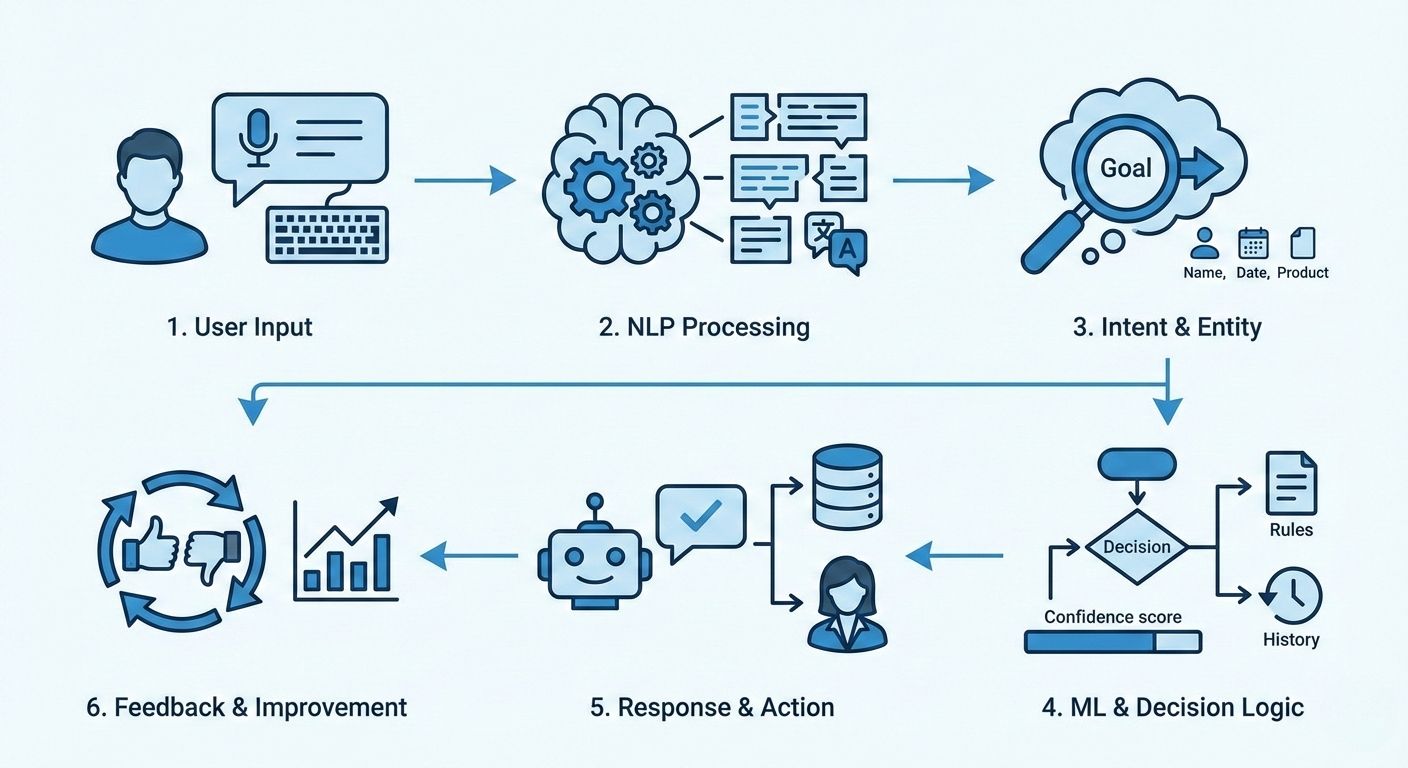
To truly understand how AI chatbots work, it helps to break the process into clear steps. Each step plays a critical role in delivering accurate and helpful responses.
Step 1. User Input Becomes Data
The user’s input initiates each interaction. For example, the user can write a message, speak through a microphone, or click a button. In each of these instances, the chatbot immediately captures the user’s input and organizes it into structured data, enabling the system to analyze the message correctly. Therefore, when the input is clean and precise, the results will be even better.
Step 2: Natural Language Processing (NLP)
Secondly, the chatbot employs natural language processing (NLP) to understand human language. In this stage, it undertakes very crucial processes, including;
Splits a sentence into smaller units to be analyzed
Targets grammar and sentence structures to understand the meaning
It identifies the language used to facilitate multilingualism.
Most importantly, this process enables the NLP to allow the chatbot to do more than read words; it has to understand their meanings as well. Thus, this step is crucial for conversing accurately and naturally.
Step 3: Intent Recognition and Entity Extraction
After understanding the language, the chatbot instantly extracts user intent. In simpler terms, purpose is what the user wants to achieve. For instance, “I need help with my account” and “Can’t log in” convey the same message but with different phrases. This particular attribute enables AI chatbots to detect similarities across diverse statements.
On the other hand, this system dynamically identifies essential entities such as names, dates, and product types. These key information points enable a chatbot to provide precise, relevant answers to users. Finally, intent recognition distinguishes intelligent chatbots from regular automation and defines the quality of the conversation process.
Step 4: Machine Learning and Decision Logic
Once it recognizes an intention, a chatbot decides which actions to take. It is at this point in the chatbot process that machine learning algorithms begin analyzing actions and responses within seconds. To make a decision, a chatbot must examine several very important factors:
The system considers:
- Previous encounters for pattern recognition of success
- A set of business rules to enforce compliance and integrity
- Confidence scores for minimizing the errors of uncertainty
Over time, machine learning improves the ability to provide accurate responses. As users use it more, the chatbot learns to determine the best answers for a conversation. Therefore, this learning ability enables AI-powered chatbots to scale while maintaining high-quality interactions.
Step 5: Response Generation and Action
At this stage, the chatbot actively generates a response based on its processing. In some applications, this could be delivering helpful information to the user directly. In others, it initiates some specific back-end action. For instance, a chatbot can:
- Answer a question immediately.
- Update a record within a connected system.
- Route the conversation to a live human agent when necessary.
Therefore, responses may be pre-trained, dynamically generated, or a combination of both, depending on the situation. Thus, the chatbot will have accurate, timely, and context-aware interactions.
Step 6: Feedback and Continuous Improvement
Lastly, the system is aggressively seeking feedback after each engagement. Using analytics, the system can analyze resolution rates, measure user satisfaction, and identify potential points of failure. On the other hand, the human team is analyzing the same and optimizing the chatbot’s performance and response. Consequently, there is improvement with time. Ultimately, the system will play a valuable and accurate role in the business.
The Core Technologies Behind AI Chatbots
Several critical technologies are combined to enable AI chatbots. It is with an understanding of such technologies that businesses can make intelligent decisions on using chatbots.
Natural Language Processing (NLP)
Natural Language Processing (NLP) actively captures user intent, tone, and language patterns for chatbots. In addition, it facilitates multi-language conversations for chatbots. Without natural language processing, it will be difficult for chatbots to scale and provide precise, contextually relevant responses efficiently.
Machine Learning Models
Similarly, machine learning actively allows chatbots to recognize patterns in user behavior and conversations. The system interprets past conversations to determine trends and anticipate the best responses for similar situations. In addition, continuous learning increases accuracy and reduces the need for constant reprogramming. Furthermore, machine learning enables chatbots to adapt to changing user behaviors, changing language, and evolving business requirements. As such, this capability enhances not only the chatbot’s performance but also reduces operational costs, improves efficiency, and ensures a consistent, high-quality user experience.
Knowledge Bases and Data Sources
AI chatbots function and depend on both structured and unstructured data. For instance, knowledge bases hold FAQs, company policies, product information, and vital documents. Hence, with accurate, high-quality data, chatbots ensure reliable, consistent responses. However, if a chatbot uses inaccurate or outdated information, it may create a negative, frustrating experience for a user. Hence, it is vital to ensure an accurate, well-organized data source to ensure a smooth chat process.
How AI Chatbots Understand Context
Context knowledge is what distinguishes good chatbots from bad ones and what prevents conversations from becoming repetitive, fragmented, and annoying. To overcome this problem, chatbots apply two kinds of memory:
Session Memory Versus Long-Term Learning
Throughout the session, memory helps chatbots retain information during a conversation, facilitating a smooth flow. Long-term learning also allows the system to maintain information from previous discussions, which helps improve responses during future interactions. By employing both technologies, artificial intelligence chatbots can maintain continuity in their responses, enabling them to have a more human-like conversation.
Why Context Matters for User Experience
Understanding the context actively helps eliminate repeated statements from users. The chatbot interacts with users based on their personal needs, making their responses feel less robotic. Therefore, users experience a seamless experience that helps build trust, making them comfortable to engage.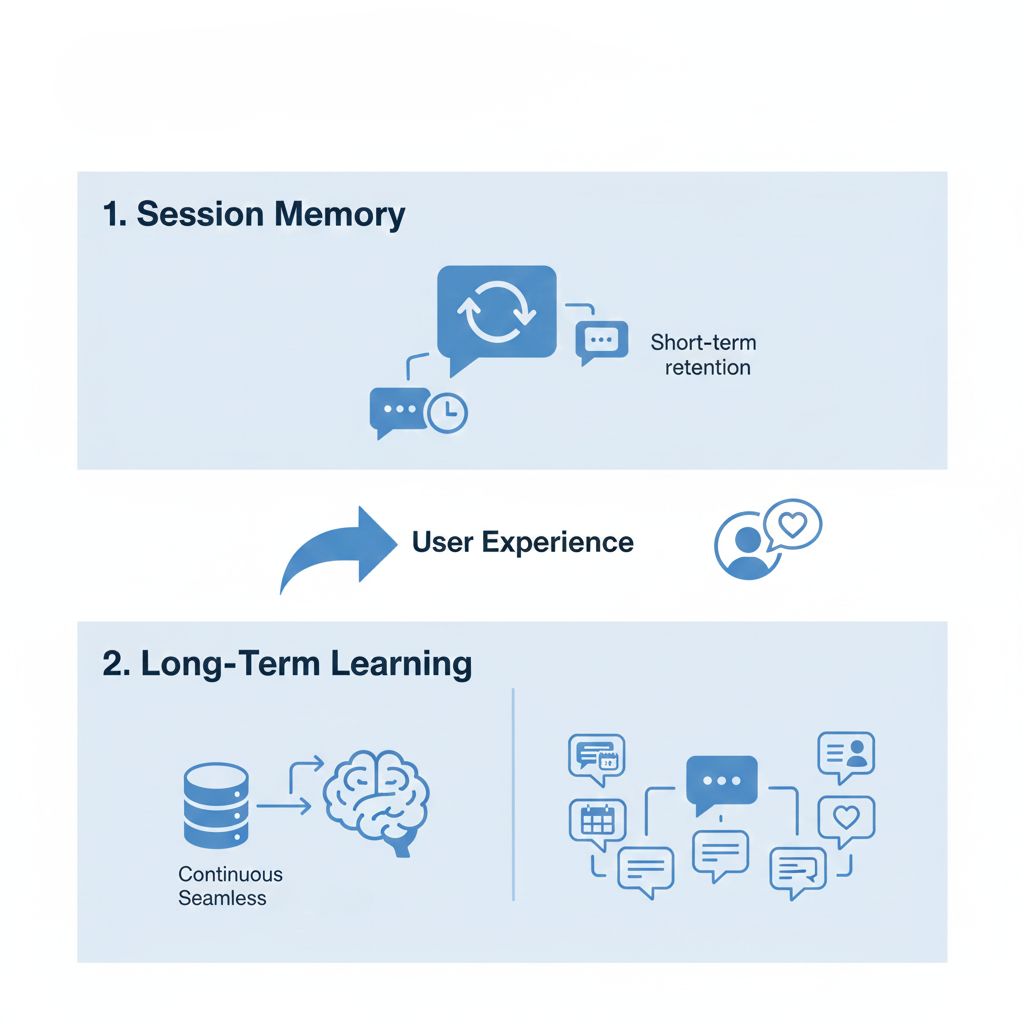
Where Human Agents Fit Into AI Chatbot Workflows
Chatbots will not replace a human being; on the contrary, they will assist a human being, thereby improving the quality of conversation.
Smart Escalation and Seamless Handoffs
Good chatbots understand their limitations. As soon as the level of confidence falls, they can escalate the session to a human representative. However, the most effective systems will ensure the continuity of the conversation so that human representatives have the full context. Humans also actively train chatbots by monitoring their interactions and improving them by identifying errors. Therefore, this combination consistently enhances accuracy, and AI chatbots are also becoming more reliable.
Real Business Use Cases for AI Chatbots
AI chatbots deliver value across departments. Their flexibility makes them powerful tools.
Automation of Customer Support
AI chatbots proactively resolve common customer issues in real time, enabling businesses to offer timely support with no delays. The chatbots answer repetitive queries, saving the customers from waiting and reducing the load on human support teams. Also, chatbots work around the clock to ensure customers get assistance at any time, even on days off or holidays. Therefore, organizations can reduce support costs, respond more efficiently, and improve overall customer satisfaction through seamless, reliable support.
The Sales and Lead Qualification
AI chatbots actively qualify leads by analyzing users’ intent and behavior during chat sessions. The chatbots enable early qualification of high-potential leads, ensuring that sales teams focus on those that are most likely to convert. Besides, chatbots allow the collection of essential information, follow-ups, and personalization based on potential customers’ responses. Therefore, this enhances revenue generation speed, lead management efficiency, and sales team sales closings.
HR and Internal Operations
Employees are actively engaging with AI chatbots to obtain quick responses when seeking answers about company policies, completing orientation procedures, or finding company resources. With these functions handled by chatbots, HR professionals are freed from addressing repetitive questions, enabling them to focus on long-term strategies. Furthermore, chatbots ensure that company employees receive consistent, reliable guidance, thereby improving overall company satisfaction. Organizations can thus achieve optimized HR functions, fast onboarding procedures, and a well-supported employee workforce.
Common Misconceptions About How AI Chatbots Work
Despite adoption growth, myths persist.
“AI Chatbots Only Follow Scripts”
People have long assumed that AI-based chatbots function solely based on rigid scripts. However, the modern version of the system not only learns but also improves over time. Unlike older systems, which were based solely on a set of predetermined paths, it can analyze the input, understand the intent, and respond appropriately.
“AI Chatbots Are Too Expensive”
Most businesses assume that AI chatbots are too expensive. Still, when implemented correctly, they can achieve long-term reductions in operational costs by automating repetitive tasks and handling volumes of interactions; chatbots free human employees up for higher-value work. In addition, it improves efficiency, speeds response times, and minimizes errors, further reducing costs. By investing in AI chatbots, one reaps tangible returns, with enhanced overall business performance and customer satisfaction.
Why Learning About AI Chatbots is Important
Knowledge of how AI chatbots function can be a significant factor in helping a business avoid some of the pitfalls of poorly designed implementations. By understanding how the tech actually works, companies and development teams can adopt best practices and methodologies to ensure their organizational strategies meet business goals. Moreover, this knowledge helps businesses maximize their return on investment by increasing efficiency, reducing mistakes, and delivering a superior user experience.
Conclusion: Why You Can’t Reduce AI Chatbots to a Shortcut
AI chatbots can truly succeed only if businesses incorporate them as a system, not an overnight solution. By emphasizing a well-defined strategy, rich data, and well-thought-out workflows, companies can lay the groundwork for AI communication to succeed. With proper implementation of AI chatbots, organizations can completely transform business processes, delivering efficiency, consistency, and satisfaction at all levels. But this can happen with an in-depth knowledge of how AI chatbots function.