
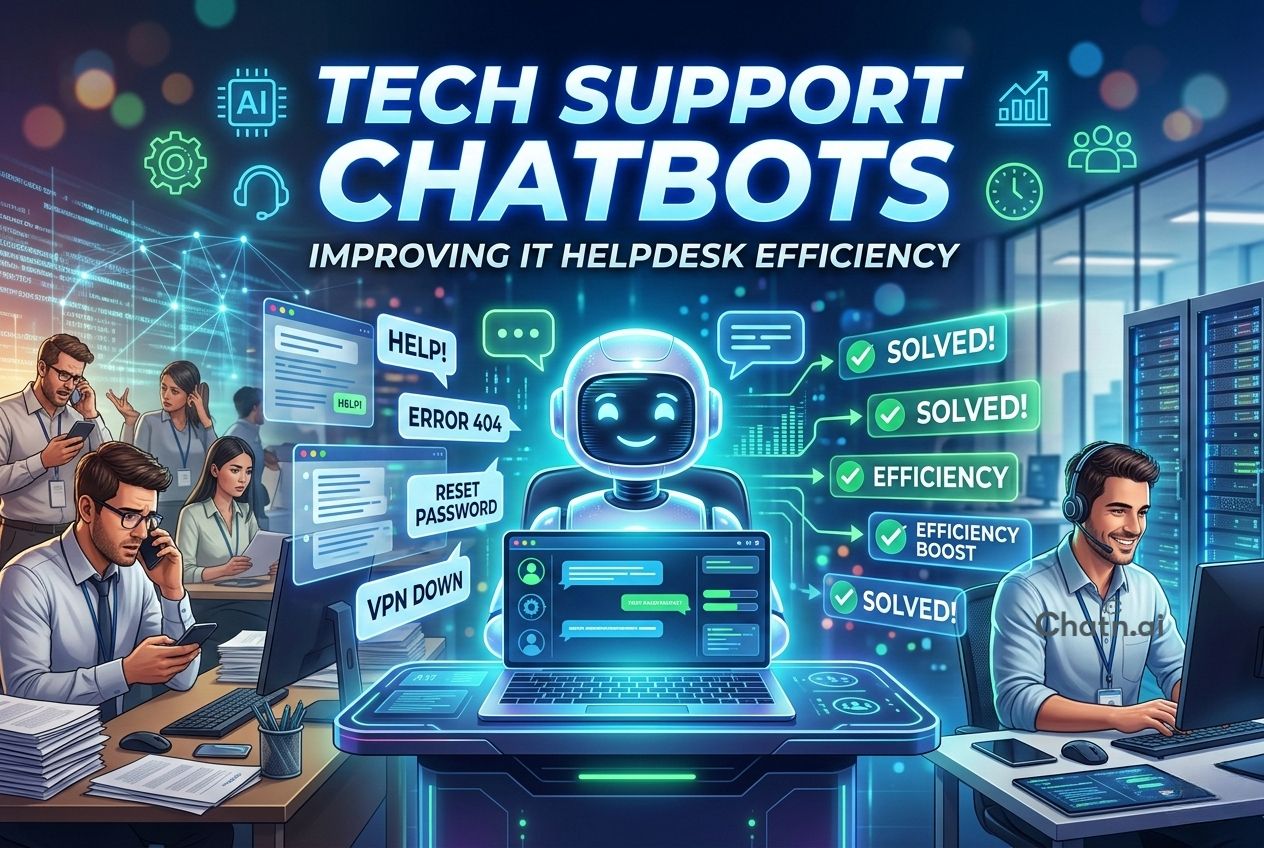
The digital world is fast-paced, and IT teams are under constant pressure. In the meantime, users demand quick, accurate customer service, and conventional help desks do not always meet these demands. Consequently, employees are frustrated by slow ticket processing, redundant inquiries, and a high rate of escalations, which are leading to low productivity.
That is where a tech support chatbot comes in as a game-changer. By leveraging AI and intelligent automation, tech support chatbots will quickly resolve common IT challenges, reduce manual tasks, and simplify support processes. In addition, they provide quicker solutions and enhance the user experience throughout the organization.
This blog will discuss the concept of tech support chatbots, identify the primary advantages of their use, provide best practices, and describe how to implement them to achieve long-term success.
What Is a Tech Support Chatbot?
A tech support chatbot is an AI-based virtual assistant capable of handling IT support quickly and efficiently. These chatbots make it available right away instead of relying on old-fashioned ticketing, and they play a proactive role in minimizing the need for human help for monotonous or cyclical requests. Faster response times improve user experience and help IT teams operate more efficiently.
Definition and Essential Operations
Tech support chatbots cover many conventional IT functions. In one use case, teams qualify and rank support tickets to address urgent issues first. Moreover, they troubleshoot typical software and hardware issues before escalation is required.
In addition, these chatbots will direct users to instructions for resetting passwords and recovering accounts. Teams process these requests immediately. They also provide easy-to-follow step-by-step guidelines for resolving common problems, which minimize support backlogs. Lastly, advanced chatbots monitor systems and issue warnings to teams about potential issues before they arise.
The automation of these functions allows tech support chatbots to free up IT teams to address high-priority, complex issues that require human expertise.
The reason Your Business needs a Tech Support Chatbot
The current generation of employees demands fast, adequate IT support. The lack of a chatbot in tech support will cost the business time and money in the form of slow issue resolution, employee frustration, and decreased productivity.
Speed and Efficiency
A chatbot tech support system handles repetitive tasks in real time, so employees no longer spend hours, even days, waiting in line while staff address fundamental problems. By automating routine tasks, IT personnel can focus on strategic projects. The system automatically addresses tickets. Moreover, a quicker response time enhances overall employee satisfaction and streamlines everyday processes.
Cost Reduction and Optimization of Resources
Through support automation, companies may greatly decrease their heavy dependence on massive human assistance. Consequently, companies are able to save money, streamline the allocation of resources and hence enhance efficiency. In addition, this can be used to avoid burnout among the IT team so that they can spend time on more strategic projects.
Improved User Satisfaction
Chatbots Tech support bots provide 24/7 support, and users never miss the opportunity to receive assistance whenever they need it. Besides that, they are also responsive and accurate, tailoring instructions based on past engagements. In turn, these properties increase engagement rates, improve general user satisfaction, and create a more productive and positive experience within the organization.
Key Features of an Effective Tech Support Chatbot
A good tech support chatbot is not an automated response system; its functionality and design directly translate into success.
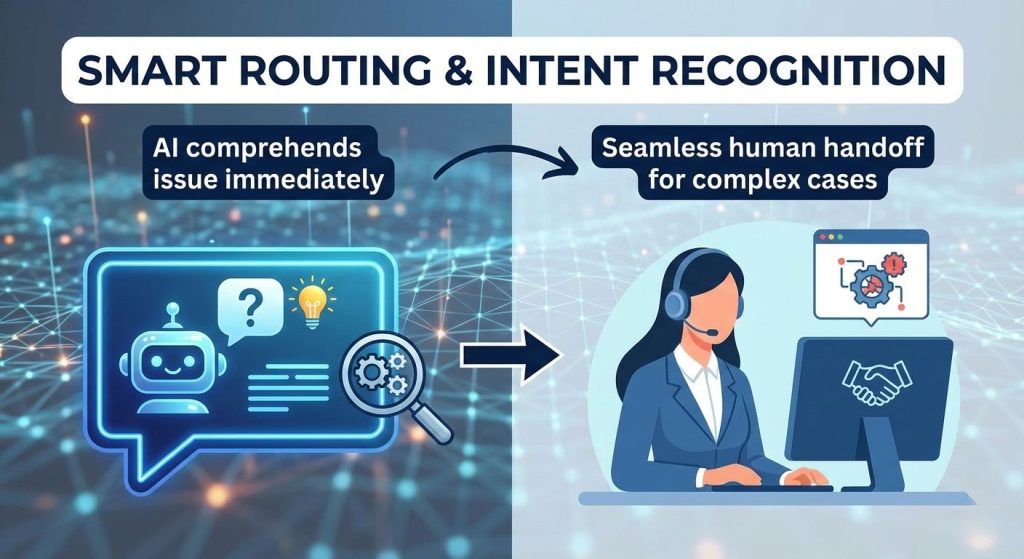
Smart Routing and Intent Recognition
One, the chatbot should be able to comprehend the user’s issue immediately. High-level AI can correctly spot intent, and when unresolved or complex cases arise, staff handle redirection to human operators. Through this, it maintains operational efficiency while providing high-quality support to its users at all times. Moreover, a smooth handoff reduces frustration and ensures a consistent support experience.
Step-by-Step Troubleshooting
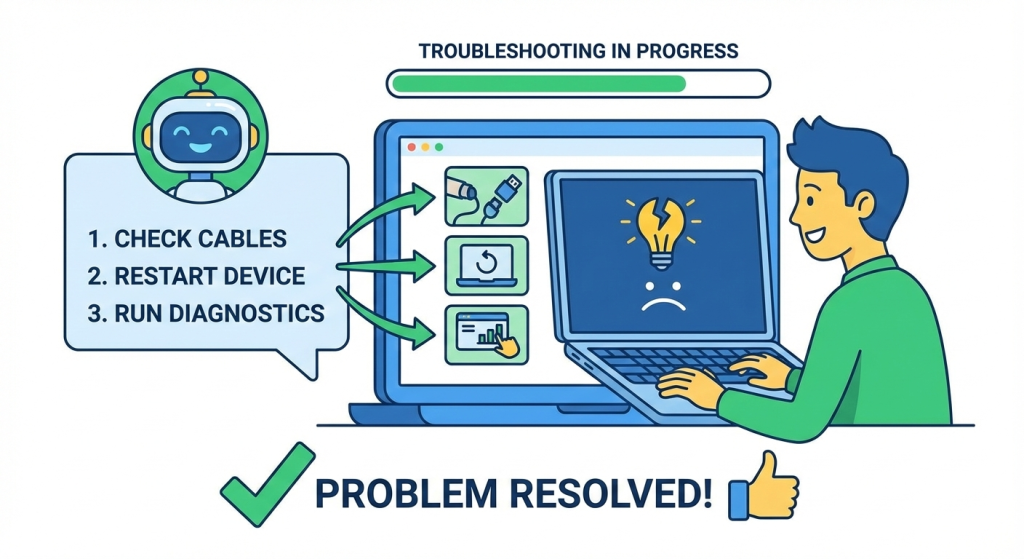
Chatbots should be helpful enough to guide users through the problem-solving process with clear, progressive steps. Moreover, interactive diagnostics reduce errors and help users follow instructions correctly, reducing frustration and increasing overall resolution rates.
Knowledge Base Integration
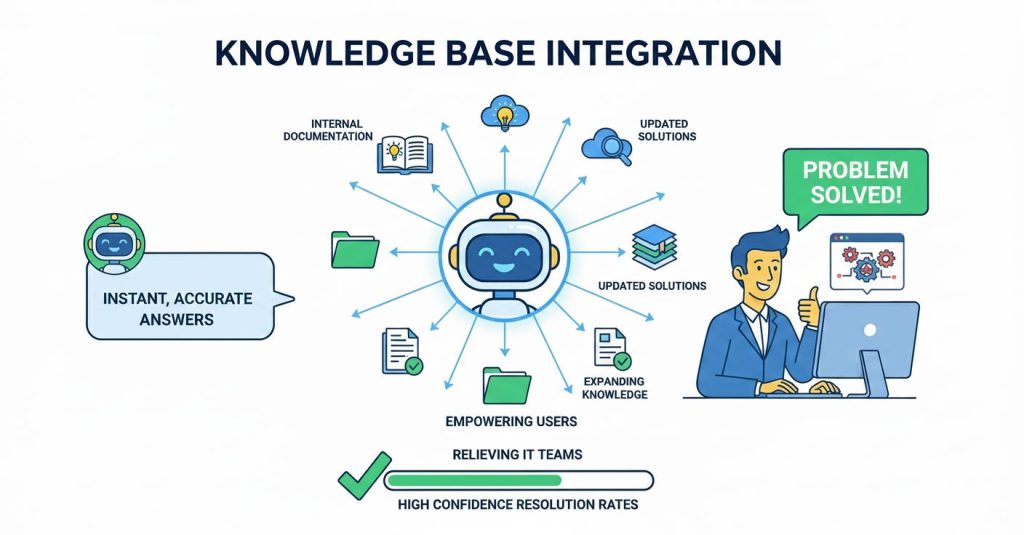
Additionally, the chatbot’s collaboration with internal documentation will ensure that users never receive a wrong or outdated solution. The chatbot will be able to respond to a large number of IT queries with a high degree of confidence by continually expanding its knowledge base, empowering users, and relieving IT teams of additional tasks.
Analytics and Continuous Improvement
An artificial intelligence chatbot analyzes interaction data to improve future responses and performance. The IT teams can also obtain helpful information on support trends and common problems through monitoring key metrics, including resolution rates, ticket deflection, and user satisfaction. Additionally, measuring such data enables organizations to understand disruptions in work processes, streamline operations, and continuously enhance chatbot performance and the quality of IT services. Consequently, the team will be able to prevent issues before they occur, become more efficient, and provide an even better user experience for their support.
Tech Support Chatbot: Best Practices of Implementation
Even a sophisticated AI will not be enough without a security plan.
Begin with High-Impact Use Cases
First, target repetitive, time-constrained tasks that cost IT resources the most, e.g., password resets, account access issues, and general software troubleshooting. Chatbots would deliver fast, easy ROI by first prioritizing these high-volume queries and reducing the IT team’s workload. Besides this, this method establishes initial momentum for trust with users and delivers immediate value, which will carry through to wider adoption within the organization.
Uphold Human Escalation Paths
There are no chatbots that are capable of coping with all cases. Thus, the reliable way to implement it is by creating clear escalation routes, through which complicated or unsolved problems are transferred to the human agents. The chatbot facilitates a smooth transition of the conversation context by avoiding the user from repeating the same set of words, which leads to avoidable frustration. Besides, this balance in automation and human support increases the general efficiency and provides the quality user experience.
Optimize for User Experience
Design plays a critical role in the effectiveness of chatbots. Hence, keep sentences short and sweet, and use a professional but friendly tone. Moreover, make cognitive efforts easy by reducing choices and prominently displaying the next course of action. In this way, you will keep customers engaged and guide them to a successful close.
Continuous Monitoring and Iteration
Moreover, monitor critical Key Performance Indicators, such as the Ticket Deflection Rate, Average Resolution Time, and Customer Satisfaction Level. IT groups can optimize chatbot scripts and knowledge repositories based on these results to further enhance Chatbot effectiveness. Hence, the Chatbot will evolve dynamically to meet users’ changing needs with ever more accurate, efficient, and satisfactory support.
Real-World Benefits and ROI
Tech support chatbots bring very real, measurable benefits to organizations of all sizes. Automating mundane tasks and streamlining IT support enable teams to pursue higher-value projects while improving overall efficiency.
Case Studies / Examples
Businesses that applied AI-enabled IT support, for example, saw an outstanding 40–50% reduction in ticket backlogs. In addition, they achieved faster resolution times for common issues and higher employee satisfaction and engagement. These findings show that a well-designed chatbot can not only enhance operational effectiveness but also elevate the user experience.
Success Metrics to Track
Monitor key metrics like average resolution time, ticket deflection rate, human escalation frequency, and user satisfaction/engagement to ensure ongoing performance. By keeping tabs on these indicators over time, an organization can optimize chatbot performance, maintain high service quality, and maximize ROI.
Common Challenges and How to Avoid Them
Typical Difficulties with Tech Support Chatbots
Chatbots that perform well still face challenges that can impair performance if not mitigated.
Overloading the Chatbot with Complex Tasks
For instance, giving the chatbot too many complex tasks at once could overwhelm both the chatbot and users. Start the chatbot program by addressing repetitive, high-volume searches, then add features based on proven success.
Disregarding User Feedback
Furthermore, the lack of consideration for user feedback may undermine the chatbot’s usefulness. Feedback helps clearly identify weaknesses, focus on improvement, and develop better responses. Therefore, incorporating the concept of feedback loops within the organization helps in continuous improvement.
Treating the Chatbot as Static
Finally, treating the chatbot as static makes it quickly obsolete. A chatbot needs to adapt to the evolving needs of users, the software platform, and the information technology system it operates in.
The Future of Tech Support Chatbots
The future of AI chatbots can elevate IT support to the highest level.
AI-Driven Predictive Assistance
To start with, future chatbots shall continuously try to predict problems faced by users before they occur. They shall use predictive analytics to anticipate trends and address problems before they escalate into unmanaged issues. Therefore, IT professionals shall be one step ahead of problems while providing a seamless user experience.
Seamless Human-AI Collaboration
Moreover, the AI will handle recurring tasks, enabling human agents to address difficult situations more effectively. This intelligent collaboration enables maximizing efficiency with a smooth user experience.
Enterprise Integration and Scalability
Lastly, future-proof chatbots will work effortlessly across various business units, systems, and geographies. This scalability will enable companies to provide AI-based support at scale without introducing operational inefficiencies.
Conclusion: Tech Support Chatbots as a Strategic Advantage
A tech support chatbot is more than a utility; it is a strategic asset for any business. When designed effectively, chatbots can delight customers by overcoming friction, redundant work, and delays in resolving issues, while also improving efficiency and reducing costs.
At the same time, a low-quality chatbot can easily disrupt service, resulting in decreased efficiency in support processes. When implementing ChatN.ai, organizations can benefit from the IT support it provides. Consequently, the primary goal of a tech support chatbot is to improve business efficiency.