
Introduction
In the current digital-first age, businesses must ensure fast, effective, and personalized customer service. Furthermore, customers are demanding immediate response times, smooth communication flows, and always-available support.
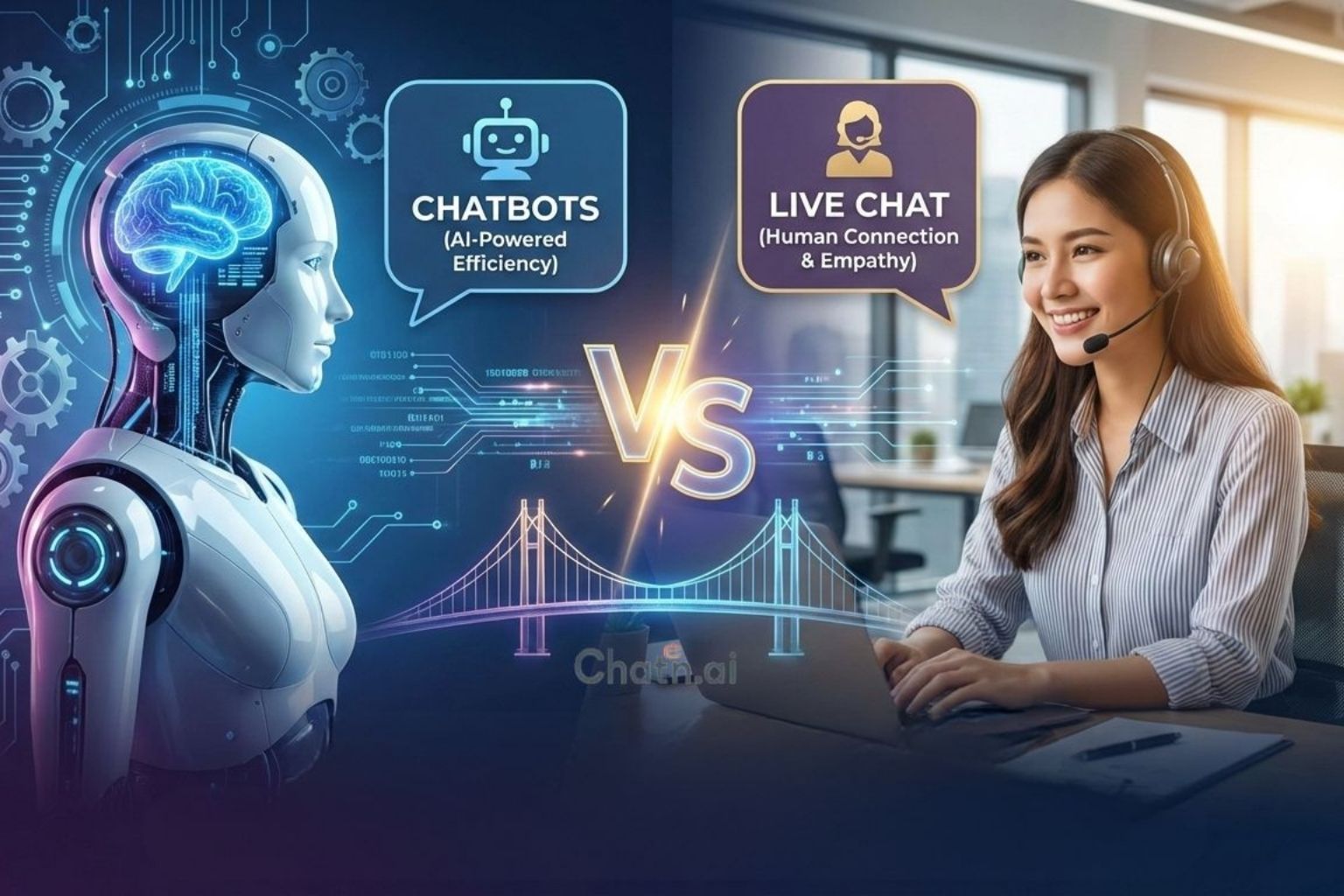
In response to these challenges, two major approaches have gained widespread acceptance: chatbots and live chat. While chatbots use AI that can respond efficiently, live chat uses human support.
In the end, choosing the right system directly impacts customer satisfaction and revenue. The following points and explanation of live chat and chatbots can help clarify their differences and benefits, and how companies actively leverage them to achieve maximum success.
Understanding Chatbots
What are Chatbots?
Chatbots are AI-driven conversational solutions that automatically interact with customers. By applying NLP and machine learning techniques, chatbots interpret user queries and respond accordingly, directing users to take specific actions. Unlike traditional forms and self-service emails, chatbots interact instantly with customers and do so in a personalized manner that scales well across platforms and applications.
Main Advantages of Chatbots
- Immediate 24/7 Customer Service Assistance: Chatbots provide instant customer service when customers ask a query, thereby increasing customer satisfaction and reducing waiting times.
- Automatic Lead Qualification: Chats involve targeted questioning to qualify high-profile leads, followed by automatic transfer of qualified leads to sales teams.
- Scalability: Chatbots can handle multiple conversations simultaneously without needing extra human resources. Chatbots enable companies to manage large volumes of interactions easily.
- Cost Efficiency: Chatbots handle routine conversations automatically, improving efficiency and reducing workload, making a business more cost-effective than when human customer service providers handle all conversations.

Understanding Live Chat
What is Live Chat?
Live chat enables customers to connect directly with human agents on a website or app, where agents deliver responses in real time, are nuanced and empathetic, and are offered directly by the live agents to meet unique customer needs.
Additionally, this goes down well for complex, sensitive, or high-value queries because it involves human judgment and personalized attention. Therefore, businesses using live chat can resolve issues more effectively and build much greater trust among customers.
Key Advantages of Live Chat
- Personalized Human Interaction: Live chat agents use contextually appropriate and need-driven communication. In turn, the interaction becomes even more personalized.
- Complex Problem Solving and Reasoning Skills: Handling unexpected problems and coming up with human-like solutions. As a result, customers get precise advice on complex or challenging issues.
- Development of Trust and Loyalty via Live Chat: Live chat builds strong relationships between customers and companies by offering sensitive, considerate, and immediate customer support, which fosters long-term customer loyalty. Customers’ confidence in a brand increases when they feel they are being heard and understood. Such a positive interaction over time leads to trust, even greater satisfaction, and repeat engagement, transforming one-time visitors into loyal advocates.
Speed and Availability
Chatbots are available 24/7, with no downtime, so a customer should always have someone to help them. In the meantime, the live chat depends on human operators, who are usually available during office hours. Delays in responding to live chat will therefore annoy the customer, diminish satisfaction, and even result in the loss of business in some cases. Compared to other systems, chatbots are more responsive and ensure high engagement and effective interactions.
Cost and Scalability
Chatbots can manage conversations without limits while consuming fewer operational costs. The need to have more staff to manage chats as they increase is a reality in live chat. Expanding the live chat team drives up operational costs. The ability to scale without strain offered by chatbots makes support management sustainable.
Customer Experience and Personalization
- The chatbot offers consistent, accurate responses, yet it lacks emotional intelligence and nuanced understanding. Live chat provides empathy in responses, instills trust in customers, and effectively manages complex interactions. Therefore, every business can increase customer satisfaction by strategically using both solutions.
- Chatbots: Automate responses to frequent queries, handle appointment scheduling, lead generation, and tracking of orders with ease, while they do the mundane tasks independently.
- Live Chat: Complex troubleshooting, engagement of high-value customers, sensitive, or escalated issues requiring human judgment and empathy. For that reason, identifying the right solution is all about the level of problem complexity and the emotional sensitivity of the customer inquiry. While chatbots provide consistent, precise answers without emotional intelligence or fine-grained understanding, live chat offers empathetic responses, builds trust, and handles complex interactions effectively. Consequently, strategically combining both solutions helps any business improve customer satisfaction effectively.
- Chatbots: Automate the resolution of FAQs, appointment scheduling, lead generation, and order tracking in an organized manner. In the meantime, they will handle repetitive tasks autonomously without human intervention.
- Live Chat: Complex troubleshooting, high-value client engagement, and sensitive or escalated issues that call for human judgment and empathy. Consequently, the selection will depend on the level of problem sophistication and emotional sensitivity of the customer’s inquiry.
How Businesses Can Combine Chatbots and Live Chat
The hybrid support strategy makes the most of the benefits that both chatbots and human support agents offer. To begin with, chatbots handle common inquiries and gather necessary information. Support agents actively handle difficult situations that require human intervention. Thus, the support solution reduces waiting times and improves the support experience. Furthermore, the support system will allow the business to scale support while ensuring a high level of support.
Measuring Success and ROI
To measure performance, businesses should actively monitor their key metrics. Firstly, check your Response Time, as customer satisfaction and quick response times tend to be closely related. Then check your Resolution Rate. It tracks the number of complaints staff resolve during the initial interaction. Thirdly, check your customer satisfaction scores given after gathering feedback through customer interactions. And lastly, check your Conversion Rate, which determines how well live chats perform and helps drive conversions and/or registrations.
Chatbots assist by optimally distributing support resources and providing cost-effective, scalable support functions, while live support optimizes conversions through customized, human-driven support. The above combinations help businesses achieve optimal support and return on investment.
Future Trends in Chatbots and Live Chat
AI is advancing rapidly and changing how customer service is delivered. For instance, businesses actively anticipate customer needs using predictive analytics before customers express them. In the same way, sentiment analysis analyzes customer mood and responds through customer service representatives and AI-driven chatbots with answers that are much more intelligent and relevant. Furthermore, the adoption of the hybrid model is on the rise and will seamlessly merge automated technology and human empathy.
Therefore, forward-looking companies that use AI technology will gain a competitive advantage and future-proof their customer service.
Hospitality and E-Commerce Examples
E-Commerce Chatbots play a crucial role in assisting consumers with product selection, addressing common questions, and retrieving abandoned carts. The live chat option, on the other hand, helps consumers address difficult orders that require human discretion. Implementing chatbots and live chat together boosts conversions and enhances customer satisfaction.
Hospitality: The bot will handle booking confirmations and other routine inquiries, freeing staff to focus on other tasks, while handling special requests, complaints, and guest-specific requirements through the live chat service.

Conclusion
Chatbots and live chats offer distinct benefits that set them apart. While chatbots are known for instantly answering chats and automatically scaling without additional operational costs, live chat agents actively demonstrate empathy and resolve complex situations.
A combination of both solutions is necessary for effective results. To start with, chatbots effectively handle routine matters, while live agents handle complex issues. In effect, this reduces wait times, increases efficiency, and improves customer satisfaction.
Moreover, companies that utilize the ChatN.ai solution are actively bridging mere conversations into valuable outcomes and, at the same time, offering exemplary customer service experiences by investing in the future of customer service with AI-powered chatbots and live chat.
FAQ Section
Q1: In what scenarios should a company rely on a chatbot, and in what scenarios should it use
A1: Businesses actively deploy chatbots to handle FAQs and qualify leads, and efficiently provide support. Simultaneously, live chat is suitable for complex and sensitive inquiries.
Q2: Are chatbots substitutes for live operators?
A2: No. The chatbot can automate repetitive tasks. Therefore, this will give human customer care agents time to focus on issues that require human judgment. Q3: How do chatbots and live chat services improve the ROI? A3: Chatbots minimize costs and scale easily and painlessly, while live chat directly enhances conversion rates, customer relationships, and loyalty. Chatbots and live chat complement each other, maximizing ROI and support effectiveness.
Q3: In what ways do chatbots and live chat services impact ROI?
A3: Chatbots cut operational expenses and support users seamlessly and scale support easily, while live chat enhances conversion rates and even helps build customer relationships. Both of them maximize return on investment and support overall efficiency.