
Introduction
AI chatbots are revolutionizing the healthcare industry by making procedures more innovative, more efficient, and patient-centric. For instance, they can schedule appointments, offer symptom information, and conduct follow-up sessions. They have become an essential part of healthcare because they provide immediate support to patients as expectations continue to rise amid increasing workloads.
Furthermore, healthcare service providers who implement chatbots today have a competitive advantage over rivals. Additionally, they will deliver enhanced patient experiences and have streamlined operations. In this article, we shall discuss some of the most critical applications, advantages, and implementation methodologies of healthcare chatbots.
What Are Healthcare Chatbots and How They Work
Healthcare chatbots are AI-driven virtual assistants that proactively engage with patients and healthcare professionals to improve communication and healthcare processes. Using natural language processing algorithms and machine learning capabilities, they can interpret patient queries, respond appropriately, and guide them toward achieving a specific goal.
In particular, among these essential functions are:
- Automation of admin work, such as appointments and reminders.
- Offering symptom evaluation and triage advice, assisting patients in assessing the level of urgency for their treatment.
- Providing educational resources and support for patients to ensure they have access to accurate and up-to-date information.
- Additionally, when integrated with Electronic Health Records (EHR) and CRM systems, chatbots can tap into patient information, enhance decision-making, and improve the accuracy of recommendations. Therefore, they improve patient outcomes and boost efficiency.

Advantages of Implementing Healthcare Chatbots
The benefits from implementing chatbots are immediate and tangible for both patients and healthcare providers. First, efficiency from automating repetitive administrative tasks, like appointment follow-ups, frees staff to focus on high-priority care.
Moreover, with their immediate responses to any inquiries from patients, they ensure users receive timely advice and support, which improves engagement. All of this is possible because chatbots generate actionable insights by tracking interactions and analyzing trends, helping providers make more strategic healthcare decisions.
Finally, chatbots operate around the clock, providing 24/7 availability so patients can always access reliable guidance and support. As a result, healthcare organizations can enhance patient satisfaction, improve operational efficiency, and optimize overall care delivery.
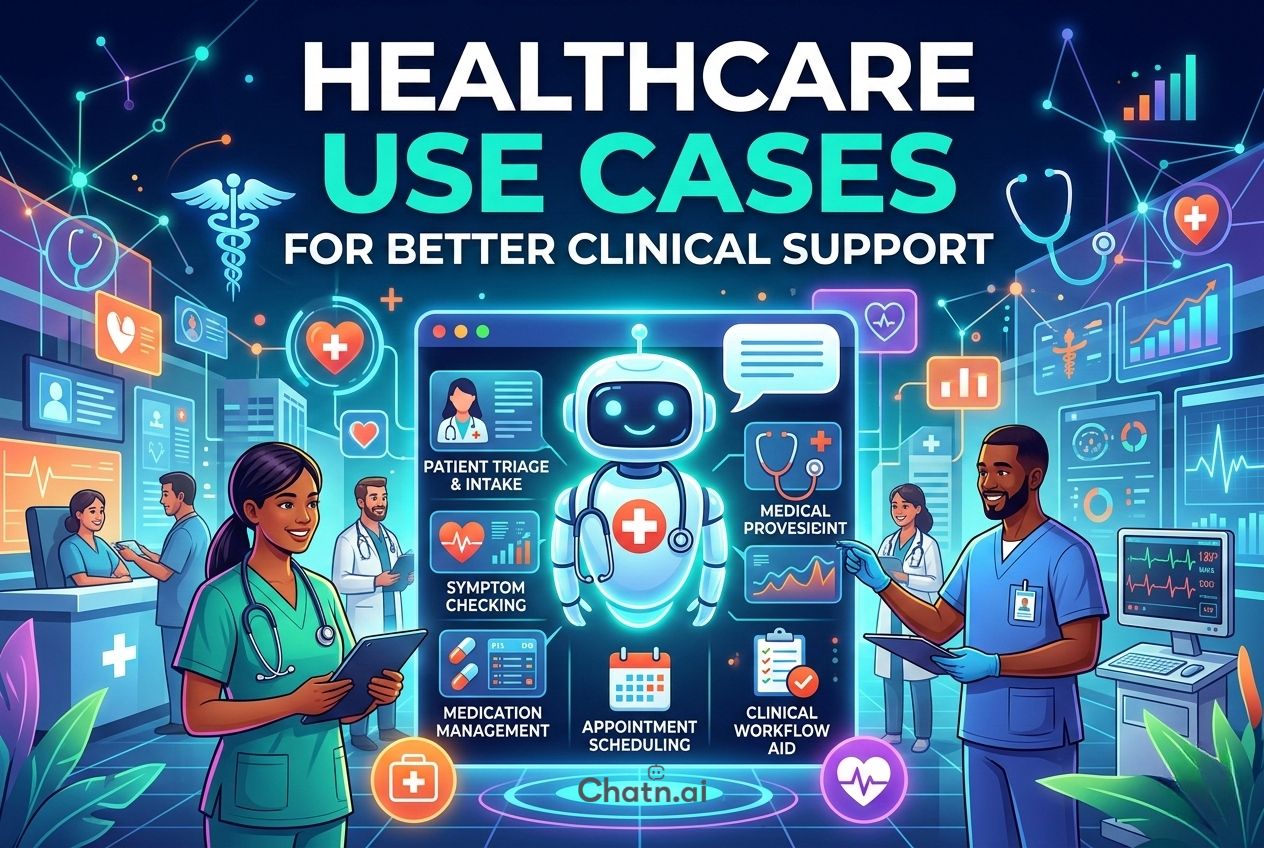
Top Healthcare Chatbot Use Cases
Appointment Scheduling and Reminders
Chatbots improve patient scheduling by completing the task instantly. For instance, patients can select their preferred time slots, which send them notifications and reminders. Therefore, chatbots reduce no-show rates and improve clinic operations. Moreover, they allow healthcare providers to avoid patient scheduling, thereby enabling them to deliver their core responsibilities without interruption.
Symptom Checking and Triage
Healthcare chatbots analyze patient symptoms in real time and provide recommendations based on those symptoms. To be specific, they instruct patients on when to see a healthcare provider immediately, when to make an appointment, and how to treat everyday ailments at home. Pre-qualifying patients saves lives, reduces unnecessary hospital visits, and optimizes healthcare delivery. Furthermore, healthcare chatbots are a reliable source of information, ensuring patients are not left alone during this time.
Patient Support and Education
Chatbots can actively respond to frequently asked questions concerning drugs, procedures, and medical situations. Additionally, they provide patients with immediate access to reliable resources, ensuring they have accurate information when they want it. Therefore, patients can make informed decisions, follow treatment plans, and have better treatment compliance. Additionally, chatbots can immediately assist patients, ensuring they do not feel confused and can be confident in managing their health.
Medication Management
Complex schedules are challenging to handle for patients. In this regard, the chatbot independently reminds patients to take their medications, monitors patient adherence to proper treatment, and immediately alerts a caregiver if a patient misses a dose. As a result, they increase patient safety, reduce potential complications, and generally improve the effectiveness of the treatment course they follow. Moreover, with the help of a chatbot, all recommendations are delivered just in time, helping patients maintain their pace and stay on track in the care process.
Mental Health Support
Many chatbots are already actively offering mental health support around the clock, guiding users on stress, anxiety, and depression. For example, they screen patients for mental health issues and provide timely support. Therefore, they increase access to care by breaking down barriers and enabling patients to get the support they need when they are most vulnerable. Moreover, chatbots improve ongoing mental health management through monitoring interactions and following up with resources while fostering overall well-being.
Telehealth Integration
Chatbots simplify telehealth appointments by gathering information from patients before a telehealth visit, assisting patients in using a telehealth system, and following up with patients efficiently. Therefore, chatbots boost patient satisfaction, simplify work for healthcare providers, and enable them to deliver high-quality care. Moreover, chatbots can help maintain patient engagement and improve healthcare outcomes by supporting patients at every step of a telehealth experience.
Benefits of Healthcare Chatbots
For Patients
- Instant Access: Chatbots deliver faster responses and advice to patients; thus, they can always get just-in-time care. Therefore, patients will spend less time waiting for information and are more empowered to manage their health.
- Personalized Care: Chatbots use patient history to provide customized suggestions and advice. As a result, every interaction becomes relevant and personalized, thus enabling patients to adhere more closely to care plans.
- Smaller waiting times: With the introduction of chatbots, there will be no more long queues for calls or physically waiting in lines, as one will have easy, quick access to communication for care. By addressing patients promptly, it is possible to increase and improve satisfaction with healthcare services. Immediate access: Chatbots provide fast responses and guidance, ensuring support is available at all times and helping patients receive timely support. Patients spend less time waiting for help and feel more confident managing their health.
- Custom care: By accessing patient history, chatbots can recommend and suggest in a personalized way. Because of this, every interaction seems relevant and personal, and will therefore assist patients in adhering to the plans of care.
- Reduced Wait Times: Chatbots eliminate long call queues and in-person delays, streamlining communication and access to care. The added benefit is reduced patient frustration, improving their overall satisfaction with healthcare services.

For Healthcare Providers
- Task Automation: Chatbots are actively automating various administrative tasks, such as scheduling, sending reminders, and following up with patients—Chatbots free healthcare staff to focus on critical medical duties.
- Reducing Workload: Through automating such processes, chatbots allow healthcare practitioners to focus more on core patient care. As such, they can dedicate more time to more complicated patients.
- Increased Patient Engagement: The chatbot provides continuous support, leading to higher patient satisfaction and loyalty. Moreover, engaging patients at all stages of treatment leads to better patient-provider relationships and increased patient trust.

Best Practices for Implementing Healthcare Chatbots
Ensuring Compliance and Privacy
Healthcare chatbots should be highly compliant with HIPAA and other privacy laws to safeguard patient confidentiality. Organizations can ensure this by implementing secure data storage, using strong encryption, and restricting system access to authorized users only. As a result, these security measures ensure that patient data is confidential and secure. Besides, early compliance and security build trust and minimize risk for healthcare providers, as well as responsible deployment of chatbots.
Developing Conversations that Work
Chatbot dialogues must be friendly, clear, and concise to keep users entertained. First, chatbots deliver personalized interactions based on patient history, improving engagement and reducing frustration. Furthermore, providing fast answer services based on frequently asked questions enables users to get answers more quickly. Meanwhile, fallback responses for unrecognized queries will ensure that conversations do not come to a halt due to misunderstandings. Consequently, properly prepared chatbot communication contributes to greater satisfaction, increased trust, and a better user experience.
Interconnection with Existing Systems
A combination of chatbots, EHRs, CRMs, and communication systems will deliver seamless, interconnected patient experiences. In this manner, healthcare organizations can allow chatbots to handle appropriate data, facilitate individual communication, and ensure the accuracy of all touchpoints. Additionally, implementing a HIPAA-compliant chatbot will ensure data security and support scaling the healthcare automation approach.
Moreover, the adoption of the omnichannel across websites, mobile applications, and messaging platforms enables patients to receive assistance at any time and place. Consequently, this degree of AI application in health care enhances engagement and continuity of care, and creates a uniform patient experience across all digital platforms.
Real-World Case Studies of Healthcare Chatbots
Hospital Example
One of the hospitals tested a chatbot to improve patient intake and triage. Consequently, the chatbot guided patients immediately, minimizing wait times and increasing overall satisfaction. Additionally, the chatbot actively collected pre-clinical patient data before the clinical examination. As a result, medical personnel might have more time and attention to address critical cases in more meaningful ways, thereby improving care prioritization and efficiency.
Telemedicine Online: An example
The telehealth platform actively used the chatbot to help patients check their symptoms and book appointments. Consequently, patient engagement increased significantly, and compliance with care plans improved. Also, the chatbot simplified workflows and provided timely customer support, further increasing patient retention. As a result, the platform had the opportunity to provide more effective care and build strong, long-term patient relationships.
The example of a Mental Health Organization
A mental health provider had managed to implement a 24/7 chatbot to assist with anxiety and stress management in patients. The chatbot provided patients with direct access to beneficial resources, enhancing mental health outcomes and increasing access to care. Also, the chatbot kept users entertained, providing timely advice and assistance, which increased overall patient satisfaction. It is an example of how successful healthcare chatbot cases can make an impression, in this case, AI patient engagement case studies and quantifiable results from virtual health assistants. As a result, the organization enhanced its care delivery and established a standard for using AI in mental health services.
Future of Healthcare Chatbots
AI in healthcare remains a rapidly developing field that has been providing predictive analytics, hyper-personalization, and proactive care recommendations. In addition, chatbots integrate with wearables and IoT devices to monitor patient data in real time and provide timely notifications. Consequently, health professionals who use them have a distinct competitive edge, enhance operational efficiency, and future-proof patient care models. Moreover, the ability to use these innovations enables providers to deliver more individualized, proactive, and outcome-focused care that keeps patients engaged and satisfied.
Conclusion: Healthcare Chatbots as a Game-Changer
Chatbots in healthcare actively change how patients interact, reduce operational load, and enhance care outcomes. Chatbots continuously improve the customer experience by streamlining routine tasks, providing immediate advice, and tailoring interactions between patients and providers.
Furthermore, visionary providers using ChatN.ai healthcare tools transform informal communication into a valuable outcome, enhance efficiency, and provide patients with high-quality care. Accordingly, the use of chatbots today is a calculated investment in patient satisfaction, efficiency, and the organization’s future success. As well, these tools help keep healthcare teams at the forefront in the fast-changing digital world without compromising the quality of care.
FAQ Section
Q1: What are the benefits of chatbots in healthcare?
A1: The active feature of healthcare chatbots is that they will increase patient engagement through providing instant replies, a personalized approach, and 24/7 support. Consequently, patients are kept abreast of developments, feel encouraged, and they feel more engaged in their care process.
Q2: Do chatbots in healthcare meet the standards of HIPAA?
A2: Yes. The leading healthcare chatbots follow HIPAA and other data privacy standards to the letter. As a result, healthcare organizations actively protect patient data while safely using AI.
Q3: Will chatbots take over medical professionals?
A3: No. Chatbots help healthcare personnel by automating routine activities, including appointment scheduling and follow-ups. Thus, medical workers will be able to provide care to patients with critical needs, clinical choices will be more effective, and overall patient outcomes will be better.