


Introduction: Define “Best” with Outcomes, Not Hype
The great chatbot program addresses actual issues and demonstrates measurable impact. Customers demand quick, accurate, and kind services, while your team desires fewer tickets and better insight. Meanwhile, leaders insist on low risk and clear ROI. This guide demonstrates an easy, feasible method of deciding. You will receive a scorecard, a pilot plan, and helpful advice. In the same lens, you will also learn how Chatn.ai compares to alternatives. Furthermore, the strategy proves effective in the areas of support, sales, and service. It also applies to both startups and world-leading brands. Ultimately, let’s decide with facts and protect your bottom line.
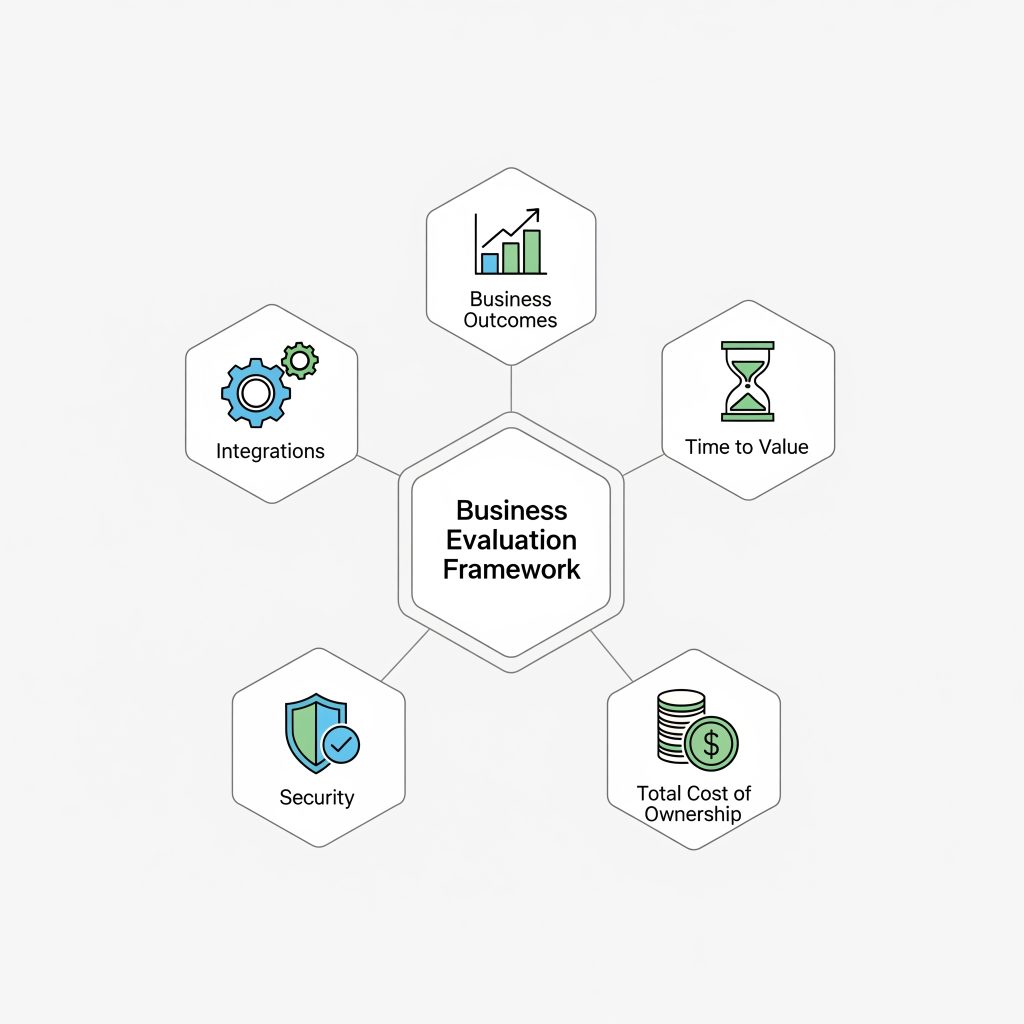
The Evaluation Framework: Great demos can mask rough trade-offs
Thus, make a decision using a common framework first. Please put it on all your calls and all your demos. No need to complicate it, make it evidence-based.
1) Business Outcomes Align to Relate abilities to performance measures
Concentrate on the deflection rate, first contact, and CSAT. Additionally, include sales and market revenue contribution to measure overall impact. Before the initial vendor meeting, make up your goals for clarity and direction. Then, monitor them every week while conducting your pilot to ensure steady progress.
2) Time to Value
In crunch markets, speed counts. Beyond being desirable, use a no-code chatbot builder with powerful templates. Next, ensure quick consumption of current content to boost adoption. Instead of empty rhetoric, request a 30-day pilot scheme to demonstrate its value. This approach creates bounty teams capable of shipping in days.
3) Total Cost of Ownership
Sticker prices lie. Platforms charge based on the number of seats, MAU, tokens, or channels. Charge for call, storage, and premium per model. Year two to one model year.
4) Security and Compliance
Guard the customers and the brand. Check SSO, role controls, and audit trails. Affirm SOC 2, GDPR, and HIPAA where necessary. Check data residency and removal requests. Require readability of PII redaction in logs.
5) Integrations and Ecosystem
Integrate your stack. Therefore, demand profound bot integration and help-desk synchronization. After that, review webhooks, events, and API coverage to ensure smooth operations. In addition, export analytics to your BI for deeper insights. Finally, conduct a workflow test in a real sandbox to validate performance.
6) AI Quality and Control
I judge quality over newness. While I prefer radio, I value grounded answering—commonly known as RAG—for its reliability. Therefore, demand credible sources and explicit assurances. Additionally, set policy and tone check rails. Finally, maintain versioned prompts with a complete change history.
7) Omnichannel and Multilingual
Meet users at their convenience. Offer support through web, application, email, SMS, and voice. Ensure parity and depth across all channels. Furthermore, validate multilingual chatbot quality in high-priority locales. When necessary, make it right-to-left compatible.
8) Analytics and Optimization
What is not measurable cannot be improved. Track funnel views, drop-off points, and A/B tests. In addition, analyze filtered and tagged search transcripts. Save raw data, then study it in greater detail. Finally, make insights a weekly ritual.
9) Governance and Handoff
Automation should not exclude agents; it should make them even better. Test warm handoffs and enable two-way context transfers. Also, affirm agent assist hints within the console. Ensure safe publishing by using roles and approvals. Finally, require audit logs to make each change accountable.
10) Scalability and Reliability
Outages should not result from growth. Therefore, request performance SLAs and review status history. Nick, also check regional hosting and failover plans. Examine load test results and error budgets. Finally, communicate incidents effectively.
Quick Picks by Scenario: Map Needs to the Right Fit
Use these patterns to short-list faster. They reduce noise and save time.
High-Volume Support Teams
These teams value deflection, precision, and smooth handoffs. In addition, solid knowledge of consummation and guardboards is essential. Powerful chatbot analytics and platforms with ready integrations help maximize efficiency. Finally, monitor time-to-value and agent satisfaction closely.
Sales and Marketing Teams
These groups focus on capturing and routing leads through form fills, calendar links, and CRM syncs. Furthermore, data-driven actions enable testing of personalized offers. Monitoring conversion rates boosts income, while simplified admin tasks keep marketers productive.
Regulated Industries
Compliance is critical. Request HIPAA support for health data, verify GDPR processes, and confirm data location. Additionally, vet SOC 2 reports and security posture, then enforce approval workflows and role-based controls.
Startups and SMBs
Speed and low overhead matter most. Therefore, choose a no-code chatbot builder with templates, usage-based pricing, and a single-channel start. Expand later and automate only top intents.
Flexibility: Use usage-based pricing. Begin with a single channel, and grow afterwards. Auto only top three intents.
Global Brands
Scale and localization take priority. Thus, select cross-platform depth, multilocation hosting, contextual translation workflows, and real-content language testing. Finally, train regional teams for consistency worldwide.
The Best Chatbot Platform Scorecard: Decide with Numbers
This scorecard keeps the process fair.
It also makes buy-in easier across teams.
Use a 1–5 score for each line.
Then multiply by the listed weight.
A perfect score is 100 points.
- AI quality and grounding (RAG): 15
- Security and compliance: 15
- Integrations and ecosystem: 12
- No-code speed and UX: 10
- Analytics and optimization: 8
- Omnichannel and multilingual: 8
- Scalability and reliability: 8
- Governance and handoff: 8
- Pricing and total cost: 8
- Support and success: 8
Share the sheet before any demos.
Ask vendors to map features to each line.
Require proof, not slides.
Pick the top score that meets your budget.
Then run a time-boxed pilot.
Feature Deep-Dive: What to Test During Demos
Strong evaluations use real data—for example, present FAQs, macros, and policies in the demo. Instead of “go,” opt for “build with me” sessions. Next, examine where friction occurs. Rather than scoring what you hear, score what you see.
No-Code Builder and Content Ops
First, check the clarity of the builder’s flow. Then, look for reusable blocks and variables. Validate staging and publishing workflows to ensure accuracy. In addition, demand versioning with rollbacks. Before going live, preview content for quality assurance.
Knowledge Ingestion and RAG
Upload PDFs, link to URLs, and connect to the help center—next, test chunking and update detection. Require source-backed answers only. Additionally, conduct dress rehearsal tests for challenging cases. Finally, assess hallucination rates on edge material.
Prompting, Policies, and Guardrails
Review prompt libraries and inheritance features. Also, test profanity filters and refusal behavior. Define tone guidelines alongside brand voice standards. Then, simulate risky scenarios to verify safeguards. Lastly, require clear logs for policy hits.
Human Handoff and Agent Assist
Simulate live transfers to agents. Confirm context, sentiment, and conversation history carry over. Then, verify that agent assist tools deliver quick answers. Check syncing of notes and fields in tickets. Measure time savings after assistance.
Actions, APIs, and Workflows
Test secure actions like order status calls. Verify proper secrets management and rotation. In addition, check error handling and retries. Review step timeouts and input validation. Finally, audit and trace every action for compliance.
Omnichannel and Voice
Compare parity across web, SMS, email, and voice channels. Then, browse IVR flows and test barge-in features. Authenticate paths across channels. Also, ensure opt-in and opt-out compliance. Create a central content hub for consistency.
Analytics and Experimentation
Open the analytics dashboard together. Examine intent casting and deflection levels. Then, A/B test different wordings or flows. Export raw data into your BI warehouse. Finally, schedule weekly consultations with analytics owners.

Pricing Models Explained: Avoid Surprise Costs
Pricing should remain predictable and fair. Therefore, choose a simple model that scales with your needs. In addition, ensure you have clear visibility into usage patterns.
Seat, MAU, and Token Fees
Seat pricing works best for agent-assist or admin-heavy use cases. Meanwhile, MAU pricing fits general, light chats. Special token-based currencies suit large AI workloads. For many enterprises, hybrid pricing offers flexibility. When deciding, balance expected volume with complexity.
Hidden Costs to Watch
Be mindful of add-ons that raise actual costs. For example, telephony, storage, and analytics toolboxes may add unexpected charges. Some vendors charge premiums for LLMs or routing—additionally, factor in training and change management participation. To protect your budget, put caps and growth-tier provisions in writing.
Simple ROI Math
Start by calculating your current ticket cost. Next, estimate monthly deflected tickets to project savings. Then, subtract platform and training costs. Finally, add revenue from sales automation. With these figures, you can decide based on data—not intuition.
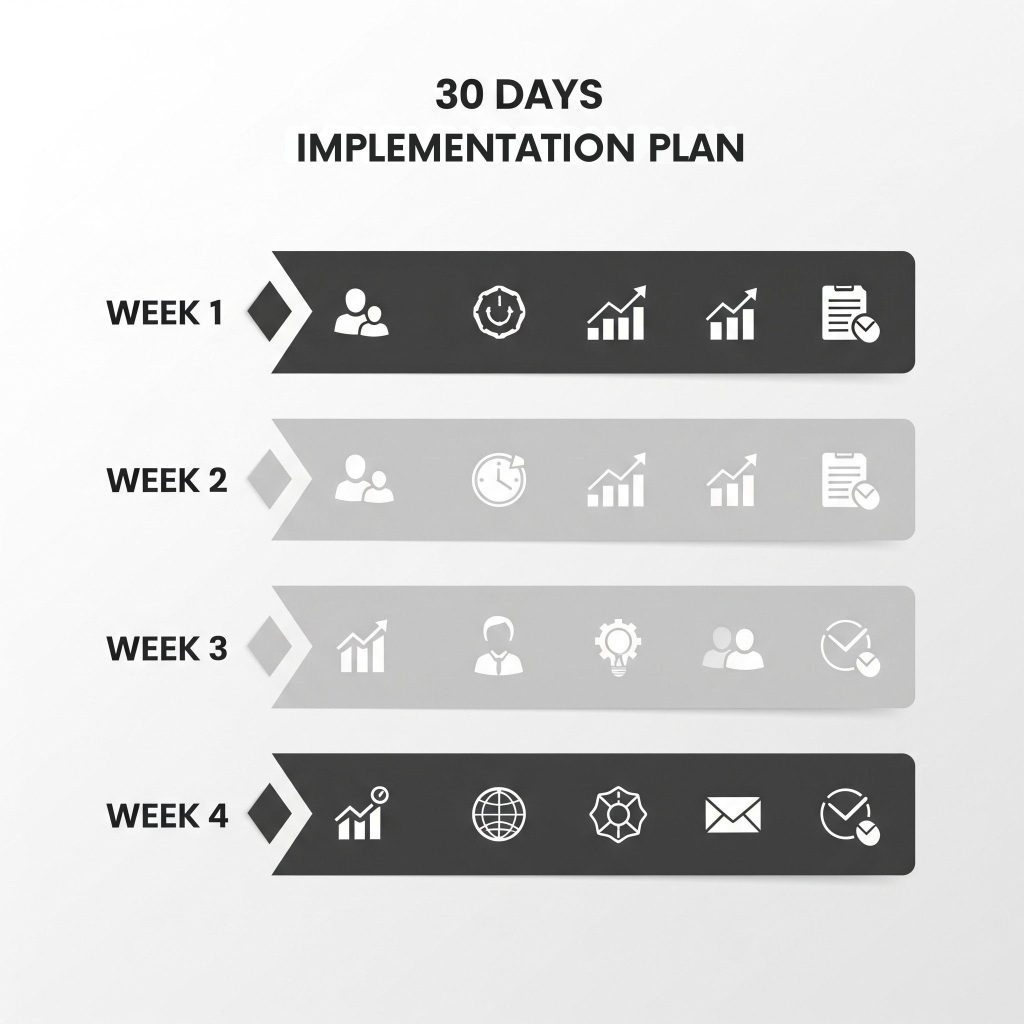
Implementation Plan: From Pilot to Scale in 30 Days
Here is a proven 30-day blueprint.
It keeps momentum and reduces risk.
Use it to guide every vendor.
Week 1: Goals, Data, and Access
First, identify target KPIs and measures of success. Then, gather FAQs, macros, and policy documents. Ensure CRM and help desk access are in place. Next, design a common scorecard along with a clear timeline. Finally, hold daily standups to maintain quick progress.
Week 2: Build and Guardrail
Begin by releasing an MVP for the top three intents. Incorporate RAG using centralized materials. In addition, add safety rails and enforce brand tone guidelines. Map handoffs and create draft escalation routes. For edge cases, conduct red-team testing.
Week 3: Integrate and Train
Integrate CRM, help desk, and analytics systems. Provide agent assist for common responses. Moreover, train agents in conversation flows and smooth handoffs. Complete dashboards and configure alerting. Lastly, prepare release notes for every team.
Week 4: Launch and Optimize
Start with a single-channel launch. Focus on CSAT, FCR, and deflection rate improvements. Use analytics to address problem areas. Additionally, A/B test prompts and messages. Gradually stage the rollout of new channels.
Common Traps That Kill ROI
Avoid these problems from day one.
They appear often in rushed deployments.
Over-Automation
Start by automating only low-risk, high-volume intents. Expand gradually once you establish quality. Additionally, avoid running risky paths early in the process. Maintain human oversight during the initial stages. Finally, review results weekly using measurable data.
Messy Knowledge
Messy knowledge leads to poor results. First, organize and clean content before use. Next, remove outdated or duplicate articles. Then, assign an owner to every knowledge domain and run regular refreshes.
No Change Management
Without change management, agents lack clarity. Clearly share objectives, boundaries, and escalation rules. Also, give them time to explore flows and maintain quick, simple feedback loops to drive improvement.
Ignoring Measurement
Never ignore measurement. Set KPIs that dashboards track and review them in a fortnightly cycle. In addition, assign owners for each improvement area to ensure progress.
Where Chatn.ai Stands: Fit to the Same Framework
This section is short and proof-driven.
It maps Chatn.ai to your scorecard.
It avoids fluff and vague claims.
Chatn.ai provides powerful RAG functionalities with referrals, decreasing hallucinations with its guardrails to enforce tone, policy, and refusals. It enforces SSO, tight role administration, audit records, and information security, which makes it compliant with SOC 2 and GDPR procedures. It also connects to CRMs, help desks, APIs, web hooks, event flows, and analytics export BI stacks: a no-code visual builder, templates, and versioning speed up deployment. The analytical tools available are funnel analysis, transcript search, A/B testing, and a weekly optimization cycle. Moreover, omnichannel and multilingual support provides uniformity of web, app, email, SMS, and voice: regional hosting, uptime surveillance, and SLAs scale stability. Governance and approvals minimize manual work through handoffs using agent assist features. Flexible pricing, pilot value acceleration, and customer success drive revenue. Apply your scorecard and test every claim. Put the plan into execution within 30 days and make a decision on measurable results.
FAQs (Schema-Ready)
What is the best chatbot platform?
The best platform fits your goals, stack, and risk tolerance.
Use the scorecard to compare with evidence.
Then run a fast pilot and measure impact.
How do I compare chatbot platforms?
Start with business outcomes and constraints.
Score every demo with the same sheet.
Reward proof, not polished decks.
What features matter most?
Prioritize RAG quality, analytics, and integrations.
Add governance, handoff, and security controls.
Confirm omnichannel depth and multilingual support.
How much do chatbot platforms cost?
Costs vary by seats, MAU, or tokens.
Add fees for channels and premium models.
Model two years to see the full picture.
Can I deploy without developers?
You can launch with a no-code chatbot builder.
Complex workflows may still need engineers.
Plan for both to move fast and safe.
Glossary
RAG: Retrieval-augmented generation for grounded answers.
CSAT: Customer satisfaction after a conversation.
FCR: First contact resolution without follow-ups.
AHT: Average handle time for agent cases.
Deflection rate: Share of issues solved by automation.
Guardrails: Policies that shape safe AI behavior.
Omnichannel: One brain across many channels.
MAU: Monthly active users for pricing models.
SOC 2: Security standard for vendor controls.
GDPR: Privacy law for EU personal data.
HIPAA: US law for health data privacy.
Conclusion and Next Step
Selecting a superior chatbot service is no joke—it’s vital for customers, agents, and margins. Use the framework and scorecard to stay objective. Start with a 30-day pilot, then scale what works while discarding what doesn’t. At Chatn.ai, we’ll guide you through the journey. Schedule a working meeting, not a sales pitch, and bring your content along with tough questions. This way, we’ll keep your brand safe and in good hands.
On Uniqueness and Style
This article follows an applied evaluation theme, rather than a feature or trend focus. With simple grammar and sharp shifts in direction, it emphasizes measurable results and straightforward steps. In addition, it avoids redundancy from earlier discussions while aiming to rank and support real teams, gaining both credibility and momentum.