


Businesses generate large volumes of information daily, yet employees often struggle to locate specific details when needed. Employees search across documents, emails, knowledge bases, CRM systems, chats, and shared drives. While they may know the information exists, they are often unsure where to find it. As a result, teams spend valuable time searching instead of focusing on critical tasks.
AI Enterprise Search provides a more effective solution. It enables employees to search using natural language rather than relying solely on keywords. The system integrates information from multiple sources and delivers more relevant results. AI Enterprise Search goes beyond information retrieval. Companies can use it to connect knowledge with decisions, processes, and daily tasks. This facilitates information sharing and enables employees to work more efficiently and effectively.
What Is AI Enterprise Search?
AI Enterprise Search helps organizations find information across systems and data sources. Unlike conventional search, it understands meaning, context, and user intent. Traditional enterprise search usually matches keywords with indexed content. However, AI-driven enterprise search takes a smarter approach. It can interpret questions, retrieve relevant information, and summarize results.
For example, an employee might ask, “What do we currently do with enterprise customer refunds?” A traditional search engine may return multiple documents containing “customer” and “refund.” As a result, the employee must review several documents to find the right answer.
In contrast, AI Enterprise Search can identify relevant policies, procedures, and related information. It can then summarize that information into a useful response. Furthermore, employees can ask questions naturally without having to search for exact phrases.
AI Enterprise Search can also connect information across document repositories, CRM systems, knowledge bases, and communication tools. Consequently, employees spend less time searching and more time using information effectively.
Why Traditional Enterprise Search Falls Short
Traditional search still has value. However, modern businesses face a more complicated information problem. Company knowledge no longer sits in one location. Instead, it spreads across dozens of platforms.
Information Lives Across Too Many Systems
Customer data can be stored in a CRM by a sales team. Product teams can continue to document their products’ information in a knowledge base, and support teams can handle conversations via a ticketing system. Also, teams may keep significant decisions in email threads or team discussions. The consequence of these separated systems is information silos throughout the organization. Staff frequently have to look across multiple platforms to find a single answer. As a result, they end up switching systems for longer, leaving less time for useful work. As a result, the search process may be slow, multifaceted, and frustrating, making valuable organizational knowledge difficult to retrieve when it is most needed.
Employees Spend Time Searching Instead of Working
Information search can mercilessly eat into organizational productivity. For instance, an employee might take several minutes to find one policy, or another might take even longer to compare different versions of a document. While each search might be a short time, when you multiply the minutes by a team, it can add up fast. Consequently, staff may be forced to spend a considerable amount of time searching for information rather than doing any actual work. As a result of this constant search for information, productivity may be affected, and frustration may build. As a result, there is a need for better tools and processes that can help organizations provide their employees with relevant information efficiently and promptly, while enabling them to dedicate more time to value-added activities.
Keyword Search Misses Context
Important: The exact words used for a keyword search are crucial. But the language employees use isn’t necessarily identical to that used in company documents. For instance, a person might type in “vacation rules,” and the document would be labeled “paid time off policy.” The relationship between these terms may be missed by traditional search, though the information is available. Thus, workers can miss pertinent information or spend more time refining their searches.
But there lies the challenge that AI-powered enterprise search can overcome—by understanding the semantics and leveraging natural-language search. It can decipher the meaning of various terms and determine information from context. This means that users will be able to find helpful answers conveniently, even if they use different search terms than those in the original documents.
How AI Enterprise Search Works
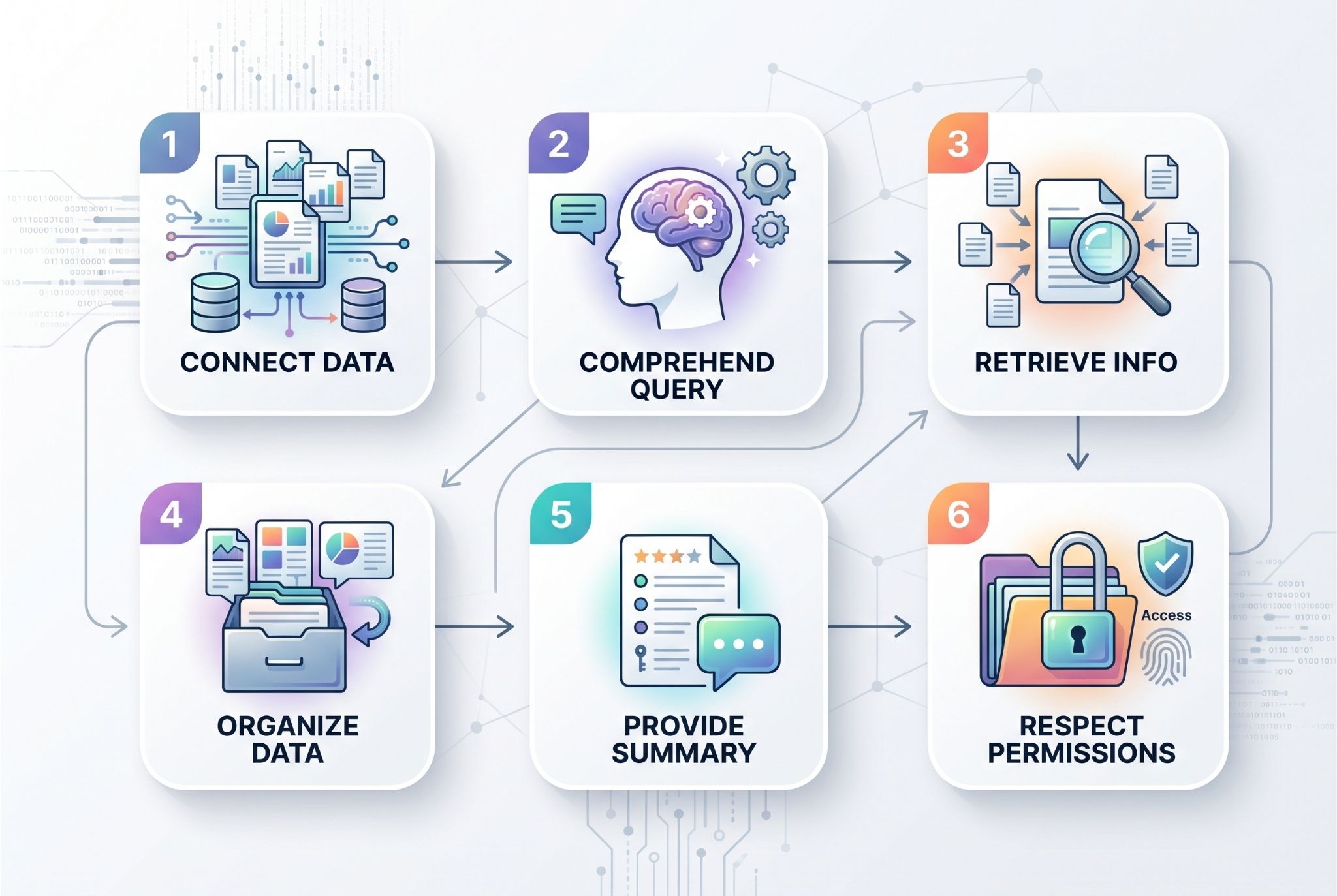
AI Enterprise Search combines several technologies to improve how organizations discover information. The exact architecture varies between platforms. However, the process commonly involves several core steps.
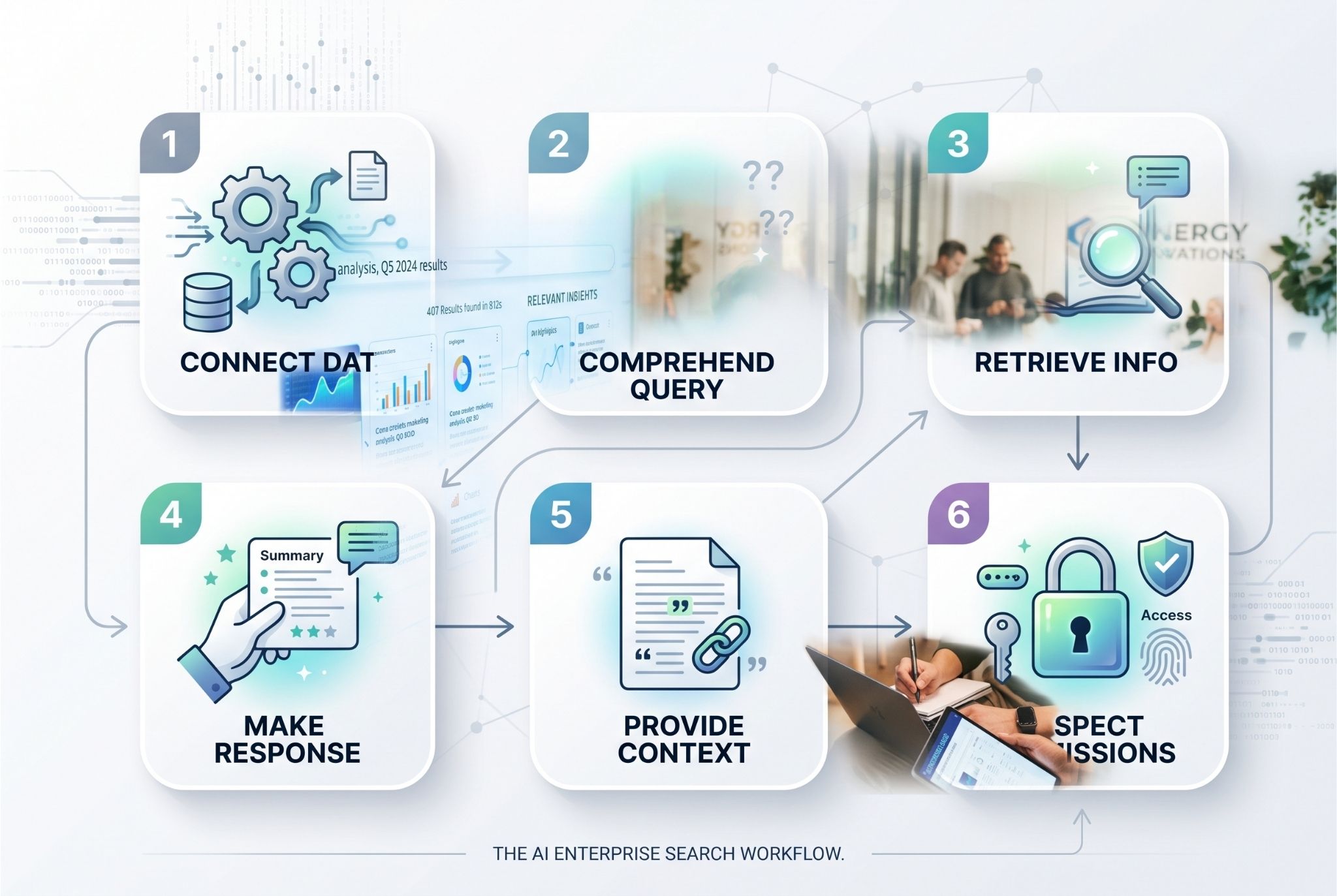
1. Connect Enterprise Data Sources
First, the organization links the AI Enterprise Search system to authorized business information sources. They can be documents, knowledge bases, CRM systems, internal applications, communication platforms, etc. The organization combines these sources into a more cohesive approach for finding relevant information. This allows employees to search across connected systems without switching between multiple platforms. The method can help make information more accessible and enable employees to find what they need more efficiently.
2. Comprehend the User’s Question
AI then reads the employee’s request and understands what they are asking for. The system looks not only for individual keywords but also for context, intent, and relationships between keywords. This means that staff members can ask questions in natural language. They don’t need to know complex search phrases or commands to find relevant information. Furthermore, this conversational format makes enterprise search simpler and more natural for everyday users.
3. Retrieve Relevant Information
The system then fetches information that is similar to the employee’s query. Traditional enterprise search limited to keywords can now be supplemented by semantic retrieval, which searches for content based on meaning and context. Additionally, Retrieval-Augmented Generation (RAG) can link retrieved data to generative AI. This way, AI systems can utilize relevant business data to create responses. This means that workers can get responses not just from the AI model’s general knowledge but also from the organization’s existing knowledge. Thus, the ability to retrieve information effectively is important for providing relevant, useful, and context-appropriate answers.
4. Make an Informative Response
AI can extract information from relevant (not necessarily numerous) documents and summarize the key details rather than return a list of documents. The employees can thus comprehend significant information without having to read every file each time. Furthermore, AI can organize pertinent information into a meaningful, useful answer. This will save staff time and allow them to concentrate on their work. But companies should still double-check the correctness of answers produced by AI. When making key decisions, employees should consult sources and use their judgment. Thus, organizations should use AI to assist employees rather than replace human judgment.
5. Provide Source Context
When employees have to access business information via AI, trust is crucial. As a result, it’s crucial for an enterprise search solution to make it easy to see where each answer originates. Furthermore, employees can use source references to check important information or read the original information. This significantly boosts the trustworthiness of teams in using AI-provided answers while ensuring proper human supervision.
6. Respect Access Permissions
Information in enterprises can be classified as confidential or private. This implies that enterprises need to ensure that AI searches comply with the enterprise’s access permissions. Employees should only receive information they are authorized to see. Secondly, a safe AI search system needs to ensure compliance with access restrictions when retrieving information. The retrieval of information should not be done regardless of whether the information is restricted. This makes permission-based access retrieval important for enterprise AI search.
What Can Businesses Do With AI Enterprise Search?
AI Enterprise Search can support many everyday business activities. The strongest use cases usually involve information that employees repeatedly need to find.
Help Employees Find Policies and Procedures
It is common for employees to require instant access to their organizations’ policies and procedures. In many cases, employees have to spend time searching through folders, documents, and systems to locate the information they need. With the help of AI Enterprise Search, employees can ask natural-language questions to learn more about the policies. This means that employees do not have to devote much effort to locating such information.
Accelerate Customer Support
Support professionals require accurate information to solve customer problems effectively. Nevertheless, they have to search for that information in product documentation, troubleshooting manuals, customer histories, and previous support records. Hence, staff may waste time switching between sources.
In the AI-based workplace search, support professionals will be able to collect relevant information efficiently. Instead of using multiple systems independently, employees will be able to ask questions and get useful information. Also, AI Enterprise Search will help them find relevant information in the context of the problem and its solution.
Improve Sales Enablement
Sales departments also rely heavily on internal information when carrying out their tasks. This information includes details such as product details, case studies, pricing information, competitor information, or customer history. Searching for this information through several systems could take away a lot of their time. With AI Enterprise Search, employees in the sales department can easily access information via natural-language queries. Additionally, the search system will be able to offer them context-based information rather than keyword-based results. This will make it easier for them to focus on their sales prospects.
What Makes an AI Enterprise Search Solution Effective?
Not every AI search implementation will produce the same results. Organizations should evaluate several capabilities before choosing an AI search platform.
Broad Data Connectivity
First, an efficient AI Enterprise Search solution must connect to the data sources employees use in their daily work. Such data sources could consist of CRM databases, knowledge bases, documents, the company’s applications, and communication channels. Of course, it is quite evident that no matter how advanced the search is, the user will not get complete answers if the information is hidden.
Semantic and Contextual Search
Furthermore, the AI-powered Enterprise Search should provide employees with the ability to type questions in the way they want. The system will be able to understand not only the words but also the question’s meaning and context. As a consequence, employees will no longer have to guess the specific terminology in a particular document.
Accurate, Grounded Answers
In addition, any answers produced by an AI should be based on realistic, accurate business data. If irrelevant or outdated content is found, then the system might provide inaccurate answers. It follows that organizations need to assess not only the retrieval results but also the answers themselves.
How Chatn Can Support Smarter Enterprise Knowledge Access
Chatn approaches business AI through conversational experiences. That makes enterprise knowledge easier to approach from a familiar starting point: a question. Instead of forcing employees to navigate complicated menus, conversational AI can provide a more natural way to interact with information.
Make Business Information Easier to Access
In addition, employees do not need to know where all business information is located. A conversational interface could allow this information to be found by posing a natural-language question. It means that employees could easily access this information without switching between several systems or needing to know how to use specific search queries.
Help Employees Ask Questions Naturally
It is unlikely that people will frame queries using SQL. Rather, they ask questions the way they do in normal conversation. Conversational AI makes this natural process easier by enabling employees to articulate their requirements. In addition, employees do not have to worry about the exact key phrases when framing their request. This means they can access the enterprise knowledge base more easily.
Connect Knowledge With Business Processes
But even more important, companies can generate value by linking knowledge with actions. In other words, once people recognize useful knowledge during their work processes, they will be able to do their job more efficiently. This could also be an opportunity to streamline processes by eliminating unnecessary steps. Chatn could help link knowledge to action through its conversational approach. Nonetheless, companies must first assess the capabilities, integrations, access levels, and data sources available in the Chatn platform they use.
How to Get Started With AI Enterprise Search
Organizations do not need to connect every system on day one. A focused approach can produce better results.
Identify the Biggest Knowledge Bottlenecks
To start with, you need to recognize where your people are spending their time looking for information. You can begin by identifying some common time-wasters, repetitive questions, or other annoying information queries. In addition, pay attention to processes that cause your people to look for information across different systems.
Map Where Important Information Lives
The next step is to define where the information most important to your company is located. The information sources may include documentation, CRM systems, knowledge bases, internal applications, communication channels, and others. After this, you need to assess each information source and determine which types of data employees should look for most often.
Prioritize High-Value Search Use Cases
After that, choose some high-priority search scenarios that will deliver clear business value to your company. The most suitable areas are those where people often seek information or experience delays. Customer support, employee self-service, and sales enablement are great areas for such projects. This way, companies will be able to measure results, improve experience, and roll out more Enterprise Search AI solutions.
Common AI Enterprise Search Mistakes to Avoid
AI Enterprise Search can create significant value. However, poor implementation can limit its impact.
Connecting Too Many Sources Too Quickly
Nonetheless, having more information does not mean better search results. Linking too many resources to one another means that staff members will encounter redundant, outdated, or irrelevant information. To begin with, organizations should link to credible, necessary sources. Consequently, businesses can enhance their search efficiency while ensuring information accuracy.
Ignores Poor-Quality Data
Additionally, AI will not always provide accurate answers because the company may feed it low-quality data. Poor-quality data will make the search less accurate and cause employees to lose trust in the AI. Consequently, the company should check its database for outdated data and delete any duplicates before further developing the system.
Treating AI Answers as Automatically Accurate
Nonetheless, AI may provide inaccurate or incomplete responses. Consequently, companies should not consider all responses generated through AI as correct by default. On the contrary, employees need to verify critical information and ensure its accuracy by consulting credible sources. Besides, teams should exercise appropriate human oversight during AI-assisted critical business decisions. In that way, companies will be able to make effective use of AI Enterprise Search.
Conclusion: Make Enterprise Knowledge Work Harder
Businesses have useful knowledge already. Yet it is hard to make that knowledge work when it is needed most. AI Enterprise Search can help businesses bring fragmented knowledge together, understand natural-language questions, and provide more relevant answers.
AI Enterprise Search can improve employee productivity, customer service, self-service, and decision-making speed. Yet businesses need more than an AI layer to get those results. They need to keep their information secure and reliable, connect relevant systems, ensure proper governance, and set quantifiable goals.
First of all, businesses should stop using search as they used to. The future belongs to the systems that will help employees get from information to knowledge and from knowledge to actions. By adopting a conversational approach, Chatn can help businesses work with organizational knowledge more effectively.
All in all, the aim remains the same – to help employees find business information faster and use it more effectively.